BrandinAI - a tool for monitoring and analyzing brand visibility in AI


In short
BrandinAI monitors your brand in 9 AI models, from ChatGPT to DeepSeek, and turns visibility, sentiment and cited sources into a clear action plan.
Update: what has changed since February 2026
This article was published in February 2026 and describes BrandinAI as it was then. Since then the tool has grown a lot, so some of the details below (the list of models, the modules, the periodic reports) no longer match the product. In short, this is what BrandinAI does today:
- Monitoring in 9 AI models - ChatGPT, Gemini, Google AI Overviews, Google AI Mode, Copilot, Claude, Perplexity, Grok and DeepSeek.
- The full picture of your visibility - visibility score, ranking position, mention sentiment, share of voice and the sources AI cites, for your brand and your competitors, model by model and over time.
- A site audit with an action plan - the GEO audit turns every issue it finds into a concrete task and sorts the list by impact on visibility, so you know where to start. You track the work in the built-in task manager.
- BIA, the AI assistant - ask about any chart, result or task in the dashboard and get an explanation and the next steps, based on your own data.
- ContentInAI - a separate SEO and GEO content tool integrated with BrandinAI, for writing the articles the recommendations point to.
- Flexible packages - you choose the AI models, the number of prompts and credits, and you can change them at any time.
The full, current description of the tool is on the BrandinAI product page, and the packages are compared side by side on the pricing page.
The original article (February 2026)
In a world where more and more purchasing, business, and branding decisions begin with a question asked to ChatGPT, Gemini, or Perplexity, classic SEO is no longer the only battlefield for user attention. Brands must now ask themselves a new question: are we visible in answers generated by artificial intelligence?
This is exactly the need BrandinAI - an analytical tool created to monitor, analyze, and optimize brand visibility in the world of large language models (LLM).
Below you’ll find a comprehensive overview: what BrandinAI is, what modules it has, and how it works in practice.
What is BrandinAI?
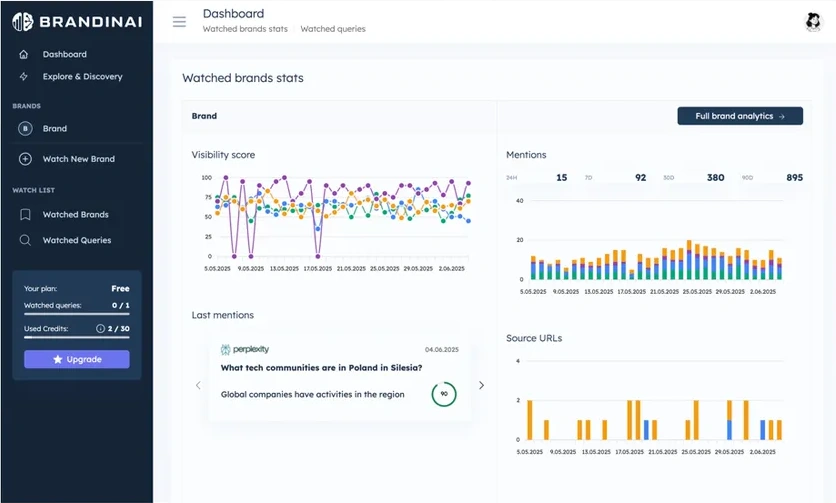
BrandinAI is a SaaS analytical platform whose goal is to measure and interpret a brand’s presence in answers generated by AI models such as:
- ChatGPT
- Gemini
- Perplexity
- Deepseek
- other LLMs used in search engines and AI assistants
This tool was created in response to the growing importance of so-called GEO (Generative Engine Optimization) - that is, optimizing brand visibility in generative systems.
While SEO focuses on ranking in Google search results, GEO concentrates on how a brand is presented in answers generated by AI:
- Does it appear at all?
- In what context?
- With what sentiment?
- Is it recommended?
- How does it compare to the competition?
In one sentence, BrandinAI is monitoring brand visibility in AI, providing answers to these questions in the form of measurable data and clear reports.
Why is visibility in AI becoming key?
Language models are changing the way people obtain information. Instead of browsing 10 links in a search engine, the user receives one synthetic answer. That answer may include:
- a recommendation of a specific brand,
- a comparison of several solutions,
- identification of a category leader,
- a description of competitive advantages.
If a brand does not appear in such answers - for the user it practically does not exist.
BrandinAI allows companies to:
- monitor their presence in the AI ecosystem (visibility in ChatGPT and other LLMs),
- identify visibility gaps,
- analyze brand perception,
- take optimization actions based on data.
How does BrandinAI work?
The tool’s operation can be divided into several key stages:
1. Defining brands
The first key stage of configuration in BrandinAI is precise definition of the brands that will be covered by monitoring. This includes both your own brand and selected competitors and - if needed - sub-brands, product lines, or specific products.
At this stage you define:
- the full brand name
- product names associated with the brand,
- competing brands analyzed within the same set of queries,
Thanks to this, BrandinAI can:
- measure the real share of the brand in AI answers,
- analyze exposure relative to competitors,
- identify which products are recommended more often,
- detect situations in which the brand is omitted despite a strong market position.
In practice, “Defining brands” is the foundation of comparative analysis and building indicators - without a properly configured list of brands, further data would have no strategic value.
2. Defining queries (prompts)
The second step is defining a set of queries that reflect real user intent, e.g.:
- “Best management tools for a small business”
- “Which CRM software should a small business choose?”
- “CRM platform ranking for 2026”
Queries can be:
- general (product category),
- comparative,
- transactional,
- expert,
- problem-focused.
They form the starting point for visibility analysis.
3. Automatic querying of AI models
The system cyclically sends the defined queries to selected language models. Thanks to this, it:
- simulates real user behavior,
- analyzes answers generated by AI,
- compares changes over time.
This enables monitoring of trends and visibility dynamics.
4. Answer analysis
BrandinAI processes the generated answers, identifying, among others:
- whether the brand was mentioned,
- in which position (for list-style answers) or in what order it appeared in the content,
- in what context,
- with what sentiment,
- what attributes were assigned to the brand,
- whether competitors appeared.
On this basis, visibility indicators are built.
5. Data aggregation and reporting
The collected data is presented in the form of:
- dashboards,
- periodic reports,
- trend charts,
- competitive comparisons.
Thanks to this, the brand can observe:
- growth or decline in presence,
- changes in perception,
- the impact of marketing actions on visibility in AI.
Key BrandinAI modules
Visibility monitoring module
This is the foundation of the entire system.
It allows measuring:
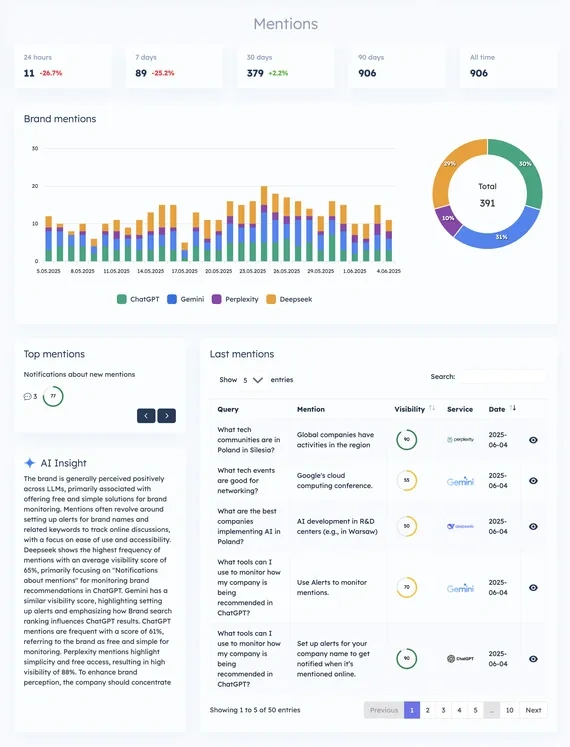
- the percentage of queries in which the brand appears,
- frequency of mentions,
- exposure relative to competitors,
- share in recommendations.
Thanks to this, a visibility index is created that shows what share of AI-generated answers a given brand has in its category.
Sentiment and context analysis module
Visibility is one thing, but equally important is how the brand is described.
This module analyzes:
- tone of the statements (positive, neutral, negative),
- recurring attributes,
- usage context (leader, alternative, budget option, etc.),
- associations with specific problems and needs.
This makes it possible to understand whether AI perceives the brand as:
- an expert,
- an innovator,
- a niche player,
- a “second-choice” solution.
On this basis, the system assigns the brand a synthetic recommendation index on a 1-100 scale, showing its position relative to competitors.
Comparative module
BrandinAI enables competitor analysis in the same query environment.
You can check:
- which brands dominate in answers,
- how competitors’ share changes,
- in which types of queries they are stronger,
- what communication advantages are attributed to them.
This is a valuable source of insights for marketing and strategy teams.
Trends and changes over time module
Language models evolve - their training data, algorithms, and the way they generate answers change.
BrandinAI tracks:
- visibility changes in daily terms on a monthly scale,
- the impact of model updates,
- effects of PR and content marketing actions,
- query seasonality.
Thanks to this, you can link specific actions with a real impact on presence in AI.
Source monitoring and analysis module
Brand visibility in AI answers is one thing, but it is equally important to understand which sources language models base their answers on. The source monitoring module allows analyzing which domains, publications, industry sites, or opinion-leading platforms influence the narrative generated by LLMs.
In practice, this module enables:
- identification of directly cited sources (e.g., in models that provide references),
- analysis of domains most often associated with a given thematic category,
- assessment of whether the brand is present in content that forms the AI “knowledge base”,
- comparison of source exposure relative to competitors.
Why is this key? Language models build their answers based on enormous datasets - including expert articles, rankings, forums, product documentation, or media publications. If a brand is not present in credible and frequently cited sources, its chances of appearing in AI answers decrease significantly.
This module therefore helps answer questions:
- Which industry sites have the greatest influence on the AI narrative in our category
- Do publications about our brand appear in high-authority sources
- What types of content (rankings, comparisons, expert articles, reviews) are most often “absorbed” by models
Thanks to this, BrandinAI not only measures the end result (whether the brand appears), but also helps understand the mechanics of how AI-generated answers are created. This, in turn, enables more precise planning of content, PR, and expert activities within a GEO strategy.
As a result, the organization gains not only visibility data, but also a map of informational influence within its market ecosystem - showing where it is strategically worth building brand presence.
GEO recommendation module
Based on the collected data, the system can indicate:
- which thematic areas require strengthening,
- which phrases are key to visibility,
- which content is worth expanding,
- where the brand is losing to competitors.
This is practical support in building a Generative Engine Optimization strategy.
Who is BrandinAI for?
The tool is used in several areas:
Marketing and branding
- monitoring brand perception,
- measuring the effectiveness of content actions,
- analyzing share in AI recommendations.
PR and communication
- controlling the narrative around the brand,
- identifying potential reputational risks,
- analyzing the tone of statements generated by AI.
Boards and strategy
- assessing market position in the AI ecosystem,
- supporting strategic decisions,
- competitive benchmarking.
Marketing agencies
- reporting a new dimension of visibility to clients,
- expanding the offer with GEO services,
- analyzing campaign effects in the context of AI.
How is BrandinAI different from classic SEO tools?
This is a very important distinction.
SEO analyzes positions in search results.
BrandinAI analyzes presence in answers generated by AI.
Differences include:
- no classic list of links - AI provides a ready-made answer,
- greater importance of context and narrative,
- synthetic recommendations instead of raw results,
- dynamic nature of answers.
In practice, this means that a brand can have excellent SEO and still be almost invisible in answers generated by language models.
What does the implementation process look like?
- Defining the category and competition
- Defining the set of queries
- Launching cyclical analyses
- Interpreting data and implementing recommendations
The entire process is scalable - from a single brand to an extensive product portfolio.
Why is this important right now?

With the growing popularity of AI:
- users increasingly ask questions directly to language models,
- search engines integrate generative answers above classic results,
- purchasing decisions are made based on synthetic recommendations instead of browsing many pages.
However, this is only the beginning of the change.
Language models are becoming a new interpretive layer of the internet. They don’t just index information - they filter it, hierarchize it, and synthesize it into a single narrative. This means the user increasingly rarely sees raw sources. They see a ready answer.
And in that answer there are:
- a few indicated brands,
- a specific hierarchy of leaders,
- a set of attributes assigned to them,
- concrete recommendations.
This fundamentally changes the mechanics of market competition.
So far, brands competed for:
- position in search results,
- clicks,
- traffic to the website.
Today they begin to compete for something else: a place in the synthetic answer generated by AI.
If a brand is not included in the model’s answer, the user may never reach its website - even if it has strong SEO and high organic visibility.
Additionally, language models affect not only traffic, but also perception. They increasingly:
- determine who is the category leader,
- define competitive advantages,
- assign specific attributes to brands,
- suggest alternatives.
In practice, this means that AI begins to co-create the brand image in real time.
Companies that do not monitor this phenomenon operate under conditions of informational blindness - they don’t know:
- whether they are recommended,
- how they are presented,
- whether competitors are taking over the narrative,
- which sources influence model answers.
Therefore, visibility in AI stops being a technological curiosity. It becomes a new indicator of a brand’s digital health.
Summary
BrandinAI is a tool that responds to one of the most important challenges of modern marketing: how to measure and manage brand visibility in the world of artificial intelligence.
Thanks to modules for monitoring, sentiment analysis, competitive comparisons, source analysis, and GEO recommendations, the platform allows you to:
- understand whether the brand exists in AI answers,
- analyze how it is presented,
- compare yourself with competitors,
- identify source places where it’s worth gaining visibility,
- take optimization actions based on data.
In the era of generative search engines and AI assistants, this is not an addition to a marketing strategy, but its natural extension. Because if a brand does not appear in AI answers - for an increasing number of users, it simply doesn’t exist.
Therefore, it’s worth starting today to measure your presence in the LLM ecosystem and understand how artificial intelligence presents your brand.
BrandinAI makes it possible to see what until now could not be measured - real brand visibility in answers generated by AI.
If you want to check how your brand performs in the world of language models, try BrandinAI and see what your share in AI answers looks like compared to competitors.