LLMs.txt - how to create a high quality file that improves your brand's visibility in AI search
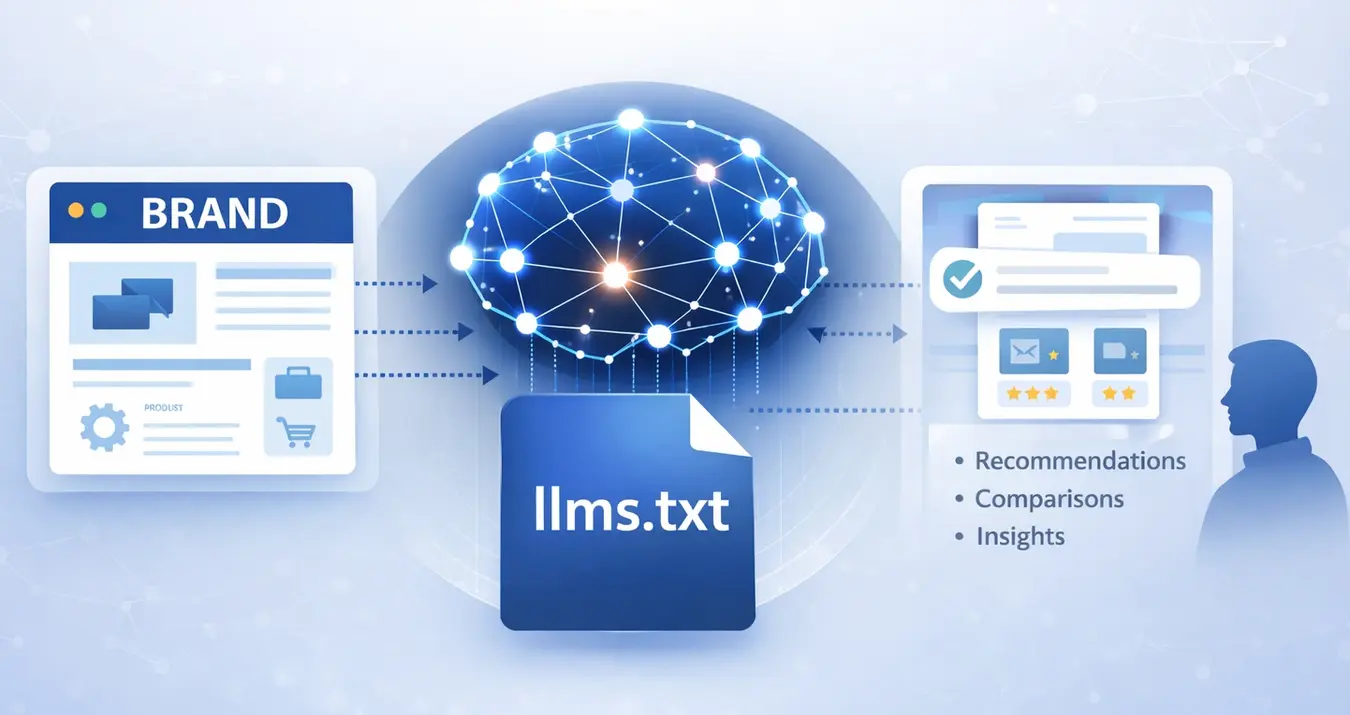
Large language models are increasingly acting as intermediaries between users and brands. They answer questions, compare products, recommend tools, and explain complex topics. In this context, one key question becomes crucial: where do models know who you are as a brand and how they should describe you?
One of the answers is the llms.txt file - technically simple, but strategically very important as an element of communication with AI systems. In this article, we show how to create a high-quality llms.txt, what information it should contain, and which practices truly impact brand visibility in responses generated by LLMs.
What is an llms.txt file and why it matters for brands
The llms.txt file is a publicly available text document, placed in the main directory of a domain, whose purpose is to provide language models with unambiguous, structured information about a brand.
It is easiest to understand through an analogy:
- robots.txt tells bots what they can (or cannot) access,
- sitemap.xml shows the structure of content,
- llms.txt explains the context, meaning, and identity of the brand.
This is not a strictly technical or marketing file. Its purpose is not to sell, but to reduce ambiguity, which language models often have to deal with when analyzing scattered, inconsistent, or outdated information about companies.
A well-prepared llms.txt acts as a reference point - a source of truth that helps AI correctly interpret what a given brand does, the area in which it has expertise, and how it should be described.
How language models use llms.txt
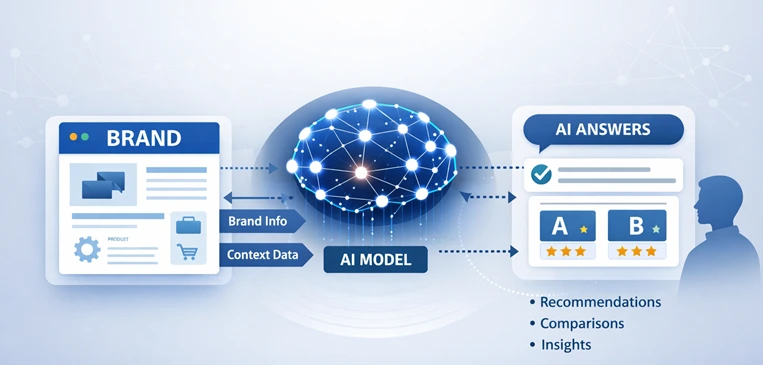
Language models do not "read" websites like humans. They analyze content probabilistically, combining signals from many sources. The problem is that information about brands is often:
- scattered across blogs, landing pages, and sponsored articles,
- linguistically inconsistent,
- too marketing-heavy or outdated.
The llms.txt file simplifies this process. It provides a condensed, logical description that is easier for the model to process than dozens of subpages of different types.
From the AI perspective, the most valuable information is:
- clearly defined,
- free of irrelevant information,
- embedded in a specific context (what, for whom, in what area).
As a result, llms.txt helps reduce hallucinations, increases answer accuracy, and improves the consistency of the narrative about the brand.
How llms.txt affects brand visibility in AI and who benefits most
The impact of the llms.txt file on brand visibility in AI search is not limited solely to "appearing" in language model answers. In practice, it is about the way the brand is interpreted, properly placed in context, and accurately compared with other solutions. A well-designed llms.txt organizes the information that AI uses to construct answers, which translates into greater narrative consistency and predictability.
A high-quality llms.txt affects brand visibility through:
- correctly assigning the brand to the right category (e.g., analytics tool vs. marketing platform),
- better understanding of the scope of products and services,
- greater recommendation accuracy in AI answers,
- reducing simplifications and misinterpretations,
- more consistent comparisons with competitors.
At the same time, not every brand will feel this impact to the same extent. The greatest benefits from implementing llms.txt are seen by:
- SaaS and technology tools, where precision in describing functionality is crucial,
- B2B companies offering specialized or expert services,
- e-commerce and marketplaces with extensive offerings,
- media and content platforms that want to be correctly cited and interpreted.
llms.txt becomes particularly important for brands operating in niche, new, or complex categories, where a lack of clear definitions leads to incorrect mental shortcuts on the AI side. In such cases, llms.txt plays a двой role: it increases visibility in answers generated by LLMs and protects the brand from being incorrectly represented in terms of its offering.
The most common myths around llms.txt
A few misunderstandings have already grown around the llms.txt file, which can lead to false expectations or completely ignoring this solution. It is worth organizing them before llms.txt becomes part of a brand visibility strategy in AI.
Myth 1: llms.txt guarantees visibility in AI
The llms.txt file does not guarantee that a brand will always appear in answers generated by language models. AI search does not work based on a single signal, but on a combination of many factors, such as content, query context, or the brand’s overall presence online.
What llms.txt actually does is:
- increases the consistency and correctness of AI answers,
- reduces misinterpretations and simplifications,
- helps models understand the brand context faster and more accurately.
In practice, llms.txt does not "force" visibility, but significantly improves the quality of what AI says about the brand when it does appear.
Myth 2: one file solves everything
llms.txt is sometimes treated as a shortcut to "mastering" AI search. That is a false assumption. This file is an important element, but only one of many.
It works well when:
- the site’s content is consistent and up to date,
- structured data supports the same definitions,
- marketing communication does not contradict the reference information.
Without these elements, llms.txt may improve brand interpretation, but it will not replace a content strategy, SEO, or conscious information management.
Myth 3: only big brands need llms.txt
Contrary to appearances, smaller and niche projects often gain the most from llms.txt. Large brands are usually well described in many sources, which gives language models more reference points.
For smaller companies, llms.txt:
- organizes a limited number of signals,
- reduces the risk of wrong associations,
- helps AI correctly understand what the brand does.
As a result, llms.txt can be one of the fastest ways to clearly mark your identity in the AI ecosystem, even with a small scale of marketing activity.
What the structure of a high-quality llms.txt file should look like
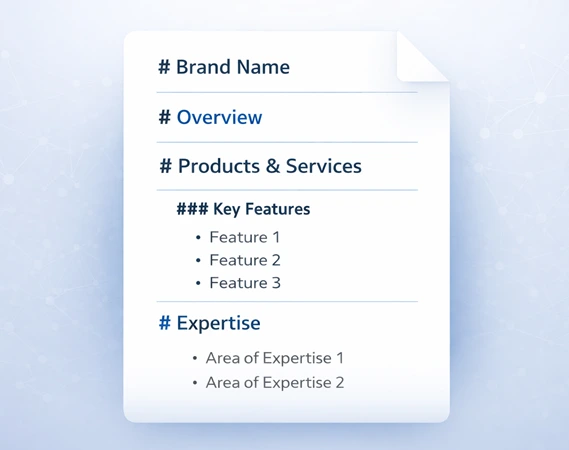
An effective llms.txt file is not a set of random information or a shortened version of the "About us" page. It is a thoughtful reference document whose purpose is to make it as easy as possible for language models to correctly understand the brand, its offering, and its operating context.
Although there is no single official standard, in practice the best-performing files have a clear, logical, and repeatable structure. Language models interpret information better when it is clearly segmented and consistently described.
1. Brand identification and domain context
The first task of llms.txt is to clearly answer the question: who is the owner of this domain.
This section should include:
- the full name of the brand or product,
- a brief note on what the site is (e.g., a tool, platform, news service),
- the market or industry context in which the brand operates.
The goal is not an expanded company history, but to eliminate ambiguity, especially in the case of:
- generic names,
- acronyms,
- brands operating globally or across multiple segments.
2. A concise, unambiguous description of the business
This is one of the most important parts of the entire file. A well-written business description:
- clearly defines the problem the brand solves,
- indicates who the offering is for,
- avoids sales language and context-free promises.
The best-performing descriptions are:
- specific,
- neutral,
- written in simple language.
From the LLM perspective, a clear definition matters, not marketing appeal. Based on this section, models often decide which questions the brand is relevant to.
3. Products, services, or key functionalities
If the brand offers more than one solution, llms.txt should communicate that clearly. This section organizes the offering and prevents it from being flattened in AI answers.
A good practice is:
- listing key products or services,
- briefly explaining their role or use case,
- keeping naming consistent with the website and marketing materials.
Thanks to this, language models:
- are less likely to confuse products with each other,
- better understand functional differences,
- more accurately match the offering to user intent.
4. Areas of expertise and topics where the brand has competence
This part answers the question: in which topics can AI treat the brand as a credible source of knowledge.
It is worth indicating here:
- key thematic areas,
- the scope of expert knowledge,
- fields in which the brand regularly publishes or operates.
Well-defined areas of expertise:
- increase the chance of the brand being cited,
- help models choose the right answer context,
- reduce attributing to the brand topics it does not actually cover.
5. Preferred information sources and current context
One of the most practical elements of llms.txt is indicating where the most current and reliable information can be found.
In this section you can:
- point to main site sections (e.g., blog, documentation, reports),
- suggest which sources best reflect the current state of the offering or knowledge,
- emphasize that information in these places is regularly updated.
For language models, this is a signal which content should be treated as preferred reference points.
6. Interpretation boundaries and context clarification
A high-quality llms.txt not only says what the brand is, but sometimes also what it is not. This is especially important in the case of:
- brands confused with other categories,
- ambiguous terms,
- acronyms or names similar to competitors.
Such clarification:
- reduces incorrect simplifications,
- helps AI avoid false comparisons,
- increases answer precision.
Best practices for writing llms.txt content
The effectiveness of the llms.txt file largely depends not on what it contains, but how the information is written. Even a well-planned structure may fail if the content is ambiguous, too marketing-heavy, or inconsistent with the rest of the brand’s communication.
When writing llms.txt, it is worth thinking of it as an instruction for language models on how to interpret the brand, not another promotional material.
1. Use simple, descriptive, and neutral language
LLMs perform best with content that:
- clearly defines terms,
- avoids emotional language,
- does not contain context-free promises.
Instead of:
"an innovative, groundbreaking platform that changes the market"
it is better to use:
"an analytics platform used for monitoring and analyzing…"
A neutral, descriptive tone:
- helps models classify the brand correctly,
- reduces the risk of over-interpretation,
- increases the consistency of AI-generated answers.
2. Avoid copying marketing content
One of the most common mistakes is directly copying fragments from:
- the "About us" page,
- landing pages,
- sales materials.
Marketing content is designed with users in mind, not language models. It often contains:
- mental shortcuts,
- metaphors,
- slogans that lose meaning without context.
In llms.txt, precision matters, not persuasion.
3. Ensure unambiguity and consistency of terms
Language models are very sensitive to naming inconsistency. If:
- a product has multiple names,
- a service is described with different terms,
- terms are used interchangeably,
AI may treat them as separate entities.
Good practices include:
- unambiguous naming of products and services,
- consistent use of the same terms throughout the file,
- alignment with the naming used on the website.
4. Think in terms of "what it is" and "what it is for"
For LLMs, functional definitions are key. Every important element of llms.txt should answer two questions:
- what is it?
- in what context is it used?
This approach:
- helps AI match the brand to user queries,
- reduces the risk of incorrect comparisons,
- improves recommendation relevance.
5. Maintain a logical structure and readability
Although llms.txt is a text file, its form matters. Language models interpret content better when it is:
- logically segmented,
- written in short paragraphs,
- arranged in a consistent order.
Good readability:
- speeds up AI information processing,
- reduces the risk of missing key parts,
- improves the consistency of interpreting the whole document.
6. Point to current and preferred sources of information
If part of the site’s content is archival while other sections are regularly updated, it is worth communicating this clearly.
In llms.txt it is good to:
- indicate which site sections best reflect the current state of the offering,
- emphasize where reference content is located,
- avoid pointing to random or outdated subpages.
This helps language models operate on a current context, not historical data.
7. Clarify the boundaries of brand interpretation
A high-quality llms.txt not only describes the brand but also limits room for incorrect interpretations.
It is worth clearly stating:
- what the brand does not do,
- in which areas it does not offer services,
- which categories it should not be associated with.
Such clarification:
- reduces the risk of incorrect associations,
- limits false comparisons with competitors,
- increases the precision of AI answers.
8. Ensure consistency with the entire brand communication
llms.txt cannot exist in isolation from the rest of the content ecosystem. It works best when:
- the descriptions in the file are consistent with on-site content,
- structured data supports the same definitions,
- marketing communication does not contradict the reference information.
Inconsistency weakens the signal the brand sends to language models.
9. Treat llms.txt as a "living" document
One of the key best practices is regular updates to the file. llms.txt should be changed when:
- new products, services, or functionalities are introduced,
- the brand’s positioning changes,
- rebranding happens,
- major changes to the offering occur.
An up-to-date llms.txt increases the chance that AI will operate on a correct and current picture of the brand.
10. Less is more - avoid information overload
Finally, a rule that is often overlooked: llms.txt does not need to contain everything. Its goal is to facilitate interpretation, not to fully document the business.
A well-written file:
- focuses on key information,
- eliminates unnecessary details,
- leaves models with a clear, consistent picture of the brand.
Why the Markdown format matters in llms.txt
Although the llms.txt file is technically a plain text file, the way it is written has a real impact on how language models interpret the information it contains. In practice, the best and safest choice is Markdown - a simple format that LLMs understand exceptionally well.
Markdown is not used here for aesthetics or visual formatting. Its role is to give the document semantic structure, which helps models:
- distinguish main definitions from details,
- identify thematic sections,
- correctly group information about the brand.
How Markdown supports LLM interpretation of content
Language models are trained on vast amounts of content written in Markdown. As a result:
- headings (
#,##) are treated as clear context boundaries, - bullet lists signal sets of features, functions, or categories,
- bold text strengthens the importance of key concepts,
- a simple text hierarchy makes knowledge extraction easier.
For AI, Markdown works like a logical map of the document, not a decoration.
Which Markdown elements to use in llms.txt
A high-quality llms.txt should use Markdown in a sparingly but consistently.
Recommended elements:
#- the brand name or the file’s main context,##- main sections (business description, products, expertise),- bullet lists (
-) - features, services, audience groups, - Bold (** ) - product names, key concepts, roles,
- short paragraphs instead of large text blocks.
What to avoid when using Markdown in llms.txt
Not every Markdown element is equally useful in this context. It is worth avoiding:
- excessively nested headings,
- code blocks that are not actual code,
- decorative elements without semantic meaning,
- long, dense blocks of text.
The goal is not to create a "pretty" document, but a maximally readable source of information for AI.
Markdown as an element of consistency and file maintenance
Markdown has one more practical advantage: it makes maintaining llms.txt over time easier. Thanks to a readable structure:
- it is easier to update specific sections,
- it is easier to maintain consistency when expanding the file,
- there is a lower risk of accidentally "derailing" the context.
This is especially important when llms.txt becomes a living document, updated alongside product or offering development.
Markdown as the standard for writing llms.txt
Although there is no formal specification that mandates Markdown, in practice it is the most compatible format for language models. It does not increase file complexity, and it significantly improves interpretability.
Therefore, in the context of llms.txt it is worth adopting a simple rule:
- write content in Markdown,
- treat the format as a semantic element,
- combine simplicity with consistency.
It is a small detail that can have a real impact on how AI understands and describes your brand.
Example of a well-designed llms.txt
Below you will find an analysis of a real llms.txt file that was published at brandinai.com/llms.txt. This is an example of a file that truly works and is used in a production environment, while also perfectly showing how to organize llms.txt in practice in a way that is:
- readable for LLM language models,
- rich in business context,
- and organized by topic, making it easier for AI to interpret the brand and its offering.
1. Strong opening and brand identity
#BrandInAI
BrandinAI is an AI-powered analytics tool that tracks how your brand appears in answers generated by major large language models (LLMs) - including ChatGPT, Gemini, Perplexity, and DeepSeek. It helps you monitor brand visibility, uncover trends, and understand how AI platforms present your brand.
The file begins with an H1 heading, which at the same time:
- identifies the brand (BrandInAI),
- briefly describes what it does,
- indicates the key technological context - LLMs and brand visibility in answers.
This format:
- communicates identity simply and precisely,
- gives AI clear semantic signals (e.g., analytics tool, visibility tracking).
This is the foundation for allowing the language model to immediately associate the brand with a specific application area.
2. Clear list of key pages
The next part of the file contains links to the most important sections of the site:
# Homepage - https://brandinai.com/
# Blog - https://brandinai.com/blog
# Contact - https://brandinai.com/contact
This short list:
- makes it easier for AI to immediately find the main pages,
- indicates which URLs are the most relevant,
- and therefore what is worth considering when generating answers.
3. Presentation of the most important features and solutions
The file contains a list of BrandInAI’s key platform functionalities:
- **AI/LLM Brand Visibility Tracking**
- **Prompt-Driven Monitoring**
- **Competitive Benchmarking**
- **Citation & Source Tracking**
- **Alerts & Change Detection**
- **Reports & Dashboards**
This is a practical and factual list that shows:
- what problems the tool solves,
- which areas of operation are most important for the brand.
Such a list:
- helps AI match the brand to user queries,
- shows concrete use cases for products/services,
- and is more readable than long marketing descriptions.
4. Linking to important blog sections
The file also contains sections with key blog categories:
# Blog categories
- [AI & Branding Trends](…)
- [Insights & Reports](…)
- [Guides](…)
- [Best Practices](…)
- [Product News](…)
This breakdown is important because:
- it shows AI which content areas are expert-level,
- provides semantic context for topics in which the brand publishes regularly,
- helps AI "understand" the knowledge domains in which the brand is active.
5. Information about target audiences
Further in the file there are specific indications of who the brand is relevant for:
# Target Audience:
- Marketing and brand teams
- SEO and GEO specialists
- PR and communications teams
- Founders and product teams
- Agencies managing brand presence
Such clarification:
- creates usage context for AI,
- allows models to more accurately match the brand to queries from users in specific roles and with specific needs,
- and helps AI understand the audience.
6. Substantive context of blog content
At the end of the file, there are also short descriptions of two example articles along with their tags:
# Knowledge
## https://brandinai.com/blog/ai-as-a-new-seo-channel-why-brands-must-think-beyond-google
Tags: ai seo, generative search, geo, llm brand visibility
Adding such descriptions:
- shows AI what expert content the brand publishes,
- gives language models concrete semantic signals (SEO topics, brand visibility in AI, GEO),
- thus increasing the relevance of generated answers in these areas.
Why this example works
This real llms.txt file is a good template because:
- it is concise but informative - it does not include excessive or marketing-heavy descriptions, only concrete data and links.
- it has an informational structure that LLMs can easily understand and use.
- it focuses on key URLs and topics, not on a full site map.
- it provides semantic context - for the brand, target audiences, and expert content - which is crucial for generating accurate answers by AI.
How LLMs read this
Language models treat such a file as a condensed "instruction for interpreting" the brand:
- they understand what the company is about,
- they know which sections are the most important,
- and they can connect this information with user queries, increasing the chance of correct and relevant answers.
Updating and maintaining the llms.txt file
The llms.txt file should not be treated as a one-time configuration. Although its structure is simple, it serves as a reference source of information about the brand, so it must keep up with changes in the offering, positioning, and communication.
In practice, llms.txt is worth updating whenever:
- new products, services, or functionalities appear,
- the way the offering or target group is described changes,
- the brand undergoes rebranding or a significant narrative change,
- new key site sections are created (e.g., reports, documentation, blog).
Regular updates are important because language models may rely on historical data. An outdated llms.txt increases the risk that AI will operate on an outdated picture of the brand, even if the website has already been updated.
A good approach is to treat llms.txt as a "living" document:
- reviewed periodically (e.g., quarterly),
- updated in parallel with important product changes,
- kept consistent with the website content and marketing communication.
Thanks to this, llms.txt remains a current and reliable reference point for language models, instead of quickly becoming another forgotten file in the main directory of the domain.
Summary and checklist: how to make sure your llms.txt really works
The llms.txt file is not a magic switch for AI visibility, but it is one of the simplest and most direct ways to influence how language models understand, classify, and describe a brand. Its effectiveness does not depend on length or technical complexity, but on clarity, consistency, and information quality.
Before you consider llms.txt "ready," it is worth treating it like a reference document and going through a short quality checklist.
Checklist: a good llms.txt in practice
A well-prepared llms.txt should meet the following conditions:
- clearly defines who the brand is and in what context it operates,
- contains an unambiguous business description, without marketing slogans,
- precisely describes products, services, or functionalities,
- indicates areas of expertise where the brand is a credible source,
- directs language models to preferred and current sources of information,
- is written in readable Markdown, with a logical structure of headings and lists,
- maintains consistency with website content and brand communication,
- has been updated after the latest changes in the offering or positioning.
If any of these points is not met, llms.txt likely does not use its full potential.
llms.txt as the foundation of brand communication with AI
The most important thing is to understand that llms.txt is not a strictly technical file or an add-on "for bots." It is a strategic element of brand communication with artificial intelligence systems, which will grow in importance over time as AI search and LLM-generated answers evolve.
Brands that treat llms.txt as:
- a source of truth about their offering,
- a reference point for language models,
- part of a long-term visibility strategy,
gain more control over how they are presented in AI answers - and reduce the risk of incorrect simplifications, outdated information, or inaccurate comparisons.
Where to look for further technical documentation
This article focuses on a practical and strategic approach to llms.txt. However, if you need:
- a formal specification,
- technical writing rules,
- current recommendations regarding the standard,
advanced technical documentation for the llms.txt file can be found at: https://llmstxt.org/
This is a good supplement for technical teams and people who want to go deeper into implementation details.