GEO (Generative Engine Optimization) - what it is and how AI optimization works

In short
What is GEO (Generative Engine Optimization) and why is it becoming crucial in the AI era? Learn how optimization for language models works, how it differs from SEO, and how to increase your brand’s visibility in AI-generated answers.
Not long ago, we were fighting for the #1 position in Google. Today, more and more often we’re fighting for something completely different - for presence in an answer generated by artificial intelligence.
In a world where the user no longer browses "10 blue links" but receives one synthetic recommendation, the entire logic of brand visibility changes. This is exactly where GEO - Generative Engine Optimization comes in.
This article explains what GEO is, how it differs from classic SEO, and why in the coming years it will become one of the key areas of digital marketing.
The end of the "10 blue links" era

For over 20 years, digital marketing was based on one principle: the higher you are in search results, the greater the chance of a click.
SEO was about optimizing a website for search engine algorithms. Keywords, backlinks, site structure, and technical aspects of indexing mattered. Visibility was measurable: position, CTR, organic traffic.
Today, however, the importance of generative search (AI search) is growing. A user asks a language model a question and receives a ready-made answer - often without needing to visit any website.
Instead of a list of links, they get:
- a summary,
- a recommendation,
- a comparison,
- an indication of a specific brand.
And since the decision is made at the level of the AI answer, classic SEO stops being the only playing field.
What is GEO (Generative Engine Optimization)?
GEO (Generative Engine Optimization) is the process of optimizing content, communication, and brand presence so that it is included and recommended in answers generated by language models (LLMs).
In other words:
GEO is optimization for answer engines, not for search engines.
In classic SEO, you fight for a position in the ranking. In GEO, you fight for presence in the answer.
That’s a fundamental difference.
In the generative world:
- there seemingly is no "#1 position",
- there is no classic CTR,
- the answer is a synthesis of many sources,
- the model may mention only 2-3 brands.
The user doesn’t have to browse, analyze, and choose among many brands on their own. They get everything in one answer. If your brand isn’t there - for the user, you practically don’t exist.
SEO vs GEO - key differences
At first glance, it may seem that GEO is simply "SEO for ChatGPT". After all, in both cases we’re talking about visibility in a digital environment, content optimization, and alignment with technological mechanisms.
But that’s too much of a simplification.
SEO emerged in a world where the user received a list of results and decided what to click. The model was ranking-based - it ordered pages according to specific quality and relevance signals. Visibility meant position, and position translated into traffic.
GEO operates in a completely different logic.
Here, the user doesn’t see a ranking. They don’t analyze a list of links. They receive a single, generated answer - often containing a ready-made recommendation. The model doesn’t sort pages. The model synthesizes knowledge. And that means the mechanisms of influence are different, the touchpoint with the user is different, and the very definition of "visibility" is different.
The differences between SEO and GEO are not cosmetic. This is not a tool change - it’s a paradigm shift. Therefore, to understand what Generative Engine Optimization really is, it’s worth putting both approaches side by side and seeing where the boundary lies between the world of search and the world of generating answers.
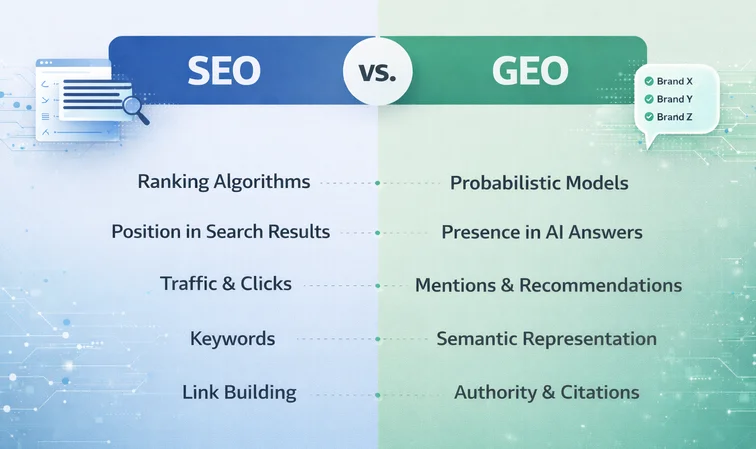
1. Operating mechanism
SEO is based on ranking algorithms.
GEO concerns probabilistic models that generate answers based on training data and context.
2. Unit of visibility
SEO → position in search results.
GEO → mention, recommendation, or quote in an AI answer.
3. Success metrics
SEO → traffic, clicks, conversions from organic search.
GEO → brand share in answers, recommendation frequency, context of occurrence.
4. Keywords vs semantics
SEO often focuses on phrases.
GEO requires understanding context, user intent, and the brand’s semantic consistency.
5. Link building vs authority and citability
In SEO, the backlink profile matters.
In GEO, the key elements are: expertise, consistency of communication, presence in credible sources, and frequency of mentions.
Most importantly:
In the GEO world, you don’t fight for a click - you fight for presence in the answer.
How do generative answer engines work?
To understand GEO, you need to understand how language models (LLMs) work.
These models:
- Learn on massive text datasets.
- Recognize linguistic patterns and semantic relationships.
- Generate answers probabilistically - predicting the most likely continuation of text.
In many cases, they also use mechanisms like RAG (Retrieval-Augmented Generation), i.e.:
- retrieve up-to-date information from external sources,
- combine it with knowledge built into the model,
- create a synthetic answer.
Why does the model mention some brands and omit others?
The most common factors are:
- frequency of the brand’s occurrence in the data,
- the context in which the brand is described,
- expertise and authority of the sources,
- consistency of communication,
- clear positioning.
The model "doesn’t like" brands that are:
- ambiguous,
- poorly described,
- present only in sales materials.
That’s why brand visibility in AI is the result of the entire content ecosystem, not just website optimization.
Why is GEO becoming crucial for brands?
Just a few years ago, brand visibility on the internet was almost synonymous with a position in Google. If you were high in search results - you existed. If you dropped to the second page - you practically disappeared from the user’s field of view.
Today, that mechanism is undergoing a fundamental change.
More and more often, the user doesn’t browse search results but asks a language model a question and receives a ready-made, synthetic answer. They don’t see ten options. They don’t analyze rankings. They don’t compare pages. They get a few recommendations - and sometimes only one.
That’s precisely why GEO (Generative Engine Optimization) stops being an experimental concept and becomes a strategic necessity.
The change is not about technology. It’s about decisions.
The most important thing is that language models are entering an area that previously belonged to search engines - the stage of early selection of vendors, tools, and brands. This is the moment when the user is only defining the problem and looking for first suggestions.
If at that moment your brand does not appear in the AI answer, it doesn’t even make it onto the shortlist.
And if it doesn’t make the shortlist - it doesn’t take part in the buying process.
That’s what makes brand visibility in AI start to have a direct impact on revenue, not just awareness.
AI as a new market filter
Language models now act as an intelligent filter. They sift through hundreds of potential options and present the user with a few selected ones. In practice, this means concentration of attention on a limited number of brands.
In classic SEO, you could operate in the long tail of search results. In the generative world, the space is much narrower. The answer has a certain length. The list of recommendations is limited. The model must make a selection.
And that selection has real market consequences.
A new layer of competition
As a result, a new layer of competition emerges - competition for presence in the answer. It’s no longer only about who has better SEO content. It’s about:
- which brand is most frequently cited,
- which has a coherent semantic representation,
- which appears in an expert context,
- which is a "natural choice" for the model.
Companies that ignore this area may not notice the problem for a long time - because SEO traffic will still flow. However, in the background their competitors will gradually take over the space in AI-generated answers.
And when AI’s share in the decision-making process crosses a certain threshold, the advantage will become difficult to catch up.
Market data: AI is taking over the discovery stage
The scale of the change we’re talking about in the context of GEO is not speculation. It is a measurable trend.
-
Tools based on language models reached tens of millions of active users in a very short time.
-
ChatGPT reached 100 million users within 2 months of launch (UBS).
-
A growing number of users declare using AI when making purchasing decisions (Salesforce).
-
In Gartner’s strategic forecasts on the "Future of Search," it is indicated that conversational and generative interfaces will change the way users discover information and brands in the 2026-2028 horizon.
-
in analyzed informational queries in the US, about 50% of Google queries contain AI-generated summaries, and forecasts speak of over 75% by 2028 (incl. BrightEdge, SEOClarity)
This means one thing: the moment of first brand selection is increasingly taking place in the generative layer, not in classic search results.
If a brand does not appear in that layer, it may be overlooked before the user visits any website.
That’s exactly why monitoring and optimizing visibility in AI are becoming a strategic necessity, not an experiment.
How AI really recommends brands - example analysis
Theory is theory, but the key question is: what does an AI-generated brand recommendation look like in practice?
Let’s analyze a simplified, model example.
Example user query
"Which CRM should I choose for a small service business?"
This is a typical question from an early stage of the buying journey. The user:
- doesn’t yet know specific brands,
- doesn’t compare features,
- is looking for a first shortlist.
What does the language model do?
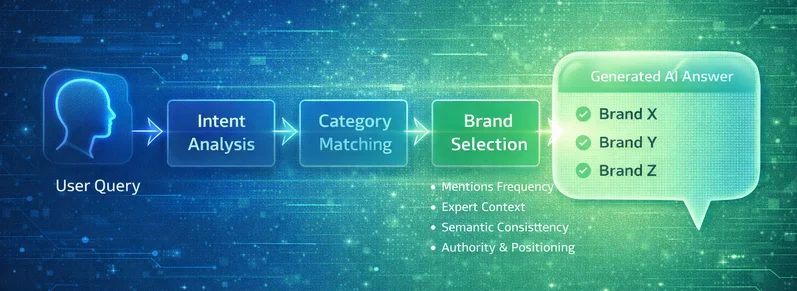
The model doesn’t "search" pages in the classic sense. Instead, it:
- Analyzes intent (small business, CRM, services).
- Matches context (scalability, simplicity, price, implementation).
- Generates a synthetic answer listing 2-4 solutions.
- Adds a brief justification for each brand.
The answer may look roughly like this:
"For a small service business, it’s worth considering, among others, X (easy to use and affordable), Y (advanced automations), and Z (good price-to-feature ratio)."
From the user’s perspective, it’s a neutral, helpful answer. From the market’s perspective - it’s the moment of selection.
Why does the model mention those brands?
The recommendation is not random. Most often it results from a combination of several factors:
Frequency of occurrence in context
If a given brand:
- often appears in articles like "best CRM for small businesses",
- is regularly compared with competitors,
- appears in industry roundups,
the model is more likely to associate it with a given category.
This is the effect of semantic reinforcement.
Consistent positioning
If a brand consistently communicates itself as:
"CRM for small and medium-sized businesses"
the model will more easily assign it to a specific scenario.
But if communication is scattered ("sales platform", "relationship management system", "marketing tool"), the semantic representation becomes less distinct.
Expert context
Language models "weigh" information. A brand mentioned:
- in expert analyses,
- in industry reports,
- in educational materials,
has a higher chance of appearing in the answer than a brand present only in advertising content.
Knowledge structure, not just popularity
This is important: AI does not always choose the "biggest" brand.
It often chooses the one that:
- has a clearly defined category,
- is strongly tied to a specific need,
- has a clear product narrative.
In practice, this means that a smaller but well-positioned brand can beat a larger player with blurred communication in AI answers.
What does this mean for a GEO strategy?
Analyzing a single query shows one key thing:
AI does not recommend brands based on a single website. It recommends them based on the entire information ecosystem in which the brand operates.
Therefore, in the context of Generative Engine Optimization, what matters is:
- repeatable semantic associations,
- presence in comparison contexts,
- content expertise,
- narrative consistency,
- digital reputation.
GEO is not about optimizing one article. It’s about building such a strong informational representation of the brand that, in a given context, it becomes a "natural choice" for the model.
In the generative world, you don’t fight for someone to click your link. You fight for the model to consider your brand as one of the most probable answers to a specific question.
And that is a completely different game than classic SEO.
Visibility model in GEO - four layers of presence in AI
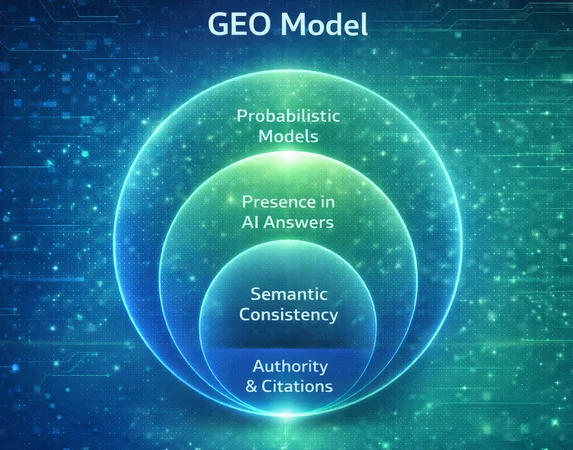
Brand visibility in a generative environment can be understood as the effect of four overlapping layers:
Data layer
These are all places where the brand exists as information:
- website,
- industry articles,
- expert publications,
- directories and roundups.
Without this layer, the model has nothing to "build" a representation from.
Semantic representation layer
This is the way the brand is described:
- clear positioning,
- consistent narrative,
- repeatable associations with a category.
This is where it is decided whether the model understands who you are.
Expert context layer
This is the environment in which the brand appears:
- comparisons,
- analyses,
- reports,
- citations.
This layer builds authority in the model’s eyes.
Recommendation layer
This is the final outcome:
- appearing in an AI answer,
- frequency of mentions,
- position in shortlists,
- context of recommendation.
Only this layer is visible to the user.
The absence of any of the layers lowers the probability of the brand appearing in AI-generated answers.
How to check if your brand is visible in AI?

This is one of the most practical and at the same time most difficult questions in the context of GEO.
Unlike classic SEO, there is no public ranking of answers generated by language models. You can’t check "position in AI" or analyze a standard SERP. Answers are dynamic - they depend on the model, system version, question context, and the way it’s phrased.
The simplest method is manual testing:
- asking different variants of queries,
- comparing answers across several models,
- analyzing whether the brand appears as a recommendation, an example, or only a general mention,
- observing the context in which it is described.
Such a method allows you to identify first visibility signals, but it has significant limitations: it is time-consuming, hard to scale, and does not provide a full picture of changes over time.
That’s why a new category of analytics tools is emerging, designed specifically to monitor brands’ presence in AI-generated answers. Solutions such as BrandinAI enable systematic analysis of:
- the brand’s share of answers across different models,
- comparison with competitors,
- visibility changes over time,
- recommendation context.
This is a qualitatively different approach than traditional SEO tools. Instead of measuring rank position, you analyze brand representation in the generative layer.
In a world where an AI answer can replace browsing several pages, monitoring this layer stops being a curiosity - it becomes an element of a conscious marketing strategy.
How to optimize a brand for GEO?
Since GEO is based on a brand’s presence in answers generated by language models, the natural question is: how can you realistically influence that?
Unlike classic SEO, there is no single technical list of "ranking factors" here. Language models don’t publish guidelines, don’t show rank positions, and don’t operate in a fully deterministic way. This means that optimization for GEO requires a broader perspective - covering content, digital reputation, the context in which the brand appears, and its semantic consistency.
The good news is that although the generative mechanism is complex, you can identify specific areas that increase the probability of a brand appearing in AI answers. GEO is not about "tricking the algorithm," but about building such a presence in the information ecosystem that makes the brand a natural choice for the model.
1. Build real authority
Language models prefer brands that are:
- present in expert publications,
- cited,
- described in a knowledge context, not only sales.
2. Maintain consistency in communication
If your brand is described once as a "platform" and once as a "tool," the model may have trouble clearly classifying its role.
Semantic consistency matters enormously.
3. Create definitional and educational content
Language models "like":
- clear definitions,
- FAQ structures,
- specific comparisons,
- numerical data,
- structured arguments.
Expert content has a higher chance of becoming part of the answer.
4. Think broader than SEO
GEO is a combination of:
- content marketing,
- digital PR,
- building expertise,
- classic SEO,
- analytics.
It’s not a single tactic, but a new layer of marketing strategy.
Will GEO replace SEO?
No.
SEO remains the foundation of online presence. It’s optimized content that forms part of the data used by language models.
However, the role of SEO is evolving.
Instead of focusing exclusively on clicks, brands must think about:
- representation in AI answers,
- context of occurrence,
- digital reputation,
- information quality.
You could say that:
SEO builds content availability. GEO builds presence in answers.
Both areas will coexist - but the importance of generative visibility will grow. We wrote more broadly about what future awaits SEO and in which direction it will evolve in the article the future of SEO in the era of AI-first search
Summary: A new dimension of visibility
Marketing in the era of artificial intelligence is entering a new phase. Visibility is no longer just ranking. Visibility is presence in the answer.
If your brand does not appear in AI-generated recommendations:
- it does not participate in the first stage of the decision,
- it loses competitive advantage,
- it yields ground to more visible players.
Generative Engine Optimization (GEO) is not a passing trend. It is a natural consequence of the transition from searching to generating answers.
Brands that understand this change earlier:
- will build an advantage faster,
- will better understand their representation in AI,
- will more effectively adapt their content strategy.
The era of "10 blue links" is slowly coming to an end. The era of one answer is beginning. And the question is no longer:
"What position are you in on Google?"
But:
"Does AI mention you at all?"