Ethics as a mathematical filter: When an assistant rejects a brand over hidden social costs


In short
An ethical filter in AI assistants could decide which products make it into recommendations and which get left out. The mechanism would depend on the precision of the user's rules, the quality of available information and how uncertainty is handled. In all of this, transparent justifications and the ability to control the adopted rules matter.
The brand drops out before the customer ever sees a recommendation
The most dangerous failure for a brand is not a low position in a ranking. It is being absent from the ranking altogether. Consider a hypothetical situation: a well-known cosmetics brand offers a favorable price, but a personal artificial intelligence (AI) assistant skips its product. There is one reason: the available information contains a documented conflict with the rule of a user who does not want to buy products tested on animals. The user will not see this offer, either at the bottom of the list or with a caveat attached. The decision was made earlier, at a stage that cannot be seen.
This is a fundamental difference from how we usually think about competing for attention. In a classic comparison, products line up in order and the customer scans them from the top. Here, the qualification stage comes before the presentation stage. A brand that does not pass the first gets no chance at the second.
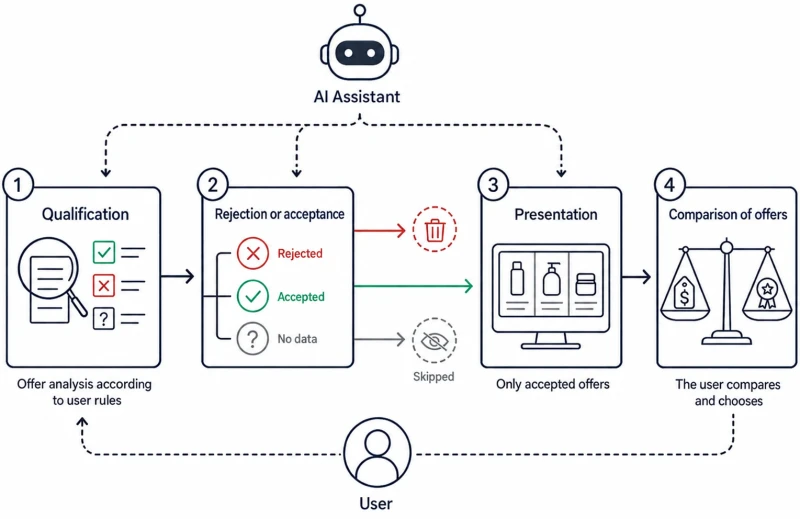
The title's "ethics as a mathematical filter" is a metaphor, not a claim that morality can be objectively calculated. The point is more modest: a user's personal conditions, written down as a clear rule by which an offer is either admitted or rejected. "Mathematical" here means only that the procedure is unambiguous, not that the result is always accurate.
It is worth separating two things right away. An assistant could analyze the information available to it. It does not follow that it has complete and reliable data on how and where each product was made. The entire mechanism described here is a forward-looking scenario, not a function that can be said to work widely today.
How to translate personal principles into product-selection conditions
The slogan "I buy responsibly" is not suitable for filtering. For a rule to work, the user would have to decide what they consider acceptable and what they do not. Only then does the assistant have something to compare offers against.
The first distinction concerns the strength of the principle. A condition without exceptions means that a product failing to meet it is dropped regardless of price. A preference is milder: it can give way when the alternative is much more expensive or unavailable. Which of these variants applies is decided by the user, not by the assistant or the seller.
The second distinction concerns scope. The same principle, written more broadly or more narrowly, yields a different set of available offers. The two main examples, no animal testing and local production, illustrate this well. A precise formulation makes it easier to check compliance, but it does not remove differences between people: for one person an ethical purchase means something different than for another, and the filter is not meant to settle that.
No animal testing: the product, the ingredients, or the suppliers?
The claim "not tested on animals" sounds unambiguous, but it can refer to three different things:
-
the finished product, that is, whether the item itself was tested in this way,
-
the ingredients used, which may have been tested separately, at an earlier stage,
-
the actions of entities involved in production, for example suppliers or subcontractors.
Confirming one scope does not settle the others. A manufacturer may not test the finished item while still using an ingredient that was tested elsewhere in the chain.
That is why the principle needs to be clarified by the user. The assistant should not tighten it on its own, treating as a violation something the user did not prohibit, nor loosen it by assuming that a general assurance from the brand is enough.
Local production: what exactly is supposed to be local?
The word "local" also hides several meanings: the place of final manufacture, the origin of raw materials, and the distance from the buyer. A simple, hypothetical example: offer A is assembled at a plant near the customer from raw materials imported from the other side of the world. Offer B is made from regional raw materials, but at a plant located farther away. Under the definition "what matters is the place of assembly," A wins. Under "what matters is the origin of raw materials," B wins. Under the criterion of distance from the buyer, A may win again.
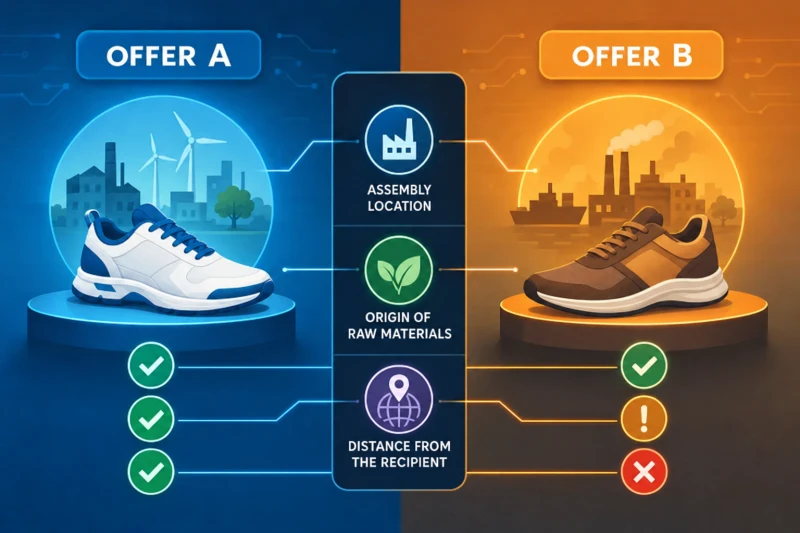
Locality may be an important criterion for the user, but it is not proof that other principles are met. A product made right next door does not thereby become free of animal testing or compliant with any other condition.
How an assistant could filter offers before showing them
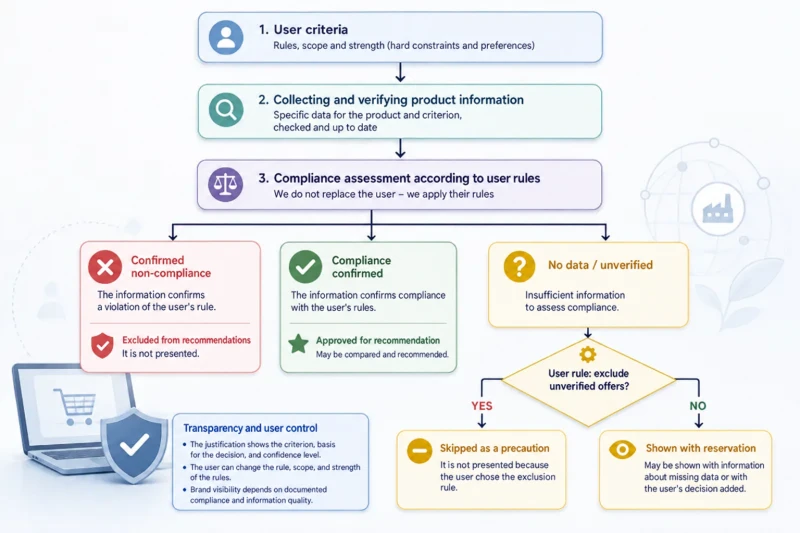
The mechanism can be described as a chain of dependencies, without going into technical architecture. First, the user's conditions are established. Then the assistant looks for information about products. Next, it assesses each offer's compliance with those conditions. Only at the end does it compare those that were admitted.
The key point is that a compliance assessment can end in three different results:
- compliance, meaning the available information confirms that the condition is met,
- non-compliance, meaning the information indicates that the condition is not met,
- no conclusive data, meaning neither is known.
The third case is in practice the hardest, especially where brands do not publish details. How the assistant handles it would matter more than the distinction between compliance and non-compliance itself.
Exclusion is not the same as a lower position
There are two ways to take a feature into account. The first is an admission condition: an offer meets the criterion or drops out of the pool. The second is scoring: an offer gains or loses points for a feature, and the total score determines its place on the list.
With an absolute condition, a better price does not offset non-compliance. An offer that violates the principle does not "make up for it" with price, because it takes no part in the comparison at all. With scoring, the opposite happens: a good price can compensate for weaker compliance.
What happens if no offer meets the principles? The honest behavior is to disclose this result. The assistant should not quietly change the selection rules in order to show something, because the user would lose control over their own criterion without knowing it.
What to do when compliance cannot be confirmed?
A lack of information is not proof that a condition is unmet. The fact that the assistant found no confirmation does not mean the brand follows unethical practices. It means only that the assistant's knowledge ends at that point.
Three rules of conduct are possible:
-
omitting the unverified offer,
-
showing it with a clear caveat,
-
asking the user whether they want to consider it.
Each is a different answer to the same question: how much risk of error is the user willing to accept? It is worth noting that a precautionary exclusion would follow from the adopted principle "without confirmation, I do not recommend," not from a finding that the brand acts improperly. These two justifications sound similar but mean different things, and a good system should distinguish them.
An explanation should show the reason, not pass a verdict
A clear explanation of a rejection would contain three elements: the criterion applied, the information on which the decision was based, and the limits of certainty. A message such as "product omitted because no confirmation of no animal testing was found for the finished item" tells the user what happened and why. A message such as "this brand is unethical" is a verdict that nobody has justified.
Another distinction matters too: rejecting a specific product is not an assessment of the whole brand. Other products from the same company may pass the filter without any problem. The user should be able to check the reason for an omission, although this does not mean every response must contain a complete list of all rejected offers. Such a list would often be hard to read and unnecessary.
What production information would such a filter need?
The selection rules are only half of the matter. The other half is the material to which they can be applied. Here a distinction appears that is often blurred in marketing practice: an advertising slogan, a description of a process, and confirmation of a specific practice are three different kinds of information. The first expresses a communication intent. The second describes how something is made. The third indicates that a particular practice actually takes place.
Four features of such information matter for the filter: scope (what exactly it concerns), currency (what moment it comes from), the ability to check the source of the claim, and its link to a specific criterion, such as no animal testing or local production.
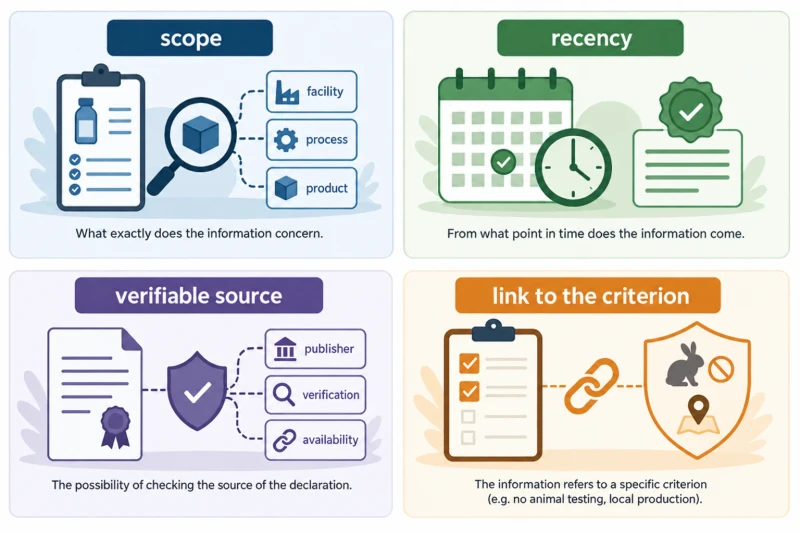
Two issues must also be separated: the truth of the information and its availability to the assistant. True information that the assistant cannot find does not help the brand. Conversely, easily accessible, formal-sounding content does not guarantee credibility. Ease of finding something is not proof.
A claim about the whole brand does not describe every product
A general assurance of responsibility is something different from information about a specific product, plant, or production stage. A brand may have one product line that meets a given criterion and another that does not. The properties of one line should not be automatically transferred to the entire offer.
Assessing a chosen criterion may also require information about exceptions, ingredients, and subcontractors, but only to the extent necessary for that criterion. The filter does not need to know every detail of the supply chain, but it must know the one that determines compliance with the user's principle.
What makes it possible to verify a claim and its currency?
Three kinds of material make verification easier: process documentation, information about origin, and independent confirmations with a clearly defined scope. The word "clearly" matters here: a confirmation that does not say what it covers says little.
Currency is equally important. A change of supplier or production site can undermine an earlier assessment, even if it was fully justified before. A certificate or label requires interpretation: one must know exactly what it covers and until when. And full knowledge of all production stages is simply not always available, and no filter will change that.
Why hidden costs could limit a brand's visibility
Social costs are consequences of production borne by people and their surroundings that the purchase price does not show directly. In the scenario described here, this group also includes the matter concerning animals, which the user named as their own criterion.
Such consequences would become an obstacle to a recommendation under two conditions at once: when they violate the principles of a specific user and when they can be established from available information. If either condition is not met, the filter has no grounds to reject offers as non-compliant. It may still omit them as a precaution, but only if the user has adopted a rule of excluding unverified offers.
Hence the need to separate three concepts that marketing often treats as the same:
-
recognition, meaning that the brand is well known to the assistant,
-
a mention, meaning that the brand appears in a response,
-
a recommendation, meaning that it is named as a suitable choice.
A brand may be perfectly well known and still not admitted to recommendation for a specific person. A model's good familiarity with a brand does not replace compliance with the user's criteria.
It does not follow that a low price means unethical production. Price and compliance with principles are separate axes and should not be confused.
Where could an ethical filter fail?
Since the mechanism has consequences for brands, its limitations must be assessed honestly. It can fail in several ways:
-
incorrect or contradictory information: if the data on production is false or mutually contradictory, the compliance assessment will be just as uncertain,
-
reducing complex practices to a single condition: real production chains rarely come down to a "yes" or "no" answer,
-
confusing documentation with compliance: a carefully described practice is not necessarily a practice actually applied, and modest documentation does not prove violations.
The last point especially affects firms with smaller resources. A brand that meets the criterion but lacks the means to document it in a way the assistant can read could be omitted despite being compliant. The filter relies on what is visible, not on what is true.
Two abilities must also be separated: describing criteria and reliably checking whether they are met. An assistant may fluently explain what no animal testing means and still be unable to assess a specific product reliably.
Does the filter apply the user's rules or the assistant provider's?
Three sources of rules can be distinguished: preferences knowingly provided by the user, principles imposed by the service, and interpretations adopted by the system itself. For the user the difference is fundamental, and for the outcome it is even greater: the same data under different invisible assumptions can produce a completely different list of offers.
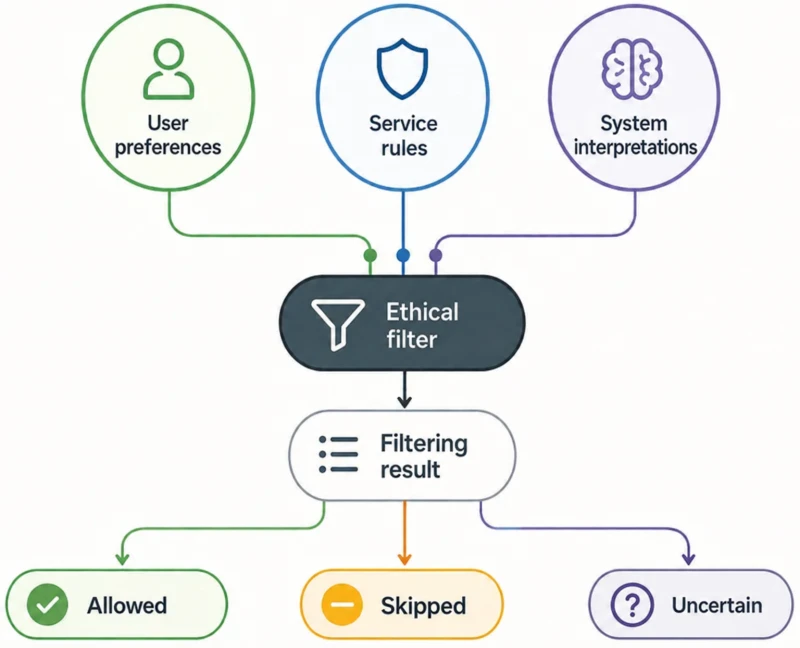
Hence the importance of transparency on the assistant's side. The user should know which rules are their own and which come from elsewhere. There must also be a way to correct wrong information about production and to control the adopted rules. Without this, a filter that was meant to serve the user's values could quietly apply someone else's, and the user would have no way to notice or correct it.
Brand visibility would also depend on documented compliance
Let us return to the brand from the opening scenario. Its product was omitted because the assistant found a documented conflict with the user's principle, not because of price or recognition. In this case documentation alone would change nothing: what would count is a change in practices. A brand omitted because of incomplete information would look different. Its compliance might be real but invisible, and the omission would result from a rule requiring confirmation.
A simple synthesis follows: presence in a recommendation would be decided by two related factors, namely the actual compliance of practices with the user's principles and the ability to document it in a way the assistant can verify. The absence of either could cost a brand its visibility.
If this direction holds, a brand's visibility in AI assistants' recommendations would depend not only on how it is presented, but also on whether it can document that its practices comply with the criteria of a specific user. For brands, this would mean maintaining documentation that an assistant is able to read and verify, not merely a claim that looks good on a website but cannot be checked.