Entities in the LLM era: Definition, role in GEO and building a conceptual structure

Key takeaways
-
An entity is a specific, identifiable information object - a brand, person, product, or place - processed by language models as a node with attributes and relationships, not as a string of characters to match.
-
Traditional keyword-based SEO is losing effectiveness in AI assistant environments because LLMs (large language models) respond to queries based on semantic understanding of objects, not lexical phrase matching.
-
A language model recognizes a brand as a strong entity when it encounters consistent, mutually corroborating signals: a canonical name, a set of aliases, associations with a specific service category, and attributes repeated across multiple sources.
-
Contradictory naming data - different versions of a name across different channels - causes the model to build several blurred profiles instead of one authoritative base entity, which directly reduces brand visibility in AI responses.
-
Building a brand's semantic environment (positioning it close to key industry terms and recognized authorities) is a measurable and repeatable tactic, not a theory - results are verified through zero-shot query tests before and after implementing changes.
-
The content layer has its limits: advanced integration with knowledge graphs and Schema.org implementation require technical support and go beyond editorial content work.
-
The entity-first strategy shifts priority from phrase optimization to building a consistent, object-based brand image - this is an operational change, not merely a semantic one.
Why traditional keywords are disappearing from AI assistants
A brand can rank at the top of classic search results and simultaneously not exist in responses generated by an AI assistant. This is not a paradox - it is the logical consequence of a fundamental difference in how the two technologies work.
Classic search engines spent decades relying on text string matching: a user typed a phrase, and the algorithm looked for documents containing the same tokens. SEO strategy therefore depended on appropriate keyword density in content, link acquisition, and technical page optimization. The model was linear and relatively predictable.
Large language models work differently. When generating a response, LLMs do not search a document database by words - they construct a response based on semantic representations of objects, the relationships between them, and the context in which those objects were encountered during training. The question "which UX agency should I trust for redesigning a banking app?" does not trigger a list of documents containing those words. It triggers a set of entities associated with the categories "UX agency," "finance," and "trust" - and from that set, the model selects those whose conceptual profile is densest and most coherent. In other words, the semantic associations of entities replace phrase matching here as the selection mechanism.
A brand that exists online solely as a collection of phrase-optimized pages, but not as a recognizable information object with clearly defined attributes and relationships, is practically invisible to a language model. It does not appear in responses not because it is weak - it appears infrequently because the model cannot unambiguously locate it within its conceptual network.
This is not a content quality problem in the traditional sense. It is a problem of information architecture about the brand.
What an entity is in the world of artificial intelligence - entity definition
An entity is a specific, unambiguously identifiable information object - such as a company, product, person, or place - that a language model processes as a node in a network of associations, not as an isolated string of characters. This entity definition is the starting point for any visibility strategy in LLM environments.
The node metaphor is precise here, not merely illustrative. In a network of associations, each node exists through its connections: what it neighbors, what describes it, which categories encompass it. A brand as an entity is not just its name - it is the entire set of attributes, aliases, and relationships that the model encountered in association with that name frequently and consistently enough to build a stable conceptual profile from them.
For marketers and product managers, this means a shift in priorities more fundamental than it might initially appear. It is no longer about how many times a given phrase appears in content. It is about whether the model has sufficiently unambiguous and mutually consistent data to answer the question: who is this brand and what does it do?
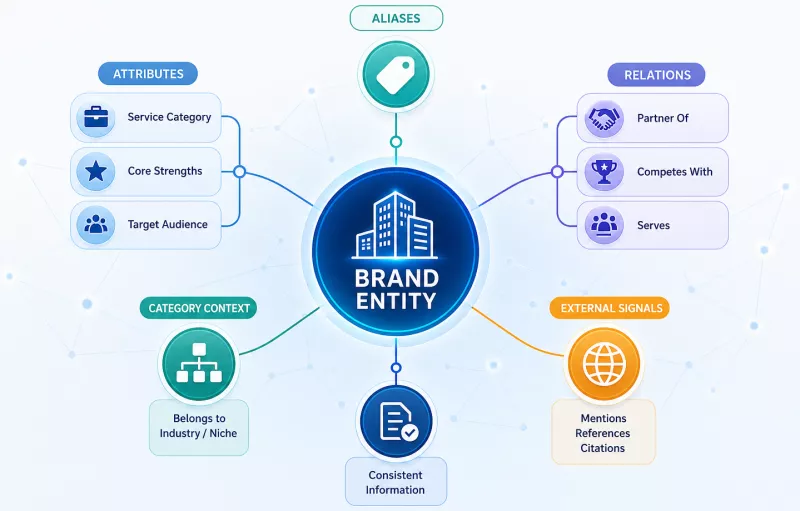
Entity vs. keyword: flat tokens versus three-dimensional objects
For an AI system, a keyword is an isolated string of tokens - a sequence of characters with no built-in knowledge of what it refers to, what it is connected to, or in what context it should be used. Older search algorithms had to infer user intent from those tokens, often incorrectly or approximately.
An entity functions differently: it is a three-dimensional object possessing attributes (properties describing the object itself), relationships (connections to other entities), and category context (membership in a specific topical domain). A language model does not guess what "Accenture" means - it knows it is a global consulting firm providing digital transformation services, associated with the enterprise sector, with a defined set of competitors and clients.
This difference between an entity and a keyword has direct operational consequences. A token-based system estimates probability based on word co-occurrence. An entity-based system builds a response based on object properties and their mutual relationships - with much greater certainty and precision. A brand that exists in a model as an entity with a dense attribute profile appears in responses far more frequently than a brand whose profile is blurred or inconsistent.
What a brand entity looks like: examples from practice
Consider three brief scenarios that illustrate how a model builds - or fails to build - a brand entity.
A creative agency with a blurred profile. The company operates under different names across different channels: "Studio Forma" on its website, "Forma Creative" on social media, "Forma Ltd." in public registries. It produces content about design, branding, and strategy, but does not connect these areas consistently with any specific service category or client group. As a result, the model does not build a single strong entity - it generates several overlapping, weak profiles. When a query appears about a "branding agency for tech startups," the company is not mentioned, despite formally meeting the criteria.
A SaaS company with a canonized name and a clear attribute profile. The company consistently uses one name across all channels, publicly defines its category ("a project management platform for distributed teams"), repeats the same set of differentiating characteristics, and is mentioned in external texts alongside recognized industry authorities. The model has enough consistent signals to build a stable entity and invoke it in responses to questions about remote work tools.
An industry consultant with a strong personal profile. An expert publishes regularly under their own name, is cited in industry articles, and their LinkedIn profile and personal website repeat the same specializations. The language model easily identifies them as an entity in the category "digital transformation expert in the financial sector" and regularly names them as an authority in response to questions from that domain.
In all three cases, the key mechanism is the same: the consistency and density of semantic signals determines entity strength, not the sheer volume of published content.
Practical steps: how to build strong semantic brand associations
Building brand visibility in LLM environments means consistently emitting structured signals that algorithms can connect into a logically coherent conceptual profile. This is not a one-off technical operation but ongoing editorial and informational work that the model "sees" each time it encounters the brand name in a new context.
AI assistants learn from data - and their responses reflect what dominates that data in terms of consistency and repetition. A brand whose signals are dispersed, inconsistent, or sparse does not give the model enough material to build a stable entity. A brand that consciously manages its information representation increases its chances of appearing in responses precisely where that has business significance.
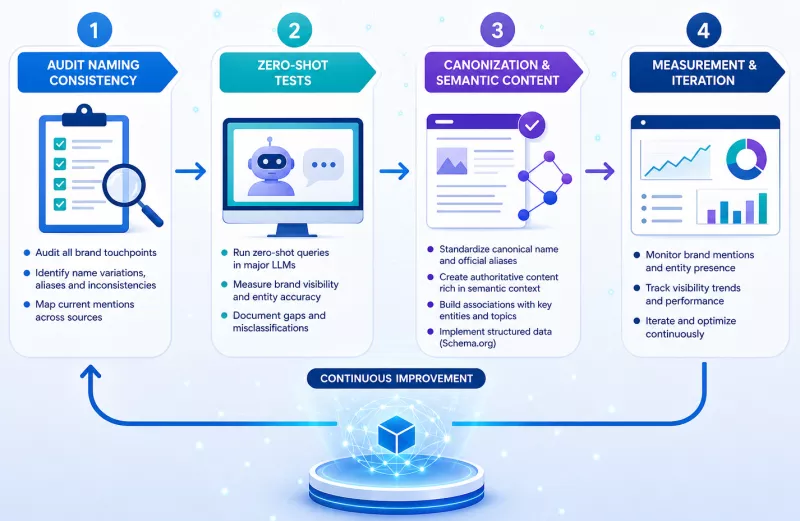
Name canonization and information control
One canonical name - identical on the website, social media profiles, press materials, publicly presented legal documentation, and external content - is the fundamental signal the model uses to identify an entity. This is the first and most urgent task for a marketing team.
Contradictory data has a concrete effect: the model does not merge several variants into a single profile but instead creates several weak, overlapping representations, none of which achieves sufficient strength to be invoked with confidence. Reducing these contradictions is an operational activity, not an artistic one - it requires auditing every brand touchpoint with the external information ecosystem and disciplined standardization.
Two additional elements are worth addressing. First, a set of recognized aliases - shortened names or commonly used variants that the model should map to the same entity as the canonical name. Second, an unambiguous association with a service category: if a company never explicitly articulates what it does and for whom, the model must infer this from context, which increases the risk of misclassification.
Building context and semantic environment
Name canonization is the foundation, but on its own it does not build a rich entity profile. The model evaluates a brand through the lens of its semantic environment - meaning which concepts, companies, experts, and problems it regularly appears alongside.
Intentional content design means consciously positioning the brand near the terms that define its category, the problems it solves, and the authorities that category recognizes. This is not about literally "inserting keywords" - it is about creating content in which the brand naturally co-occurs with the concepts that form the core of its area of activity.
Concretely: an article analyzing the challenges of digital transformation in the financial sector, in which the company is cited alongside recognized industry institutions, builds a stronger entity profile than ten promotional articles describing the company in isolation. External mentions - citations, links, references to the brand as a point of comparison - carry particular weight, because the model treats them as a signal of independent confirmation of the entity's attributes.
The density and naturalness of this conceptual environment is critical. The model does not respond to the mechanical proximity of a brand name to a trending term - it responds to a consistent, recurring semantic pattern that appears across many independent contexts and sources.
Verifying visibility: how to test entity presence
The effectiveness of entity building for LLM environments is measurable - and should be measured regularly, not only after a deployment is complete.
The simplest method is entity zero-shot testing: queries directed at an AI assistant with no context about the brand provided. Questions such as "which companies offer [service category] for [customer segment]?" or "who is a recognized expert in [industry area]?" allow you to check whether the brand appears spontaneously and whether the attributes it is described with match the desired entity profile. Results should be treated as observational guidance, not certainty - models are updated irregularly and their responses can vary between sessions.
The second type is category recommendation queries: a request to identify the best solutions or providers in a given niche without mentioning the brand name. The result before implementing changes and the result after - for the same set of queries, in the same assistant - constitutes a measurable indicator of visibility change.
It is worth maintaining a record of these tests. For each entry, document:
-
the query text and measurement date,
-
the model's full response and the presence or absence of the brand,
-
the attributes with which the brand was described.
This documentation enables quantitative trend analysis over time and identification of specific gaps in the entity profile that require correction. That is why tests should be repeatable: the same set of queries, conducted regularly, provides a more reliable picture of the trend than a one-off measurement.
Monitoring automation: tools for tracking brand mentions
Manually maintaining a log of test queries is feasible at the outset, but as the number of phrases and AI assistants to check grows, it quickly becomes inefficient. This is where dedicated tools come in.
One solution designed with this stage in mind is brandinai.com - a platform that allows you to define a set of monitoring queries once, then automatically track how the brand appears in language model responses. Instead of manually running zero-shot tests and logging results in a spreadsheet, the user configures prompts corresponding to typical category or recommendation queries - and the system reports on every brand mention, its attributes, and visibility changes over time.
The practical value of this approach lies in measurement continuity. A one-off test provides a snapshot; regular, automated querying of the same prompts reveals trends - whether the brand's entity profile is strengthening after subsequent editorial actions, whether the brand is beginning to appear in new semantic contexts, and whether the attributes the model associates with it are changing. This translates directly into more informed decisions about which gaps in the entity profile require urgent correction.
Content limitations and the move to the technical layer
Editorial actions have a natural ceiling. Even the best-managed content layer cannot replace the structural technical signals that models and knowledge graphs treat as hard metadata.
When an entity profile is sufficiently coherent at the textual level and the brand's visibility in AI responses still does not meet objectives, the next step is implementing Schema.org microdata - structured markup that allows precise declaration of an entity's type, attributes, and relationships in a machine-readable format. In parallel, it is worth considering integration with knowledge graphs - such as Wikidata or the Google Knowledge Graph - which are among the key sources from which models draw entity data in LLMs.
These actions require the involvement of data engineers or technical SEO specialists and go beyond the competencies of a typical editorial team. They are, however, the logical extension of the work done at the content level - not an alternative to it.
Entity-first strategy: a paradigm shift and first steps
The starting point of this article was concrete: a brand optimized for traditional SEO can be practically invisible to AI assistants. Not because its content is poor quality - but because language models do not search for phrases; they recognize objects. A brand that does not exist as a coherent, richly attributed entity in a model's semantic representation simply is not considered when generating responses.
Transitioning to an entity-first strategy means changing the unit of analysis: from phrase to object, from content saturation to informational profile consistency, from the number of published articles to the quality and consistency of semantic signals emitted across all channels. The result of this work is what can be called the brand's conceptual structure: a coherent arrangement of attributes, relationships, categories, and external confirmations that the model is able to unambiguously recognize and invoke.
For a brand team that wants to test this impact in a measurable way, the first three operational steps are as follows.
The first step is a naming consistency audit: a review of all external brand touchpoints - website, social media, directory profiles, mentions in industry media - and identification of all name variants and inconsistent category descriptions. The output should be a list of discrepancies to standardize.
The second step is a series of zero-shot tests conducted before any changes are made: a set of at least five queries to selected AI assistants, covering the category in which the brand should be visible. Results must be documented - brand presence or absence, attributes used, position within the response.
The third step is implementing canonization and semantic corrections - standardizing naming conventions, publishing content that reinforces associations with key category terms - and then repeating the same set of tests after several weeks have passed. The difference between the first and second measurement is the quantifiable effect of the intervention.
Iteration is a principle here, not an option. Models change, market categories evolve, and an entity profile requires regular refreshing. Treating AI visibility as a state to be achieved rather than a process to be maintained is a mistake most easily detected through systematic testing - which is precisely why it is worth building that practice into the team's routine from the very beginning.