The fall of 'above the fold': How AI assistants replaced the homepage first impression

In short
A discussion of how AI assistants are changing the first point of brand contact - from replacing 'above the fold' with LLM syntheses to the effects on SEO and social proof. Includes recommendations: canonical endpoints, structured metadata, and fidelity metrics to protect brand identity.
The fall of "above the fold": What AI assistants have replaced as the homepage's first impression
For the past decade, "above the fold" - the first section of a homepage visible without scrolling - functioned as the sacred ground of digital marketing. Agencies spent weeks devising strategies to design the perfect hero: the right tagline, a precisely chosen photograph, a visual hierarchy that would communicate everything a brand wanted a user to understand within three seconds of first contact. It was a handshake, a manifesto, and an invitation rolled into one.
A growing segment of B2B users - and beyond - skips that handshake entirely. Instead of visiting a website, they type a query into an AI assistant. Instead of viewing the hero, they receive a paragraph. Instead of a brand narrative, they get a synthesis generated by a large language model (LLM) that has never seen a brand book and carries no obligation to the company's positioning. The fundamental shift this situation forces can be reduced to a single sentence: control over the first brand interaction has passed from the marketing department to the algorithm.
Why users bypass the homepage
Conversational interfaces - ChatGPT, Perplexity, Gemini, Copilot - deliver on a promise Google never fully kept: immediate synthesis rather than a list of links to wade through. For a B2B decision-maker researching process automation software, the difference is enormous. A browser returns ten addresses, each requiring a click, an evaluation, navigation. An assistant returns an answer.
A practical example: a chief operating officer types "which data management tools work best in a mixed cloud environment in financial services?" and within seconds reads a synthetic overview. That overview names several companies. Their descriptions do not come exclusively from their own websites - the model has synthesized information from dozens of nodes: official sites, reviews, industry articles, Reddit discussions, LinkedIn posts. Each of those sources had precisely the same access to the algorithm. The company's homepage carried no privilege.
The brand loses something fundamental: the ability to set its own context. For years, framing was the marketing department's domain - whoever speaks first shapes perception. In an AI environment, the brand does not speak first. The model does.
Why algorithms distort brand messaging
The mechanics by which a brand loses narrative control inside AI systems are not intuitive for marketers accustomed to thinking in terms of channels and creative assets. It is worth decoding without the mathematics.
An LLM does not "read" a webpage the way a human does. The model processes text as sequences of tokens (fragments of words and characters), assigning them statistical weights learned from vast datasets. When generating a response about a given brand, it does not reproduce content from the website - it constructs new text that, according to learned patterns, represents the most probable, coherent answer to the question posed. The brand narrative is therefore one signal among many, not a canonical source of truth. This applies to most popular generative assistants, though systems with web-search capability - such as Perplexity or Copilot with web search enabled - may favor current, authoritative documents to varying degrees.
Compression of the offer into a plain description
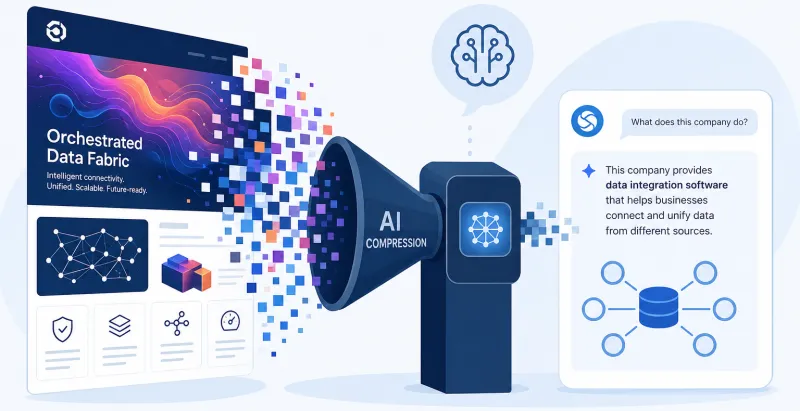
Imagination can serve as the instrument here: lossy JPEG image compression. The original contains thousands of subtle gradients, color nuances, shadow details. The compressed file preserves the general outline - but the details that gave the image its character vanish irretrievably. Algorithmic compression of a marketing narrative works in exactly the same way.
A SaaS company that has spent years building a reputation around the concept of "orchestrated data fabric" - its own carefully developed term - discovers that the model describes it as "a data integration tool." The reason is straightforward: common vocabulary appears more frequently in training data, so the model assigns it greater weight than proprietary terminology (words coined by a specific company). The algorithm is not acting maliciously; it simply optimizes for comprehensibility relative to the average query. The effect for the brand, however, is unambiguous: instead of positioning as an innovator, the user reads a description that could apply to hundreds of competitors.
Source collision and the loss of narrative monopoly
Modern AI assistants do not rank sources in the way marketers might assume they should. A company's official website is not automatically the overriding authority - in typical implementations, models treat publicly available signals as equivalent inputs with no guaranteed importance hierarchy. In practice, a model may combine, within a single paragraph, an official claim from a landing page, a critical opinion from a user forum, and a mention from an article a journalist wrote about the company three years ago in connection with an acquisition.
The result? A synthesis that sounds objective but contains sentiment and narrative no copywriter at the company would ever have approved. The brand ceases to be the sole author of its own story. It becomes one of its sources - and not necessarily the most influential one.
Tone averaging and the neutralization of a distinctive character
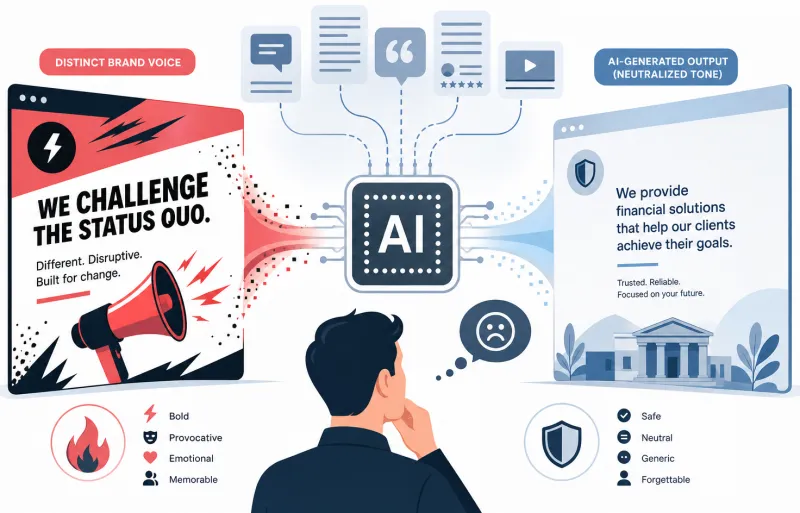
This effect is subtler, but for brands that have built a strong character it is the most painful of all. Generative algorithms are systematically optimized toward "safe" responses: useful, neutral, free of controversy. Irony in tone, provocative energy, the highly empathetic and almost therapeutic communication style of a wellness brand - these elements are noise to be eliminated by the model, not a signal to be preserved.
A brand that has spent five years consistently building a rebellious outsider persona in the conservative financial services sector finds that an AI assistant describes it in language that would equally well describe a generic bank from the nineteen-nineties. The emotional bond the brand built with its community is invisible to the algorithm. That bond does not live in tokens; it lives in how people feel when reading the text - and that is not something language models extract.
Critical identity attributes vulnerable to algorithmic reduction
An operational diagnosis requires precision. Not all brand identity elements are equally susceptible to algorithmic degradation. Four areas exhibit particularly high vulnerability:
-
Value proposition - complex, multi-layered promises are compressed into dictionary-level category definitions.
-
Social proof - the algorithm does not respect the carefully curated hierarchy of case studies and references.
-
Context and the aspirational layer - connotations, status, and cultural meaning disappear; specifications remain.
-
Provenance (credibility of origin) - founding story, production philosophy, and geographic rootedness are difficult to preserve in synthesis.
Value proposition in collision with baseline functionality
A complex, multi-layered value proposition - for example, a subscription platform promising "proactive AI-driven supply chain optimization instead of reactive reporting" - is too abstract for an AI assistant to survive compression without simplification. The model will extract a banal functional description: "supply chain management software." Years of conceptual work, user research, and copywriting precision are reduced to a dictionary category. The gap between the brand's own definition of innovation and the algorithmic reduction is proportional to how unique and terminologically specific the value proposition is.
Erosion of social proof and provenance verifiability
On its own website, a brand controls the hierarchy of evidence: it highlights the strongest case studies, flagship client logos, certifications, and awards. A language model does not respect that hierarchy. When synthesizing a picture of the brand, it draws on the full spectrum of available signals - including unverified forum posts, old reviews of a previous product version, and articles written at a moment of crisis for the company. Moreover, algorithms have a limited ability to assess source credibility unambiguously. An authorized company document is not automatically treated as more reliable than a highly upvoted Reddit user post.
The practical consequence is serious: the selective curation of social proof, which forms the core of a brand's trust strategy, loses its effectiveness in the AI channel.
Reduction of context and destruction of the aspirational layer
Premium and luxury brands communicate largely through context and connotation rather than technical specifications. A watch campaign declaring that it "doesn't tell time - it tells heritage" revolves around cultural meaning, status, and group belonging, not around movement calibration. That context is precisely what the algorithm cannot see.
An assistant asked about a given premium watch brand will respond with: specification, price range, country of manufacture. The aspirational layer - the reason a customer pays four times the objective material value - disappears without trace. For brands that sell meaning rather than function, this reduction is not so much a distortion as an existential image problem.
Loss of provenance credibility
The algorithm may correctly describe what a company offers while being entirely wrong about where it comes from and why that matters. Founding story, geographic rootedness, production philosophy - these provenance elements are difficult for models to preserve in synthesis, particularly if they are not precisely encoded in a machine-readable data structure. A craft company with a thirty-year tradition may be described by an assistant in terms indistinguishable from a three-year-old startup.
Strategic levers of control in the GEO environment
Generative Engine Optimization (GEO) - optimization for AI assistants - is not an SEO analogue with a different name. Traditional SEO operates on ranking signals: links, keywords, page load speed. GEO operates on the quality and structure of information itself - on whether a brand supplies language models with data in a format that can survive extraction and compression without losing its identity.
Building canonical content endpoints
Canonical endpoints are information-dense, highly authoritative textual documents designed with algorithmic extraction in mind. They are not conversion-optimized pages or branding landing pages. They are precise, structurally coherent knowledge sources about the brand: definitions of proprietary terms and concepts, official product descriptions with full value-proposition specifications, documented case studies framed in language that unambiguously attributes outcomes to the company's methods.
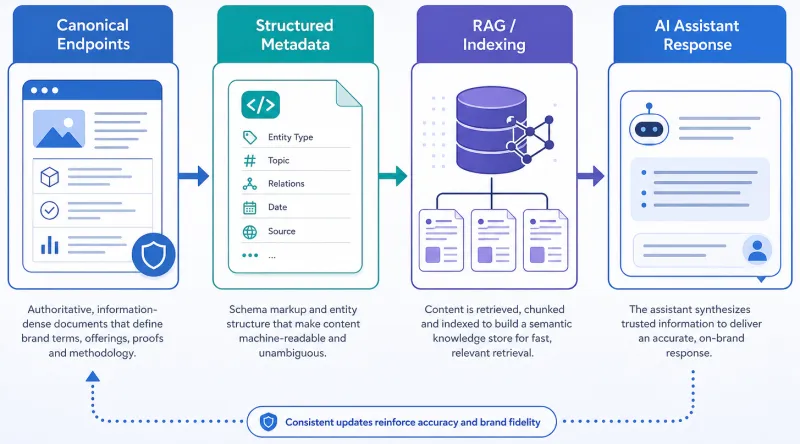
Key design principles for such documents: avoid metaphor and impressionistic language where facts are the point; use proprietary naming consistently and define it explicitly - clearly and without ambiguity - on first use in every document; structure information hierarchically so that the model can extract a coherent fragment from every level without losing the overarching meaning.
Canonical endpoints function as semantic anchors - they increase the probability that the model will return to the company's precise terminology rather than reaching for generic equivalents. The strategic decision for a brand leader is not a technology question: it is a question of which team within the organization owns the maintenance of these documents and on what update cycle.
Structured metadata and unambiguous entity architecture
The semantic layer of a website - structured data in schema.org format, knowledge graphs, unambiguous entity definitions - is one of the few mechanisms through which a company can communicate to machines not only what it offers, but how it should be categorized and with whom it should be compared.
An example: a company that defines its market in structured data as "orchestration layer for hybrid data architecture" rather than "data integration software" supplies the model with a categorization signal that may influence the terminology chosen in the synthesis. Similarly, precisely defining competitive relationships in a knowledge graph reduces the risk of an assistant pairing the brand with the wrong rivals - a real problem when the model lacks sufficient category context.
Structured metadata effectively becomes a document describing the brand in machine-readable language: it does not convey aesthetics, but it does convey the categorical facts that aesthetics were intended to illustrate.
Costs and limits of direct collaboration with AI providers
An idea circulates in agency circles that brands can form direct partnerships with model providers - OpenAI, Google, Anthropic - and thereby influence how their brand is represented in responses. This picture requires correction.
Model providers offer APIs (application programming interfaces) for building proprietary products, not mechanisms for editing responses to questions about specific brands. Influence over brand representation in generated syntheses happens indirectly: through the quality of publicly available data, through indexing by RAG (Retrieval-Augmented Generation - a technique that supplements a model's knowledge in real time by pulling current data from external sources) systems, and through publication in sources to which models assign high authority.
For most companies, the optimal budget allocation remains the systematic improvement of the structure and quality of publicly available knowledge assets - work on the open web, not negotiations with the algorithm as a black box.
Quantitative measurement of synthetic visibility
Traditional traffic metrics - sessions, bounce rate, time on page - do not measure the phenomenon that is actually unfolding. A user who learns about a brand from an AI assistant and never reaches the website is invisible in classical analytics. A brand can record stable organic traffic while remaining entirely unaware that its synthetic representation in the AI channel is consistently distorting it.
An evolution of the metrics toolkit is necessary.
Fidelity metrics
Fidelity metrics measure the deviation between an authorized brand narrative and the synthesis generated by AI assistants in response to intent-based queries. The goal is not a simple count of how many times the brand is mentioned by name. The focus is on precision: does the assistant reproduce the correct market category? Is the value proposition framed in line with the positioning? Is the tone of the synthesis neutral, positive, or pejorative toward key brand attributes?
Measurement requires the creation of a reference standard - an authorized, model answer for every strategic category query - and systematic comparison of actual assistant responses against that standard. This is analytical work, not technological: it involves classifying types of deviation, assessing their significance for brand strategy, and tracking how they evolve over time.

Designing audits and tests for AI assistants
The methodology for systematically auditing synthetic summaries rests on several principles. Test queries should replicate real user intentions at different stages of the decision process: from category awareness ("what tools for X exist?"), through comparative evaluation ("compare A and B on dimension Y"), to reputational queries ("what do users say about company Z?").
Tests should be conducted under controlled conditions - isolated sessions with no conversation history, across different models and assistants, with systematic documentation of prompts and responses. An open methodological question is model stochasticity: the same question in an identical session can produce a different response, which requires aggregating results across multiple trials rather than evaluating any single instance.
Audit results provide precise guidance for optimizing canonical endpoints: which narrative fragments survive compression and which are consistently eliminated or distorted.
The landscape after visual first contact
A brand that spent years designing its first impression as a controlled visual experience now confronts a reality in which that first impression is increasingly generated by an algorithm. Lossy compression eliminates distinctive positioning, reducing it to a dictionary category definition. Source collision blurs a carefully constructed hierarchy of evidence. Tone averaging neutralizes the emotional character of the communication.
The response to this situation does not lie in abandoning the visual identity of the website - that still holds value for users who do reach it. It lies in building a parallel information architecture designed with AI assistants as intermediaries: canonical endpoints as machine-readable identity anchors, structured metadata as a digital brand book for algorithms, systematic fidelity audits as the new standard for measuring branding effectiveness.
The same mechanism that strips brands of control over the first impression does, however, reward a specific type of content: precise, well-encoded, unambiguous knowledge documents. Brands that invest in categorical clarity and terminological consistency have a greater chance of their narrative surviving algorithmic synthesis recognizably - and reaching decision-makers who will never open a browser. This is a new visibility window: one built not on advertising reach or organic position, but on the quality of the information infrastructure.
Marketing directors who treat GEO as an SEO tactic with a fashionable prefix are right about the surface but wrong about the nature of the phenomenon. Generative Engine Optimization is, in essence, a new discipline of corporate data governance - the question is not how highly a company ranks, but how faithfully its identity survives algorithmic synthesis at the first contact with a decision-maker who will never visit the homepage.
The first authority window in the era of conversational assistants is not visual. It is textual, structured, and architectural. Brands that understand this difference and invest in the appropriate knowledge infrastructure before their category is dominated by a competitor better prepared informationally will gain a form of advantage that no amount of hero section redesigns can buy.