The biggest myths about AI optimization (GEO) that beginner marketers believe

Key takeaways
Effective action in an AI environment requires abandoning advertising habits shaped by decades of paid campaigns and keyword-based SEO.
-
Organic positions in AI assistant responses cannot be bought - generative systems have no price list for brands and ignore advertising budgets when formulating answers.
-
Changing content on a brand's own website does not automatically update AI model knowledge - without external validation in independent publications and industry media, a brand remains invisible to assistants.
-
GEO (Generative Engine Optimization) is a separate discipline, not rebranded SEO - high rankings in classic search engines do not automatically translate into brand presence in generative responses.
-
No one-time technical trick or plugin can guarantee lasting AI visibility - presence in model responses is built through the systematic delivery of credible, objective facts across the digital space.
-
Brand visibility in AI can and should be measured quantitatively - making strategic decisions without a measurement baseline means operating in the dark, regardless of budget size.
What is AI optimization (GEO) in the context of brands?
Before examining the myths, it is worth establishing clearly what this subject is actually about. Generative Engine Optimization (GEO) is the process of building substantive context around a brand in the external digital space, so that artificial intelligence systems - such as conversational assistants and generative search engines - can reliably recommend it in their responses.
It is the systematic delivery of objective, easily verifiable facts about a brand in places that AI models recognize as credible sources. It is not technical code manipulation or meta-tag modification. This simple definition is the starting point, because most costly mistakes arise from marketers beginning to act without understanding it.
More on this topic is covered in the article GEO - what it is and how AI optimization works.
The myths surrounding GEO have deep roots. Most marketers enter this area carrying ready-made mental frameworks shaped by years of working with Google Ads, SEO, and social media. Those frameworks were effective in the old environment - but in the environment of generative artificial intelligence, they work in the opposite direction to what is intended, directing budgets and energy toward places that produce no results whatsoever.
Myth 1: You can pay for a guaranteed position in AI assistant responses
The belief is intuitively understandable: if a top position in Google Ads can be purchased, why would the same not work in chatbots and assistants? Digital agencies quickly recognized this mental pattern and frequently offer "guaranteed AI visibility packages" as an evolution of familiar PPC (pay-per-click) campaigns. The problem is that such a product simply does not exist in a technical sense.
Why language models ignore advertising budgets
Generative systems, such as large language models (LLMs), formulate responses by analyzing the credibility and consistency of information available in their training data and in indexed external sources. They have no mechanism that accepts a payment and returns a higher position in a response - the architecture of these systems simply does not allow for it.
The right mental model: AI is an objective researcher, not a billboard - it seeks facts and independent opinions, not a space to rent. A researcher does not change their assessment of source credibility based on a budget - they change it based on the quality and number of corroborating pieces of evidence.
The correct model: digital PR instead of buying positions
The right course of action is digital PR and building expert authority in external, trusted media: industry publications, mentions in independent outlets, expert commentary in credible sources. These are the elements that create the factual context that AI models can absorb and use.
The business consequence is measurable: a company that spends a quarter paying an agency for "guaranteed chatbot positions" is spending its budget on a product that cannot exist. Those same funds invested in genuine PR activities would instead build an external context that permanently strengthens the brand's position in generative responses.
The exception: ads in AI assistants are not the same as a position in a response
It is worth noting one important nuance that can cause confusion. AI assistants such as ChatGPT are gradually introducing paid advertising formats - and it is indeed possible for a brand to appear in a chat window thanks to an advertising budget. However, the way these ads work is entirely different from a "guaranteed position in the response."
Sponsored content in AI assistants functions similarly to display banners on a website: it appears in the chat interface as clearly labeled content, separated from the actual response. The language model still formulates its response according to the same principles - it analyzes source credibility, cross-references facts, and is not guided by an advertiser's budget. The advertisement appears alongside that response, not inside it.
The distinction has practical implications. Paid exposure in a chat window is a classic attention purchase - the user sees the brand's message, but the assistant does not cite that brand as a credible source or place it higher in the body of its response. These are two separate layers: the advertising interface and the generative core. Conflating them leads to the mistaken conclusion that "AI can be bought" - when what can actually be bought is advertising space around AI, not its credibility assessment. It is possible that in the future these formats will become more invasive and begin to penetrate more deeply into the content generated by the assistant, but at the current stage, an ad in the chat window and an organic model response are two separate layers that do not influence each other.
Myth 2: AI automatically knows about changes on your website
This is one of the most common and most costly false assumptions. A company launches a new product, updates its product page, refines its "About us" section - and assumes that AI assistants will know about it. That is not how any of today's generative systems work.
Language models are trained on datasets collected within a specific time window. Even systems with the ability to search the internet in real time index selected, externally validated sources - they do not crawl company websites the way Google's bot does. The consequence: an innovative product described only on a brand's own website may remain completely invisible for months or years to consumers asking an assistant about solutions to their problems.
Where AI assistants really get their knowledge about brands
Models learn from high-quality external data: articles in industry publications, PR mentions, independent reviews, and analytical reports. A brand's own website is still an important source of structured information - owned content builds a factual base, while external sources increase its credibility and the chance of broader visibility in the AI environment. However, internal documents and sales pages written solely to rank the brand's own domain are far less influential for large language models than external confirmation of those same facts.

The practical implication: every change in a brand's offering that the brand wants to make visible in the AI environment requires parallel activity in the external digital space - mentions, expert articles, commentary in independent media. Rewriting the website alone is not enough.
Myth 3: AI optimization is just classic SEO under a different name
SEO and GEO are two fundamentally different mechanisms - although both disciplines concern visibility, they operate according to different principles. For marketers with experience in search engine optimization, the temptation is understandable: if SEO builds visibility in search engines, then "AI SEO" should build visibility in assistants - along similar lines. In practice, this is not the case.
Classic SEO optimizes content for specific keywords, keyword density, and the technical structure of a page. Google's ranking algorithm rewards, among other things, phrase matching and domain authority. Generative systems work differently: they analyze semantic relationships, the clarity of definitions, the objectivity of facts, and the consistency of information across different external sources. Text stuffed with keywords but sparse in specific, verifiable claims is, for a language model, a low-quality source.
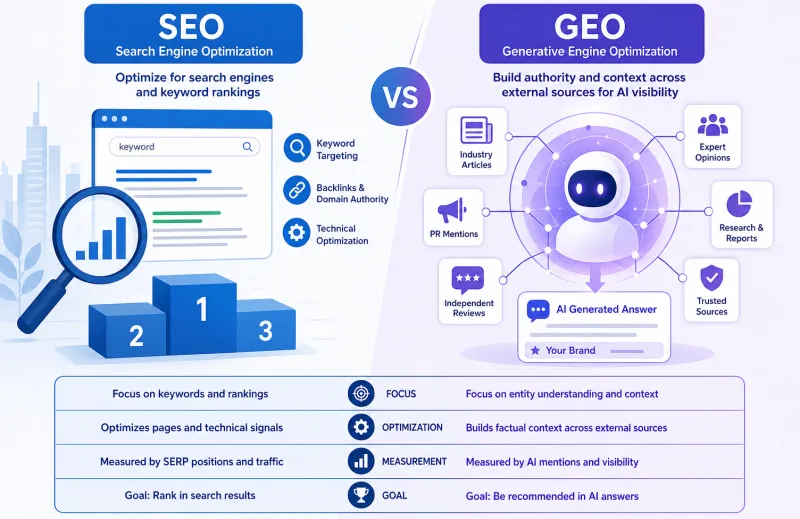
An example from the business world: an HR software company invests two years in classic SEO infrastructure - hundreds of blog articles saturated with phrases like "HR system" or "leave management software." It generates solid organic traffic from search. At the same time, its customers start asking conversational assistants: "What HR software would you recommend for a company with 50 employees?" Because the company has not built context in external, independent publications, the assistant has no basis to mention it - and instead mentions competitors with a stronger external profile, even if those competitors rank lower in Google.
High rankings in classic search and presence in AI model responses are two separate outcomes, requiring two separate strategies. It is entirely possible to have one without the other.
Myth 4: There is a quick technical trick that will guarantee brand visibility
Every new technology attracts offers promising immediate results. In the GEO ecosystem, proposals circulate for "AI-ready data structure audits," plugins that "optimize content for LLMs," and one-time "chatbot visibility implementation packages" - typically priced as a single service with a guaranteed outcome.
None of these solutions have a mechanism of action consistent with how generative models actually build and update their knowledge about brands.
Why GEO is a process, not a one-time plugin
AI models' knowledge of brands is dynamic - it evolves with every training data update, with every new publication indexed by the system. Competition does not stand still: it regularly supplies new, credible information that feeds those same models. A one-time audit carried out in October does not protect a brand from what a competitor publishes in December.
Lasting presence in AI responses requires ongoing work: systematically building external factual context, maintaining consistency of information across different sources, and responding to the changing informational needs of the market. This is a model closer to a long-term communications strategy than a one-time technical project.
Decision-makers who treat GEO as a one-time annual website audit typically discover that after the next major global model knowledge update, their position has returned to square one - or deteriorated, because the competition was active in the meantime.
The costly illusion: a story of a burned marketing budget
False assumptions about GEO have direct financial consequences - the following example shows how quickly costs accumulate when acting without measuring the starting point.
The following example is hypothetical but based on decision-making patterns observed in the market.
A mid-sized e-commerce company plans a quarterly AI visibility campaign. The marketing director, persuaded by two agencies, launches three activities in parallel: purchasing a "guaranteed AI assistant visibility package" for €1,200 per month, a one-time website audit for "AI compliance" costing €500, and a keyword-saturated blog campaign for €800 per month.
After the quarter, analysis reveals: traffic from Google increased slightly, but the company still does not appear in the responses of any of the tested assistants when asked about its product category. Total expenditure: more than €7,000 with no measurable result in the target channel.
The key mistake was not choosing the wrong tools - it was the absence of a baseline measurement. The team did not know what the brand's actual AI visibility was before starting, so it had no way to assess whether anything was working. Professional analytics platforms make it possible to measure this visibility quantitatively - which allows strategies to be verified and budgets rescued before permanent losses occur.
Before spending the budget: a simple assumptions audit before implementation
Before signing a contract with a GEO service provider, it is worth spending an hour verifying one's own assumptions. This is not an implementation guide - it is a set of questions that protects against ill-considered investments.
Manual visibility test in the browser
The simplest way to establish a starting point requires no tools at all. All it takes is opening any AI assistant and asking a few natural questions about the problems a brand solves - without using its proper name.
For example: "What software would you recommend for project management in a manufacturing company?" or "Which brands are considered leaders in the [product category] industry?" If the brand does not appear in the responses, this means it has not built sufficient external context - and no agency promising "guaranteed results" will change that overnight. This test establishes a raw, factual starting point for further strategy. This is precisely what a brand AI visibility audit looks like - inexpensive, yet delivering more actionable insight than many a paid agency report.
How to reject false agency promises
Warning signs in GEO provider proposals are relatively easy to recognize when the mechanism of generative systems is understood:
-
The offer guarantees a specific position or number of mentions in AI assistant responses within a defined timeframe.
-
The provider refers to "secret algorithms" or "internal relationships with AI model manufacturers."
-
The service is one-time and priced as a fixed-scope project with a defined end date.
-
There is no measurement indicator for results before and after the activity.
Each of these signals points to an offer that is inconsistent with how GEO actually works. Healthy skepticism toward guarantees of immediate results is not pessimism - it is budget protection.
Summary: moving from buying attention to building authority
The evolution of marketing in the era of generative systems comes down to one fundamental shift: from aggressively buying attention to patiently building factual context around a brand. This is not a change of tools - it is a change in the logic of action. Effective AI optimization requires measurement, external sources, and a clear distinction between GEO and classic SEO.

The four debunked myths lead to three mental models worth keeping as fixed reference points. First: AI is an objective researcher, not a billboard - no budget can buy a recommendation that can only be built through credible facts in external sources. Second: brand visibility in AI is the result of presence in the independent digital space, not the state of a website - a brand's own domain supplies structured facts, but without external confirmation those facts reach models with limited force. Third: GEO is an ongoing communications process, not a one-time technical project - its results are proportional to consistency, not to the size of a single investment.
The next step in the AI environment
Before any budget decision is made, one simple experiment is worth carrying out: open any AI assistant and ask three to five questions about a brand's own product category, the way a potential customer searching for a solution would ask them - without entering the company name. Check which brands appear and what context the assistant uses to describe them. This takes fifteen minutes and delivers concrete, actionable strategic knowledge: the brands that appear without prompting are the ones that have successfully built external factual context - and analyzing their presence is precisely the right place to begin planning a brand's own GEO activities.