Brand digital twins: The future of simulation in GEO

A vision of the future: Brand digital twins as the foundation of GEO strategy
For years, brands have built their visibility in the digital ecosystem through trial and error - publishing content, waiting weeks for feedback signals, and hoping that algorithms would reward their effort. In a world where generative AI engines increasingly replace traditional search result lists, this way of working is starting to resemble navigation without a map. This article is an attempt at forecasting - a vision of the direction that testing the impact of content on brand image in AI models might take. It does not describe the current state of things, but rather sketches the architecture of a future that appears to be the logical consequence of what is already becoming possible today.
A brand digital twin (brand digital twin) is a locally maintained simulation environment in which a miniaturized AI model - running on an organization's own servers, outside the cloud of external providers - replicates the recommendation mechanics of global generative engines. Instead of waiting for the market to react, a brand can first test its message in a controlled environment and only then release it into the public ecosystem.
The need for such a tool stems from one fundamental observation: the global AI ecosystem does not wait. Local simulation models deliver what external APIs cannot provide in the same mode - immediate, repeatable feedback on content tested in a controlled environment. Instead of sending a message to a public engine and waiting weeks for organic feedback signals, a brand can check within minutes how a trained model - calibrated to reflect the mechanics of global generative engines - responds to its message, interprets its positioning, and whether it regards the brand as a credible point of reference at all.
It is precisely this speed of verification that changes the rules of the game. In the era of GEO (Generative Engine Optimization, meaning the optimization of content for AI-generated answers), every day without feedback is a day on which a communication strategy is effectively blind. A brand digital twin transforms that uncertain waiting period into an iterative testing process - where each version of a message can be verified, refined, and tested again before it enters the public ecosystem.
How miniaturized AI models predict the decisions of global algorithms
A local AI model does not copy a global system - it simulates its content evaluation logic. That is a crucial distinction: the aim is to replicate decision-making patterns, not to reproduce the entire architecture.
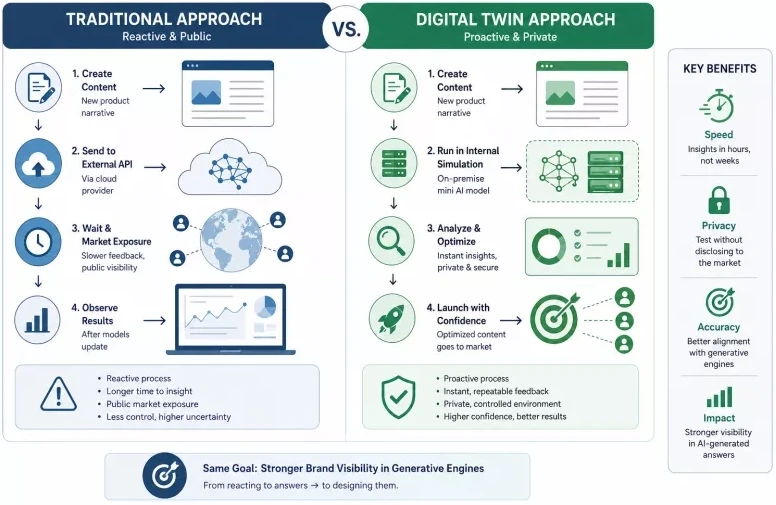
Consider two models of responding to the same situation. In the first scenario, a marketing team prepares a new product narrative, sends it through an external API to a cloud provider's model, and observes the results - publicly, with full market exposure and with a longer wait time before results appear (models first need to update their information about the brand). In the second scenario, that same narrative goes first to an internal simulation environment, where a miniaturized AI model analyzes its structure, evaluates the strength of its argumentation, and predicts how similar content would be treated by global recommendation engines.
The difference between these two approaches is not just a matter of speed. It is a fundamentally different philosophy of brand management - a shift from reactively tracking results to proactively designing credibility.
Miniaturized on-premise models (running on an organization's own servers) are not copies of tech giants. They do not need to be. Their value lies in their ability to replicate the decision-making logic of those systems - the patterns by which content is assessed as more or less credible and useful for a user seeking answers. Such a local model functions like an advanced early-warning radar: it does not see everything, but it sees enough for a marketing team to test hypotheses before the material reaches a public audience.
Understanding the signals: intent, ranking, and localization
The usefulness of such a simulation depends on one key factor - the fidelity of the replication. A local model must replicate not only what algorithms see, but above all how they interpret the inputs they receive.
Three elements are fundamental here. The first is user intent - the question a system asks in response to a query. Is the user looking for a definition, a comparison, a solution to a problem? Content that accurately addresses the dominant intent is favored by generative models. The second element is contextual signals - the circumstances of the query, the session history, and the semantic relationships between concepts. The third is the ranking mechanism: the way in which a model assigns credibility to specific sources and arguments.
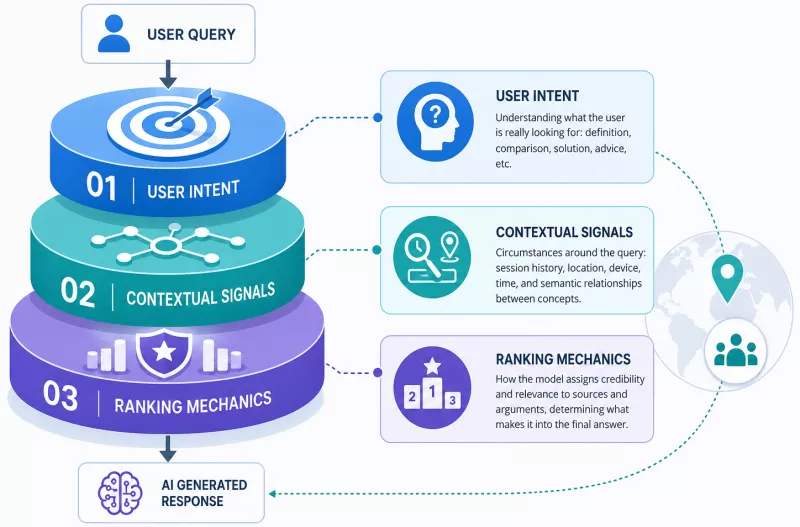
Only correctly mapping these three layers allows a brand to see which parts of its communication actually break through into AI's final answers - and which are filtered out as low-relevance or poor quality. Localization adds yet another dimension: the same sentence may be interpreted differently by a model calibrated for the English-speaking Nordic market and by one adapted for a Spanish-speaking audience in a metropolitan region.
Generative Engine Optimization (GEO) in a safe sandbox
Optimization for generative engines differs from classical SEO (Search Engine Optimization) in one fundamental respect - the output is not a ranking of links but a synthesis of information. In the context of brand digital twins, this difference is critical: an AI model does not display a list of pages; it responds, selecting and composing information from sources it considers credible and well-structured.
This changes everything about how content is designed. And it is precisely here that the closed simulation environment acquires an almost laboratory-grade value. A team can examine how a model synthesizes the information it has been given: whether it pulls a specific phrase into an answer or skips it; whether a particular content structure - headings, bullet points, definitional sentences - increases the likelihood of being cited; and how changing the tone or the length of a paragraph affects the way it is interpreted.
Equally important, these experiments take place without revealing the brand's hand to the market. No one outside the organization can see that the brand is testing alternative framings of its message, different argumentative architectures, or different ways of defining its value proposition.
From defense to proactivity: New competencies for marketing teams
Brand managers have long worked with the feeling that a large portion of their effort disappears into the black box of algorithms and returns - or does not return - in the form of results that are difficult to plan for in advance. A brand digital twin offers a way to replace that feeling with something concrete: the ability to verify assumptions before they are deployed publicly.
This is not just psychological comfort. It is a real strategic advantage. Decisions about communication tone, the selection of key arguments, and content structure no longer have to rely solely on intuition and historical analogies. They become the outcome of an iterative testing process in which every hypothesis can be confronted with a model's prediction before it consumes budget and team time.
Rapid A/B tests before a global campaign launches
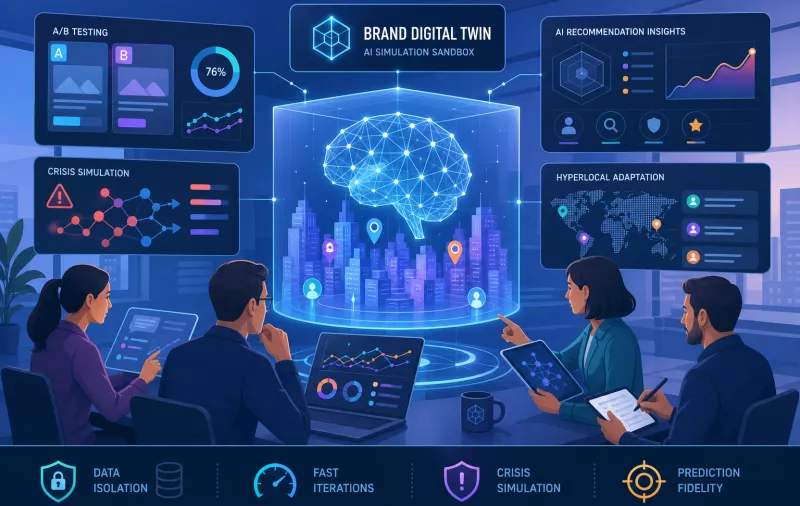
A classic A/B test in a campaign context takes time - time to publish, gather data, analyze, and draw conclusions. In a simulation environment, that cycle is dramatically shortened. In a single working session, a team can modify the argumentation, change the tone, rearrange the order of sections, and immediately compare how each version is evaluated by the local model.
The key advantage here is data isolation and independence from external update cycles. Global AI engines change constantly - new versions, new filtering layers, new content priorities. An organization with its own testing environment does not have to wait for the market to reveal the effects of those changes on its own results. It can simulate and adapt ahead of time. On top of that, there is the confidentiality aspect: sensitive campaign data, communication strategies, and the positioning of new products remain entirely within the organization.
Simulating PR crises behind closed doors
Managing a reputational crisis has always involved an element of uncertainty - it is never clear how quickly a negative narrative will come to dominate the information space, or how to respond without making the situation worse. A brand digital twin makes it possible to reverse that logic.
Disinformation or hostile narratives can be deliberately introduced into the simulation environment, and the model's reaction observed - which sources and arguments begin to dominate in the synthesized responses, which phrases start to become associated with the brand, and in what direction its overall credibility score evolves. On that basis, an organization can prepare a defensive communication strategy in advance: specific formulations, structured facts, and corrective narratives capable of competing with disinformation in the generative space. When the real crisis arrives, the response is ready - tested, not improvised.
Hyper-local message adaptation at micro scale
Global brands have repeatedly learned that communication effective in one region can be neutral or even counterproductive in another - not because of translation errors, but because of subtle differences in how local users formulate questions and which types of answers they trust.
Miniaturized AI models can be calibrated for specific linguistic and cultural markets, making it possible to verify how regional nuances influence the way content is interpreted by local variants of generative engines. For a brand entering a new market, this means being able to test message adaptations with minimal risk - without the need for costly pilot campaigns and without exposing the strategy to local competitors.
The illusion of free testing: What simulation fidelity actually costs
The greatest cost of implementing a brand digital twin is not the initial setup - it is the ongoing calibration and validation that determine whether the simulation remains useful.
This is where the hard side of the concept begins, and it deserves an honest look. A brand's own digital twin is not a one-time investment. Nor is it a guarantee of unlimited, cheap testing. It is a continuous commitment that demands regular input of resources, attention, and budget - otherwise it becomes a tool that creates a false sense of security, which is worse than having nothing at all.
The fundamental problem is model drift. Global AI engines evolve at a pace that local simulation environments do not automatically track. Every update to a public model can change the way it evaluates content structures, source credibility, or semantic dependencies. This is not only about fundamental changes - even minor adjustments in how a brand is indexed or how contextual signals are weighted can cause the twin to point toward false optima. An organization that does not invest in regular calibrations of its twin will quickly find that it is testing communication effectiveness against a model that increasingly diverges from market reality. Simulation results stop correlating with the actual behavior of production systems - and the entire investment loses its business justification.
From vision to pilot: How to prepare an organization for its own digital twin
A brand digital twin pilot has one primary goal: to confirm whether the local model's predictions correlate with the actual behavior of public generative engines at a level high enough to justify communication decisions.
Every well-designed pilot begins with clarity about what it is meant to prove - not what it is meant to deploy. For a brand digital twin, this means one fundamental question: do the local model's predictions correlate with the actual behavior of market generative engines at a level high enough to justify communication decisions?
If the answer is yes - the pilot opens the path to broader implementation. If not - the organization gains an important piece of information: either calibration requires more work, or the concept is not yet mature enough in the given business context. Both outcomes are valuable, provided the pilot is designed rigorously.
At the organizational level, effective implementation requires something harder than purchasing technology: abandoning siloed thinking. IT, brand strategists, and data analysts must work in the same rhythm - not exchanging reports, but co-creating test scenarios and interpreting results together.
Selecting hard metrics and correlation indicators
The measure of a pilot's success is correlation - the statistical alignment between what the local model predicts and what actually happens in the public AI ecosystem. The team should define that measure before tests begin, not after.
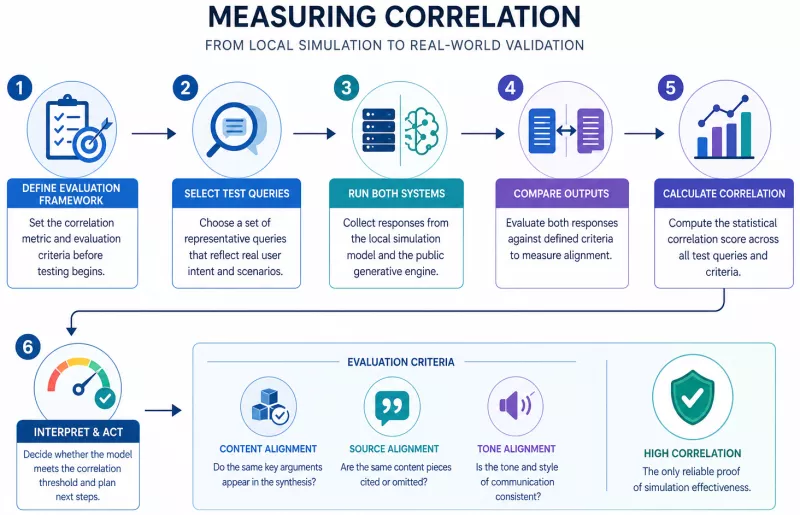
In practice, this means selecting a set of specific test queries for which the organization collects both the local model's response and the response of a public generative engine. Those two outputs are then compared against established criteria:
-
Do the same arguments appear in the synthesis?
-
Are the same content fragments cited or omitted?
-
Are the tone and style of communication aligned?
A high level of correlation across that test set is the only honest proof that the simulation is working. Everything else is intuition.
A new division of roles between marketing and technology
In the target operating model, IT acts as the guardian of the environment - responsible for security, performance, and system continuity. But it is brand strategists who must take ownership of what is being tested and how results are interpreted.
This represents a meaningful shift in authority. Ownership of the simulation environment - defining test scenarios, prioritizing research questions, assessing the accuracy of predictions - should rest with those who understand the brand's strategic objectives. Technology creates the possibility; it is marketers who decide whether that possibility is converted into a real competitive advantage.
The future of optimization: Readiness for a new brand management architecture
The concept of brand digital twins is not yet a market standard. It is a direction - and there is value in moving toward that direction early, because organizations that build analytical competencies and a culture of iterative testing before the technology matures to full implementation will be in a far stronger starting position.
What does this mean in concrete terms for marketing teams today? First, education - understanding what GEO is and how generative AI engines make decisions about content synthesis is the foundation without which no pilot will yield meaningful conclusions. Second, building an analytical framework: defining what questions an organization would want to ask its own digital twin, which test scenarios carry business value, and what metrics will form the basis of evaluation.
Four pillars must stand together for the entire architecture to make sense:
-
Data isolation - sensitive strategies remain within the organization
-
Rapid message iteration - tests measured in hours, not weeks
-
Crisis simulations - a response ready before a crisis arrives
-
Prediction fidelity - regular validation of correlation with the public ecosystem
GEO will evolve. Generative engines will become an increasingly important point of contact between brands and their audiences, and the pressure to understand the mechanics of brand visibility in AI - not merely to observe it, but to actively shape it - will only grow. In that context, brand digital twins may become not a technological curiosity but a standard element of the strategic toolkit.
Every in-house simulation, however, only makes sense when its results are regularly compared with what is actually happening - in the public AI ecosystem, in the real answers generated for real users. That requires precise, quantitative measurement of brand visibility in the external world. Advanced analytics platforms such as Brandinai make exactly that possible - providing hard data on brand presence in AI-generated answers, without which even the most meticulously calibrated digital twin remains an island cut off from the mainland.