How to optimize your 'About us' page so AI models accurately understand your company's uniqueness

Why company "About us" pages disappear from AI results
Most "About us" pages are collections of sentences that sound good to the human ear but communicate nothing to an algorithm. Phrases like "we are a leader in innovation", "we put the customer at the center", or "we build relationships based on trust" are messages optimized for emotion - and that is precisely why language models have a serious problem with them.
Large language models (LLMs) do not interpret text the way a human does. They do not pick up on a sentence's poetic intent. They look for patterns, entities, attributes, and conceptual relationships that can be mapped onto their internal knowledge representation. When an "About us" page consists entirely of corporate rhetoric, the model either skips it as low in information value or - more dangerously - fills in the gaps with its own interpretation.
The consequences are concrete. A model generating an answer to the query "which companies offer fleet management software?" may simply overlook a company whose page contains no clear, machine-readable signals about that specialization. Worse, it may assign incorrect attributes to that company - confusing it with a competitor, overstating or understating the scope of its offering, or miscategorizing its target market. In an AI-generated industry comparison, there is no room for a "brand story" - there is room for companies whose identity is unambiguously encoded in available sources.
The "About us" page is effectively the brand's primary reference document - one of the few places on the web where a company has full control over what it says about itself. The problem is that most organizations treat it as a mandatory layout element rather than a strategic source of signals for AI systems.
Text written for emotion versus text rich in facts is not a question of style - it is a choice between invisibility and representation. In other words: optimizing the "About us" page for language models is not an editorial option but a condition of the brand's presence in AI-generated answers.
Semantic vectors: how machines read brand identity
Before moving to optimization, it is worth understanding what actually happens to page content after a model has "processed" it. This is not indexing in the classical SEO sense - the mechanism is different.
Language models transform text into semantic vectors (also called semantic embeddings) - multidimensional numerical representations that encode the meaning of words, sentences, and entire paragraphs. The simplest analogy is a concept map: every word and every sentence lands in a specific position on that map, near semantically related concepts. A company described as "a B2B software provider for purchasing process automation" lands in a completely different position on that map than a company described as "an innovative organization supporting digital transformation" - even if both offer an identical product.
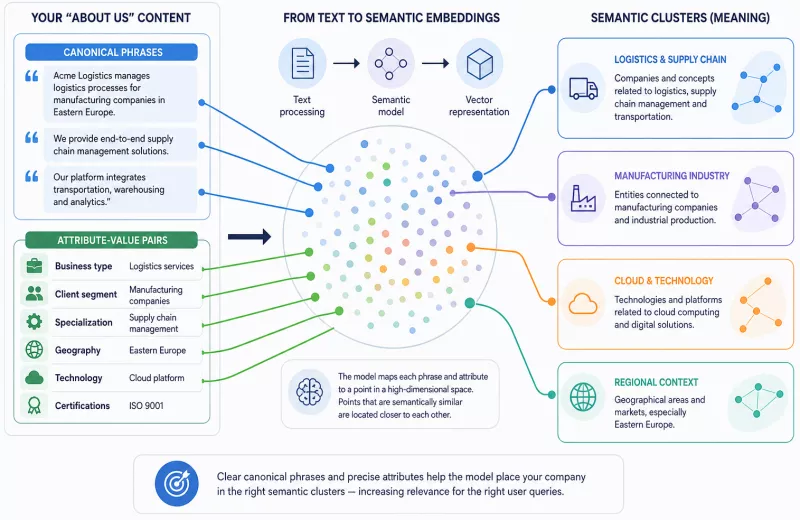
This "position on the map" determines for which user queries the model will consider a given company relevant. That is precisely why the quality and precision of the content on the "About us" page has a direct impact on whether the brand appears in AI-generated answers at all.
From corporate poetry to hard attributes
Embedding-friendly attributes are unambiguous, concrete characteristics of a company that a model can associate with a specific category, industry, or function. They are not assessments or promises - they are facts describing what a company is and what it does.
The distinction matters. The sentence "we are a leader in the field of modern logistics solutions" contains an assessment (leader), a metaphor (modern), and a general concept (logistics solutions). The model does not know what that means in practice. By contrast, the sentence "the company provides supply chain management services to FMCG manufacturers in Poland and Central Europe" contains attributes: service type, customer segment, geography. These are signals the model can map and use.
Replacing vague generalities with attribute-value pairs is the basic operation of any AI optimization effort. Examples of such pairs:
-
Business type: SaaS software
-
Customer segment: SME-sector companies
-
Specialization: invoice automation
-
Market: Poland, Czech Republic, Slovakia
-
Core technology: Microsoft Azure cloud computing
Canonical phrases as the foundation of understanding
Canonical phrases are concise, repeatable sentences that define the core of a company's activity. They act as anchor points for the model: when they appear multiple times across different parts of the page in a consistent form, the model treats them as a reliable, credible signal about brand identity.
A good canonical phrase meets three criteria: it is short (one or two sentences), it is grounded in concrete facts rather than metaphors, and it retains its meaning when taken out of the page's context. Example: "Acme Logistics manages logistics processes for manufacturing companies operating in Eastern European markets." - that sentence can be lifted from any paragraph and remains fully understandable on its own.
The risk of omitting such sentences is real: a model that finds no clear, repeatable description of a company will construct its own - based on fragmentary clues scattered across the page - which leads to inconsistency and potential errors in the brand's representation.
The importance of entity lists in building context
Language models build brand context partly through the identification of entities - specific proper nouns: products, services, technologies, partners, markets. The more explicitly these are named, the lower the risk that the model will confuse them with a competitor's offering or lose them against the general industry background.
The "About us" page should include an explicit list of key entities: product or module names, technologies used, market segments served, certifications, partnerships, and geographic coverage. This does not have to be a bulleted list placed immediately under a heading - it can be woven naturally into the text - but it must be clear and unambiguous. Avoiding proprietary product names in favor of generic descriptions is one of the most common mistakes that makes it harder for models to correctly assign attributes to a specific brand.
Deconstructing the mission: from generalities to signals for language models
Transforming a traditional mission statement into an AI-friendly structure does not mean removing it or replacing it with a dry table. It means breaking it down into component parts and rebuilding it in a form the model can process without guesswork.
A typical corporate mission statement looks something like this: "Our mission is to support businesses in digital transformation by delivering innovative solutions that create lasting value for customers and stakeholders." That sentence is grammatically correct and sounds professional. But what does it actually convey? Who are the customers? What solutions? What does "innovative" mean? The model cannot resolve any of this.
Reducing the vision to key parameters
The first step is isolating the key differentiators - ideally four to eight - from the mission text and offer descriptions. The goal is not to shorten the mission but to extract from it the data the model can interpret unambiguously.
From the example mission text, the following parameters can be drawn:
-
Customer type: businesses (lacking precision → needs supplementing)
-
Scope of activity: digital transformation (too vague → needs specifying)
-
Form of offering: "solutions" (undefined → needs concrete products/services)
Each of these parameters becomes a starting point for formulating a more precise statement. If the company delivers document workflow software for the financial sector, that specific fact should appear in one of the canonical sentences - not hide behind the abstraction of "digital transformation."
The result of this process is a set of four to eight concrete parameters describing: industry specialization, offering type (product/service/platform), customer segment, geography, core technology, and measurable scope of activity. These parameters do not replace the mission - they become its analytical backbone, visible in the page content.
Building statements and attribute-value pairs
Based on the extracted parameters, canonical sentences are formulated: simple declarative statements, free of complex syntactic constructions and evaluative adjectives.
Complex marketing promise: "We offer advanced, scalable enterprise-grade solutions that revolutionize the way modern organizations manage their processes."
Canonical sentence: "The company provides SaaS software for HR process automation to enterprises employing more than 500 people."
The difference is clear. The first sentence serves a rhetorical function - the second serves an informational function. For a language model, only the second provides useful data. It is also essential that the canonical sentence retains its meaning independently - without reading the rest of the page. That property is precisely what determines whether the model correctly encodes the company's identity or is forced to interpolate from incomplete cues.
Information architecture on the page: where to place GEO signals
GEO (Generative Engine Optimization) is a set of optimization practices aimed at making content not only readable for humans but also well-processed by generative models. In the context of an "About us" page, this means deliberately placing semantic signals in specific zones of the document.
Every subpage has several layers in which brand signals operate most effectively: heading hierarchy, the opening text lead, bulleted blocks, the FAQ section, and invisible metadata. Neglecting any of these layers weakens the coherence of the entire message.
Headings and microcontent designed for AI
Heading hierarchy (H2, H3) serves a dual function: it structures content for the reader and sets semantic priorities for the model. Headings should contain concrete terms describing the company's activity - not marketing slogans. Instead of a heading like "Our philosophy", something like "Specialization and scope of services" or "Who we work for" will perform better.
The first sentence under each heading should contain a direct answer to what the heading suggests - especially when the heading poses a question. Language models, when looking for passages to compile into results, more frequently reach for the first sentences following headings, because those sentences are more likely to carry a definition than the middle of a paragraph. If that sentence contains a canonical phrase, the risk of incorrect extraction drops.
For bulleted blocks, a similar rule applies: each item should be informationally self-sufficient. A bullet point reading "We serve more than 300 companies from the e-commerce sector in Poland and Germany" is far more valuable to the model than "Experience and a broad client portfolio."
It is also worth using full brand and product names on first use within each new content block. A model processing text in fragments must be able to unambiguously assign attributes to the correct entity - without having to refer back to earlier paragraphs.
FAQ as a mine of direct answers
The FAQ (Frequently Asked Questions) section is one of the most effective zones from a GEO perspective. Its format - a question followed by a direct answer - perfectly mirrors the way generative models construct their responses for users.
Questions in the FAQ should reflect real queries that users might type into a search engine or chatbot: "Which companies is this software designed for?", "In which countries does the company operate?", "What technologies are used in the platform?". Answers must be concise - one or two sentences - and draw directly on the established canonical phrases.
The FAQ section loses its informational value when answers become vague instead of delivering concrete data. The answer "Our platform is suitable for companies of any size that want to grow their digital presence" is useless to the model. The answer "The platform is designed for companies with 50 to 500 employees operating in the B2B services sector" is not.
The invisible layer of the page: Schema.org and metadata
Optimizing visible content is a necessary but insufficient condition. Structured data according to the Schema.org standard is a technical confirmation of what the company declares in its text - and an additional source of signals for models that operate on data from multiple layers of a page.
For an "About us" subpage, the recommended Schema.org types are Organization with attributes such as name, description, url, foundingDate, areaServed, knowsAbout, makesOffer, and - where applicable - hasCredential for certifications and memberOf for industry affiliations. A correctly implemented brand knowledge graph in JSON-LD (JavaScript Object Notation for Linked Data) format not only makes it easier for models to verify the company's identity but also reduces the risk that a model will incorrectly synthesize information from various inconsistent external sources.
The page meta description should contain at least one canonical phrase and two to three key brand attributes. This is not merely an SEO element - it is another point of contact at which the model can confirm the consistency of the signals.
Authority and team signals
AI models assess the credibility of a source not only on the basis of content but also on the basis of identifiability signals - that is, whether the company is backed by specific, identifiable people with documented expertise. An anonymous company with no names or competencies is difficult for a model to distinguish from an entity with no history.
It is worth ensuring:
-
full names of founders or key specialists,
-
their specific roles and areas of competence,
-
education, certifications, or publications,
-
links to profiles (e.g. LinkedIn) that the model can treat as external confirmation.
Example of a weak entry:
"Our team consists of technology enthusiasts with years of experience."
Example of an AI-optimized entry:
"The company was founded by Marta Kowalczyk, a software engineer with a doctorate in computer science from Wrocław University of Science and Technology, and Tomasz Drejer, an AWS Certified Solutions Architect with 14 years of experience in the financial sector."
Such a sentence creates a network of entities - person, institution, certification, industry - that the model can connect with other fragments of knowledge and correctly place the company in the appropriate expert context.
How to check whether AI correctly understands the brand
After rebuilding the "About us" page, the natural question is: what is the effect? Evaluation does not have to be complex - a few repeatable operations are enough to compare the old and new state of the brand's representation in AI models.
The starting point is a set of neutral test prompts - questions posed to the model in a way that does not suggest an expected answer. Examples:
-
"What does the company [name] do?"
-
"Which customers are [name]'s services intended for?"
-
"In which industries does [name] operate?"
-
"What technologies does [name] use in its platform?"
The model's answers are then compared against the canonical sentences established as a reference point. The primary criterion is attribute accuracy: did the model correctly identify the type of activity, customer segment, and geography? Did it assign any incorrect characteristics to the company, or confuse it with a competitor?
A useful complement is a simple assessment of the model's responses along three dimensions: precision (are the attributes correct?), completeness (does it cover the key differentiators?), and consistency with brand identity (are there any incorrect attributions?). Scoring each question on a scale of one to five allows for comparison across page versions without the need for advanced computational methods.
Regular monitoring of these results - even on a quarterly cycle - provides data on how the brand's representation in AI models evolves and where signals need to be supplemented.
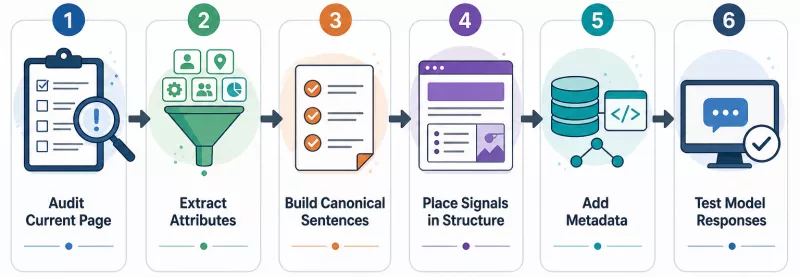
Action map: 6 steps to an AI-readable "About us" page
The following steps form a concise operational plan - a starting point for implementation, not a detailed how-to guide.
-
Audit the current page. Review the existing content and identify passages built on emotional marketing language - generalities, metaphors, promises without concrete data. Mark them for replacement.
-
Extract attributes. List the company's concrete characteristics: the type of services provided, the customer segment served, geographic coverage, technologies, years of experience, and key partners. This is the raw material for AI models.
-
Build canonical sentences. From the collected attributes, formulate several short, unambiguous sentences that define the core of the company's activity. Each sentence should work independently - without the context of the full page.
-
Distribute signals throughout the structure. Introduce canonical phrases and entity lists into headings, section leads, and bulleted blocks. The page should communicate key information at the level of its content architecture alone.
-
Complete the metadata. Add or update structured data (Schema.org) and meta tags so that the machine-readable layer of the page is consistent with the content visible to the user.
-
Test model responses. Submit a neutral test prompt to a chosen language model - for example, "What does company X do?" - and compare the response with the prepared canonical phrases. Discrepancies indicate areas that require correction.
Building consistent brand authority in the age of AI search
Transforming an "About us" page from a marketing essay into a structured source of semantic signals is not a one-time project - it is a change in approach to what this document is and whom it serves.
Language models are increasingly becoming the first point of contact between a potential customer and a description of an offering. A company whose identity is encoded in an unambiguous, repeatable, and structurally consistent way holds a real advantage over competitors operating in corporate jargon. Not because the algorithm "likes" it more - but because it provides data the algorithm can use without guesswork.
The key operations covered in this article come down to a handful of concrete actions: replacing metaphors with concrete attributes, extracting four to eight key differentiators from the mission text, formulating canonical phrases that retain meaning independently, explicitly listing entities (products, technologies, markets), and saturating all layers of the page - headings, leads, FAQ, and metadata - with consistent informational signals.
The measurable success criterion is straightforward: after rebuilding the page, AI models should correctly and consistently answer basic questions about the company - its specialization, customer segment, and geography - without assigning incorrect characteristics or confusing it with competitors.
The "About us" page is a living document, not an artifact. AI models are updated, new data sources are indexed, and the market context changes. Regular testing using the evaluation framework described here, and iterative adjustment of content based on the results, is not optional - it is the standard for maintaining brand visibility in systems that are increasingly replacing traditional search engines as the gateway to information.