Ads in LLMs: Are paid recommendations in AI the future?

Why ads in AI assistants are only a matter of time
Every new communication technology goes through the same cycle. It arrives as something entirely new, draws attention through the purity of its experience, and then - when costs grow faster than revenue - starts looking for sponsors. That was true of radio, television, web portals, and search engines. AI assistants are now at exactly the same point where Google stood at the turn of the millennium: a growing user base, enormous infrastructure to maintain, and investor pressure demanding profitability.
For marketing and brand managers, this means one thing: the playing field for brand visibility is changing in a fundamental way. More and more users, instead of typing a phrase into a search engine and browsing a list of links, are asking an AI assistant a question and waiting for a ready-made answer. They are no longer searching for pages - they are looking for recommendations. This shift in consumer behavior is not yet universal, but its direction is clear: each successive generation of users reaches for a conversational interface more often than the previous one. Advertising budgets that today flow toward search engines may soon need to find their place in the chat window too - because that is where purchasing decisions are increasingly beginning.
This article examines how ads in LLMs and paid recommendations in AI may work - and what this shift means for the organic visibility of brands.
What "Ads in LLMs" are and how they differ from traditional advertising
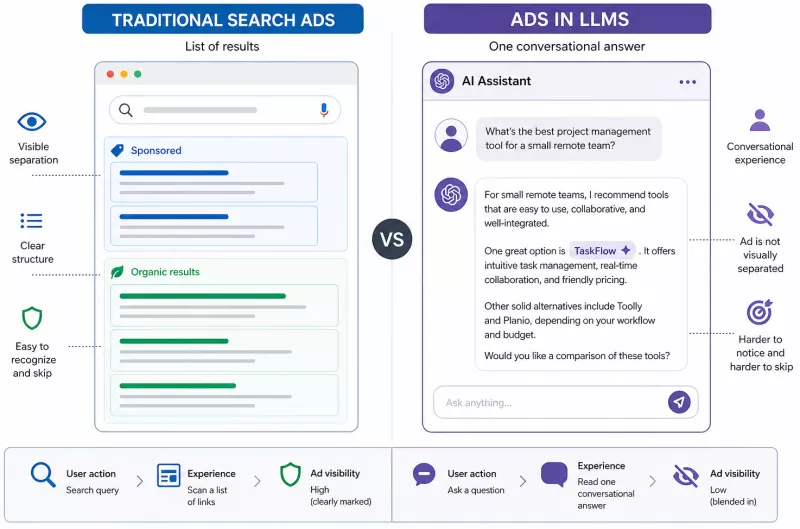
Ads in language models (or Ads in LLMs, where LLM stands for Large Language Model) involve placing commercial content directly inside responses generated by AI assistants. The difference from traditional search is fundamental - and concerns above all the moment at which the user makes a decision.
In Google, a user types a phrase and receives a list - a few paid results at the top, highlighted and separated from the organic ones. The mechanism is visible, familiar, and easy to skip over. In an AI assistant, the user holds a conversation and receives a single, fluid, personalized response. There is no list. There is no numbering. There is a narrative - and it is precisely into that narrative that a recommendation for a specific product, service, or tool can be woven, without any visible break in the text.
This is a paradigm shift: from a static list of links to a conversational interface where the boundary between objective advice and a paid message becomes structurally invisible. That is precisely what makes this topic so important - and so delicate at the same time.
The cost of running LLMs and the pressure to monetize AI assistants
Training and operating large language models is one of the most expensive technological undertakings in history. Industry estimates consistently indicate that the cost of a single AI assistant response is many times higher than displaying a traditional search result. With millions of queries per day, that difference translates into hundreds of millions of dollars in annual operating expenses.
Individual user subscriptions and revenue from business API (Application Programming Interface - a programming interface that enables integration) integrations cover part of these costs, but technology market analysts agree: for platforms with mass-market ambitions, this model is not sufficient. The free tier of the product - critical to growing the user base - requires a different source of funding.
Hence the first, low-profile tests of advertising formats in the free versions of popular assistants. According to industry reports, at least one leading provider (ChatGPT - official blog post) began exploring this path in its free version - quietly, without announcements, in the manner typical of a market-response testing phase. This is a classic pattern: a silent pilot first, then scaling once the model proves itself.
The history of search engines suggests what to expect. Google operated without advertising for its first few years. When it launched the AdWords program in 2000, the industry reacted with skepticism. Today, paid search results generate the majority of Alphabet's revenue. The pace in the world of AI will likely be faster - economic pressure is stronger, and the lessons of internet monetization have long since been internalized by the industry.
New interaction formats: From a discreet suggestion to a promoted plugin
A conversational platform is an entirely different environment from a search results page. There is no room for a banner. There is no sidebar. There is only text - and it is precisely this constraint that forces creators to develop new, more subtle formats for presenting commercial content.
The most likely approach is integration at the narrative level: an assistant's response that naturally leads toward a specific solution. Not as an interruption, but as part of the advice itself. This is fundamentally different from the visual aggressiveness of display advertising, and it is precisely what makes this format simultaneously attractive for advertisers and potentially problematic for users.
Built-in product and tool recommendations
Imagine a conversation with an AI assistant about managing a small team. The question is how to improve communication in a hybrid work environment. The response describes several approaches, discusses common pitfalls, and then - completely seamlessly - mentions that users often reach for a particular project management tool that handles these scenarios well. A link. A brief description. The context fits perfectly.
Is this an organic recommendation because the algorithm judged this tool to be the best? Or is it a paid suggestion? Without a clear label, the user has no way of knowing.
A second format is promoted plugins or extensions within assistant ecosystems that have a developed integration marketplace. An advertiser pays for its tool to be actively suggested in response to specific categories of queries - not as the result of a quality evaluation, but as purchased visibility within the user's specific intent context.
Both formats share a common feature: they are designed not to interrupt the flow of the conversation. That is their strength from a UX (User Experience) perspective. It is also their primary risk from a trust perspective - a brand associated with an unclearly labeled recommendation may face reputational consequences, regardless of whether the contextual fit was accurate.
Transparency and the separation of organic from paid results
Advertising regulations in most jurisdictions - from EU directives to FTC (Federal Trade Commission - the US body that regulates commercial practices) guidelines - require unambiguous labeling of commercial content. This is not optional; it is a legal obligation. The question is therefore not "will there be labels" but "what will they look like and will users actually notice them."
In a conversational interface, subtle "sponsored" annotations may be easier to miss than on a search results page. Research into blind spots in the perception of digital advertising shows that users learn over time to ignore fixed visual elements. When text is woven into a narrative, the distinction becomes even harder to detect.
For brands and managers responsible for share of voice (the proportion in which a brand appears in a model's responses compared to competitors), this creates a new tension: the organic brand visibility in AI, built over years through GEO (Generative Engine Optimization - optimizing content and brand presence for AI assistants) activities, could be displaced by a competitor's paid recommendations. And without adequate measurement tools, a brand may not even know when that is happening.
Market mechanics: How brands will buy attention in the chat window
The market for advertising in AI assistants will not emerge in a vacuum - it will be shaped by the relationships between model providers and the companies that already control a large share of the internet's advertising infrastructure. Technology partnerships may prove more important than open auctions, at least in the beginning.
Auction models versus closed technology partnerships
The classic auction model familiar from search advertising assumes that advertisers bid in real time for placement on a specific query. In the conversational world, the mechanics are similar, but the space is radically more constrained. A Google results page can accommodate several paid positions. In a chat window, there is room for one - perhaps two - discreet messages. Inventory (available advertising space) is structurally scarcer.
This translates into higher prices for high-intent queries and - likely - a phenomenon already visible on other closed platforms: exclusive partnerships between AI providers and large advertising players, which may for a time block smaller entities from accessing the most valuable inventory.
A plausible scenario: a leading AI assistant provider signs a multi-year agreement with one of the major advertising networks, granting it priority in serving commercial content. The open auction - if it exists at all - covers only the remaining inventory. For brands without access to that network, or without budgets allowing participation in an exclusive program, paid visibility may be out of reach for years.
The fight for visibility: Local businesses versus global FMCG
Large global brands in the FMCG (Fast-Moving Consumer Goods - high-turnover everyday products such as food, cosmetics, and household goods) category will naturally dominate broad, generic queries. A question asking for a recommendation for a shampoo for dry hair will generate recommendations from brands with global reach and the budgets to bid aggressively.
But AI assistants are contextual by nature. And this is where an opportunity opens up for smaller players.
A local café in Paris has no chance in a bidding war for the phrase "best coffee." It does, however, have a real opportunity for visibility on a query like: "where to get good coffee in a quiet neighborhood in Paris on a rainy afternoon" - if its data is well structured, its presence in local ecosystems is consistent, and the AI model has reasons to recommend it. Contextual precision and hyperlocality are the natural niche for entities that cannot compete on capital.
Paradoxically, the arrival of paid formats may disrupt this dynamic in both directions: a global FMCG brand may buy visibility in niches it previously had no reason to serve. But it may also create formal frameworks in which a smaller brand gains access for the first time to precisely targeted advertising space - as long as auction models remain sufficiently open.
Analytics and attribution challenges in the age of paid conversations
Measuring the effectiveness of advertising in traditional search engines took the industry years - and it still is not trivial. Conversion tags, UTM (Urchin Tracking Module - URL parameters used to track traffic sources) parameters, multi-channel attribution models - all of these are solutions that evolved gradually in response to growing advertiser requirements. In a conversational environment, these tools do not work the same way.
When a user clicks a link in an assistant's response, that can be recorded. But what about situations where a recommendation influenced a purchasing decision, yet the user returned to the product three days later through a different channel? What about brands that appeared in a response without a link - mentioned by name as an option? How can a brand measure whether its organic presence in the model is growing or being displaced by paid AI recommendations generated by competitors?
These are questions the industry does not yet have ready answers to. And that is precisely why quantitative monitoring of visibility in AI models is becoming a strategic necessity today - not a luxury for the largest players, but a foundational tool for any brand that wants to understand its share of a new medium.
Paid advertising will force analytics to open up
The history of advertising platforms points to one consistent pattern: when a paid ecosystem emerges, tools to measure it emerge too. Advertisers cannot buy space without data on its effectiveness. Google Analytics, the Facebook Pixel (a tracking tool that records user actions on websites), the advertising consoles of streaming platforms - all of these analytics ecosystems were built in response to the need to prove the value of budgets being spent.
AI assistant providers will face identical pressure. When ads begin generating measurable revenue, a reporting infrastructure will emerge: frequency of appearances in responses, click-through rates for suggested links, conversion forecasts segmented by query category. Brands that are already building competencies in measuring their organic presence in models will be better prepared to interpret this data - and to defend their share of voice when paid formats begin compressing the organic space.
The future of AI visibility: 3 scenarios for the market and a strategy for brands
The driving forces described above - infrastructure cost pressure, the development of discreet commercial formats, and the deficit of attribution tools - are operating simultaneously and will shape the market for years to come. None of them acts in isolation. Their combination points to three realistic trajectories:

-
Open auction markets - AI platforms adopt a model similar to Google Ads: transparent auctions open to any advertiser, clear labeling of paid content, and access to analytics data. This is the scenario most favorable for smaller brands and most predictable for budget planning. It requires, however, either regulatory pressure or a strategic decision by providers that user trust is worth more than short-term gains from exclusivity.
-
Closed platform ecosystems - advertising inventory controlled by narrow partnerships between AI providers and dominant advertising networks. Brands without access to these arrangements have limited options for paid visibility. Organic GEO activities become the key alternative - and the ability to maintain a presence in model responses without paid amplification becomes a genuine competitive advantage.
-
Regulatory enforcement of transparency - regulators, particularly in the European Union, impose standardization on the labeling of commercial content in conversational interfaces. Industry standards emerge for distinguishing "organic" from "paid." This scenario most closely resembles the evolution of search advertising and creates the most predictable environment for long-term brand strategy.
For each of these scenarios, the strategic implications are concrete. In an open model, brands need budgetary readiness and the competency to buy conversational space - much as they once needed for Google Ads. In a closed model, organic presence and GEO become critical, because paid access may simply be unavailable. In the regulatory scenario, the priority is monitoring: a clear separation of paid and organic signals will make it possible to quickly assess whether a brand is gaining or losing share of model responses.
In all three variants, brands that enter this period with a solidly built organic presence in AI models and an effective system for measuring that presence will be in a position of strength. Not because they predicted the right scenario - but because they have the data to adapt quickly when the market's direction becomes clear.
The search advertising ecosystem took years to build, yet brands that entered it late ended up paying many times more to recover the positions they had lost. A new medium rarely offers a second chance to enter on favorable terms. The window for thoughtful preparation is open now - before paid AI recommendations set the new rules of the game.