Context window: what it is and its role in AI assistants

Key takeaways
-
The context window is the temporary working memory of an AI model - it strictly defines how much text the model sees and processes at any given moment. Everything outside that limit is invisible to the assistant.
-
Language models do not analyze words as whole units; instead, they process text as small units called tokens - every instruction, brand name, and model response consumes part of this limited budget.
-
In long conversations, the oldest information is permanently pushed out of active memory by new messages - a phenomenon known as the sliding window.
-
Lengthy system prompts and multi-turn dialogues accelerate the point at which the oldest data becomes inaccessible to the model - and therefore disappears from generated responses.
-
Session memory (the context window) and a persistent knowledge base (RAG - Retrieval-Augmented Generation architecture) are two fundamentally different mechanisms: the first is volatile, the second allows trusted information to be dynamically injected on demand.
-
A canonical profile - concise, token-optimized information - along with chunking and pinning techniques are proven methods for delaying the moment at which critical data falls out of the context window.
What is a context window in AI?
The context window is the temporary working memory of a language model - a strictly bounded area that determines how much text the model can process at one time. This is not a metaphor or a simplification: it is a hard technical limit. Anything that falls outside this area simply does not exist for the model. This mechanic affects every aspect of how the model operates - from conversational coherence and remembering instructions to maintaining the thread of a multi-turn dialogue.
A useful analogy is human short-term memory. A person can hold only a finite number of thoughts in mind at once - new information pushes out older items. Another way to picture it: a sheet of paper with a fixed size. Only so much text will fit; when space runs out, some content simply cannot be added, and the oldest material must be erased.
Context window sizes in popular language models
Understanding the mechanics of the context window becomes practically meaningful when looking at the specific values offered by widely used language models. The differences are significant and have a direct impact on how long initial information remains accessible during a session.
Context window sizes vary considerably depending on the model tier. Lower-cost models and lighter open-source variants typically operate with windows in the range of 8,000–32,000 tokens - which in practice corresponds to a few to a dozen or so pages of text. Mid-range models, most commonly used in commercial assistants and business platforms, typically offer 128,000–200,000 tokens. The most advanced and expensive solutions can handle over one million tokens - values that far exceed the capacity of cheaper counterparts.
The general rule is straightforward: the more advanced and expensive the model, the larger its context window. This reflects the higher computational cost of processing long sequences and the investment in architecture optimized for handling large volumes of input. It is worth keeping in mind, however, that vendors regularly update these figures, so it is always advisable to verify current specifications in the model's documentation before any deployment.
Simply increasing window size does not eliminate the sliding window problem (discussed in more detail later in this article) - it only reduces its severity. One million tokens sounds impressive, but a lengthy corporate document, extensive system instructions, and a multi-hour dialogue can approach that limit faster than intuition might suggest. An additional factor is that a larger context window does not mean the model pays equal attention to everything within it - research into model behavior indicates that information placed at the beginning and end of the window is more frequently drawn upon than content in the middle, a phenomenon known as lost in the middle.
Tokens as a measure of context window capacity
Language models do not analyze text word by word. They process it as small, countable fragments called tokens - units into which a tokenization algorithm breaks down every string of characters before processing.
The segmentation does not follow word boundaries neatly. Take the sentence: "The platform analyzes results." A model might break it into several units: "The", "␣plat", "form", "␣ana", "lyzes", "␣re", "sults" - each one a separate token. Spaces, punctuation marks, prefixes, and suffixes all count individually.
The practical consequence is straightforward: every instruction entered by the user, every system rule, every brand name, and every response generated by the model occupies a specific number of tokens from the window's available budget. That budget is indivisible and finite. When it runs out, something has to go.
The sliding window phenomenon
As a conversation with an assistant grows longer, the model must hold an increasing number of messages in active memory. When the total volume of the conversation exceeds the window limit, the oldest fragments of the dialogue are removed from working memory to make room for new ones. This is the mechanism known as the sliding window - a shifting context window.
A good analogy is a conveyor belt. The first messages - system instructions, a company description, key brand attributes - lie at the start of the belt. Every new user question and every model response moves the belt forward. At some point, the first items fall off the end - irreversibly.
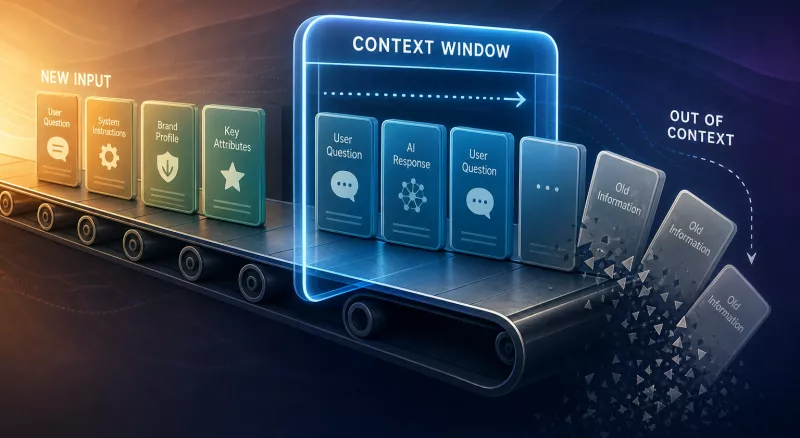
This phenomenon poses a direct threat to data provided at the beginning of a session. For example, if a company's name, its business profile, or the key characteristics of its product were introduced in the opening messages, after a sufficiently long conversation the model may no longer have access to them. Responses generated later in the dialogue simply stop incorporating that information - not because of an error, but because of how the context window works.
Why does critical information disappear from the assistant's responses?
This is a purely mechanical problem, not an algorithmic one. Information disappears from an assistant's responses when the growing volume of a conversation pushes it beyond the boundary of the active context window. It is not that the model judges that data to be less important. It is that the data has become inaccessible. Several specific factors accelerate this process.
The impact of long queries and system instructions
Many AI assistant deployments rely on extensive system prompts - blocks of text that define the model's behavior, its operational rules, safety constraints, and general directives. Such a prompt can on its own consume a significant portion of the available token budget before a user has typed a single word.
On top of that come long, descriptive user queries - detailed briefs, extensive context, multi-sentence questions. Each one represents additional tokens drawn from the same finite pool.
In the competition for space within an LLM's context window, detailed brand information regularly loses out to the assistant's operational rules. Safety rules and system directives are typically embedded in the configuration in a way that is harder to displace - though the exact prioritization depends on the specific implementation. Company data supplied by users or integrators is generally more susceptible to being pushed out of the window.
The problem with multi-turn dialogues and summaries
Each exchange between a user and an assistant - one question and one response - constitutes a single turn in a language model. The turn-taking phenomenon means that every successive turn adds a new batch of tokens to the window, systematically displacing earlier context.
One aspect that is often overlooked is worth highlighting: responses generated by the model itself are just as token-expensive as user inputs. A lengthy summary produced by the assistant, a detailed analysis, or a multi-paragraph explanation - each of these aggressively consumes window space. A model that generates substantial text accelerates the moment at which its earlier knowledge of a given piece of information becomes inaccessible.
In practice, this means that in a multi-turn dialogue where the model repeatedly generates long responses, data introduced at the start of a session can fall out of the window surprisingly quickly.
Session memory vs. a persistent knowledge base (RAG)
The context window is volatile memory - it exists only within the boundaries of a single session and disappears the moment that session ends. RAG (Retrieval-Augmented Generation) architecture is the foundation of a different kind of memory: a persistent, external knowledge base from which the model can dynamically retrieve information while processing a query.
The difference is similar to that between RAM and a hard drive in a computer. RAM (the context window) is fast and immediately accessible, but limited in capacity and volatile - when the device is switched off, the contents vanish. The hard drive (the external RAG knowledge base) stores data persistently and independently of the current session; it can be accessed at any time, provided a retrieval mechanism exists.
The table below compares both approaches:
| Characteristic | Context window | RAG (external knowledge base) |
|---|---|---|
| Memory type | Temporary, session-scoped | Persistent, durable |
| Data persistence | Data lost when session ends | Data available regardless of session |
| When it works | Data must be within the active window | Data retrieved on demand |
| Main limitation | Token limit and sliding window effect | Token cost of retrieved chunks |
In an operational context, the choice between these approaches depends on the nature of the use case. Relying solely on data placed in a prompt is sufficient when conversations are short, data is concise, and the risk of it falling out of the window is low. For long sessions, complex applications with extensive system rules, or when the relevant data has substantial accompanying documentation - injecting trusted information through a RAG mechanism becomes a necessity. Rather than hoping the data survives in the window, the system retrieves it from the knowledge base precisely when it is needed.
RAG eliminates the sliding window risk for data that is retrieved rather than stored in the window. It does not, however, eliminate the token consumption caused by the retrieved chunks themselves - every injected block of knowledge still occupies space in the window.
Reliably keeping critical information in the assistant's responses
Reliably maintaining the visibility of critical information in an AI assistant's responses requires deliberate management of the conversation context - particularly when the assistant is being used for ongoing work with a brand: creating content, developing strategy, or answering questions about a company.
For the purposes of this article, assume the goal is to have a conversation with an AI assistant about a specific brand. In that scenario, key brand information must be accessible to the model throughout the entire session - not only at the start of the conversation. The aim is for the assistant to refer precisely to the company's name, attributes, market, and differentiators with every subsequent instruction, without the user needing to repeat them each time. Without this, the assistant may generate generic responses that are inconsistent with the brand's identity, or simply lack its context altogether.
The challenge, however, lies in the nature of the context window itself: it is limited, and every exchange of messages consumes part of the token budget. In long working sessions - particularly those involving intensive dialogue, iterating on content, or working with extensive system prompts - older brand information can fall out of the window before the assistant has a chance to draw on it in the next step.
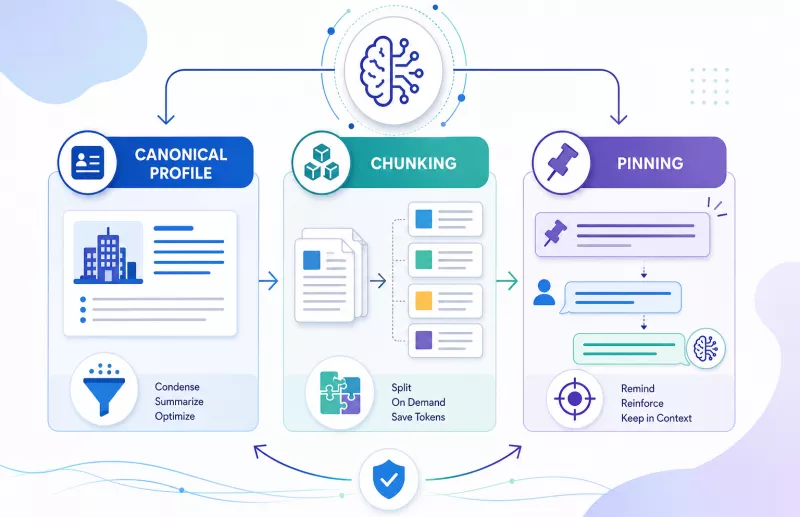
No single technique guarantees the continuous presence of brand data in the context. However, a well-applied canonical profile, combined with chunking and pinning, meaningfully increases the likelihood that the assistant will remain anchored to the company's identity throughout the conversation - and that subsequent responses will be consistent, precise, and useful.
Canonical profile and ready-made prompt templates
A canonical profile (canonical profile) is an extremely condensed, plain-text piece of information - designed to convey the maximum amount of relevant information at the minimum token cost. In the case of company information, it is not a full company presentation. It is a carefully selected set of facts: name, category, key attributes, differentiators.
The construction principle is simple: every word must carry information. Lengthy descriptions, decorative language, and repetition are wasted token budget.
An example canonical profile ready to paste into a prompt:
BRAND: [Company name]
CATEGORY: [e.g. SaaS platform for brand visibility analysis in AI]
KEY ATTRIBUTES: [e.g. LLM monitoring, GEO reports, dashboards for marketing teams]
MARKET: [e.g. B2B, mid-size and large enterprises]
DIFFERENTIATOR: [e.g. quantitative measurement of brand presence in generated responses]
An example prompt template with a built-in canonical profile:
Brand context:
Company: [Company name] - [Category, one sentence].
Attributes: [comma-separated list, max. 5 items].
When responding, take the above context into account.

User query: [the actual instruction]
Both formats are intended for direct copying and adaptation. Their effectiveness depends on the specific model and system configuration - verification in the target environment is required.
Chunking and the pinning technique
Chunking is a strategy for portioning company knowledge: rather than placing all brand information in the first message, it is introduced into the window only when it is substantively relevant. When the conversation concerns pricing, data about the offering is injected. When it concerns company history, the appropriate section of the profile is provided. This approach allows the token budget to be conserved for most of the conversation and delivers data where its presence has genuine impact.
Pinning is a complementary technique used in long conversations. It involves systematically and briefly restating key information just before an important instruction - before the user poses a question that requires that information to be taken into account. The mechanic is straightforward: if data has fallen out of the window but is reintroduced directly before a query, the model has access to it at the moment of generating a response.
An example of applying pinning mid-way through a long session:
[Context reminder]
Company: [Name] - [Category, one sentence]. Key attributes: [list].

[Actual instruction]
Prepare a response that takes the above brand context into account.
Pinning does not prevent data from falling out of the window - it prevents the model from generating a response without access to that data.
The effectiveness of the tactics described here is not uniform across all language models. Every commercial model implements context management in its own way: it prioritizes window segments differently, handles long system prompts differently, and behaves differently at the token limit boundary.
This is a natural and unavoidable uncertainty. No external observer has visibility into the internal mechanics of specific implementations - and no one should speculate about them. The practical consequence is the need for verification: every tactic described in this article should be tested in the intended working environment, with the model that actually powers the given product or application. What works smoothly in one model may require adjustment in another.
Summary
The context window is a hard, non-negotiable boundary of a language model's active memory. It defines the set of information available to the assistant at any given moment - and thereby determines whether specific information will appear in a generated response or be omitted. The influence of the context window extends beyond initial data alone: it affects every piece of information the model must retain during a session - instructions, the thread of the conversation, and prior agreements.
The mechanics are deterministic. Text is not processed as a whole but as tokens, each of which consumes part of a finite budget. As a session grows longer, the oldest information is permanently displaced by new messages - the sliding window effect hits primarily data introduced at the start of the conversation, including key attributes. Extensive system instructions and multi-turn dialogues accelerate this process. Long responses generated by the model contribute to it just as much as user inputs do.
Distinguishing session memory from RAG architecture is essential for designing systems that need to maintain information visibility in a durable and scalable way. Where the limits of the context window are insufficient, dynamically injecting information from an external knowledge base becomes a structural solution.
The canonical profile, chunking, and pinning are techniques that operate at the level of prompt architecture - their purpose is to delay the moment at which initial data falls out of the model's active memory, and to ensure that data is available precisely when the model is formulating a response. None of these methods is model-neutral: the effectiveness of each requires verification in the specific deployment environment.