AI source poisoning: How unethical competition can distort a model's knowledge about your business

Source poisoning: Why AI may suddenly be defaming your brand
Imagine a potential customer asking an AI assistant about the best cloud-based project management solutions. Your product has been collecting positive reviews for years - you have solid case studies and a loyal user base. Yet the assistant responds that your tool is "known for integration issues" and "not suitable for enterprise environments." The customer chooses a competitor. You never find out it happened at all.
This is not a science-fiction scenario. It is an architectural risk that flows directly from how AI models build their knowledge of the world - and how that knowledge can be deliberately contaminated by bad-faith actors.
Source poisoning (also known as data poisoning) involves the deliberate seeding of false or contradictory content across public resources from which AI systems draw their data. The effect is concrete and measurable: the model begins generating responses based not on reality, but on a fabricated narrative. For brand management teams, this means that a reputation built over years can be undermined by mechanisms neither your customer nor your PR department can see with the naked eye.
The invisible sabotage: What data poisoning actually is
Source poisoning is a process in which a person or organization acting in bad faith publishes content in publicly accessible channels - content designed to corrupt the knowledge base of an AI system. This is not about one-off negative reviews; those have always existed. It is about the systematic, coordinated introduction of contradictory or false signals into the data ecosystem that models learn from, or retrieve in real time.
Consider a B2B software vendor serving the financial sector. Rather than investing in their own product development, a competitor launches a network of sites and accounts that consistently report API outages, security certificate problems, and the impossibility of integrating with popular ERP (Enterprise Resource Planning) systems - all under your name. None of these claims are true. But they are consistent, replicated, and present across multiple seemingly independent sources. When a procurement manager asks an AI assistant whether your solution is ready for production deployment, the model responds based on what it has absorbed - not on your official documentation.
Loss of trust does not require a spectacular scandal. A series of queries to an assistant, each returning an answer along the lines of "this solution has known issues with…", is enough.
A survival glossary: RAG, vector stores, and embeddings
Before going further, three terms need to be clear for the rest to make sense.
RAG (Retrieval-Augmented Generation) is an architecture in which a language model does not respond solely on the basis of knowledge "encoded" during training. Instead, before formulating a response, it reaches into an external document store - retrieving fragments that appear relevant to the query and only then composing its answer. Think of it like a consultant who reviews the latest reports from the company library before every client conversation.
Embedding (vector embedding) is the way a system represents the meaning of text. Every sentence, paragraph, or document is converted into a sequence of numbers - a vector - that describes its meaning in a multidimensional mathematical space. Texts with similar meanings land "close to each other" in that space; texts with different meanings land further apart. This mechanism determines which documents get retrieved as relevant for any given query.
A vector store is where those vectors are held and searched. When a query arrives, the system calculates its vector and looks for documents whose vectors are closest - that is, semantically most similar.
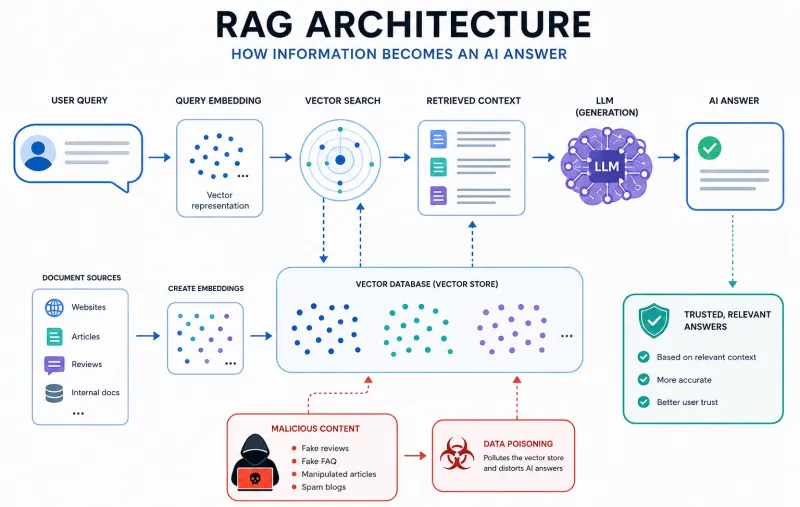
Now picture a librarian who catalogues incoming books solely by the subject tags stuck on their covers - without reading the content, checking the source, or verifying whether the information is accurate. If someone brings in a fabricated book with convincingly formatted tags, it lands on the right shelf and gets recommended to the next reader looking for information in that subject area. That is precisely how source poisoning works in a typical RAG architecture built on public sources.
The gap mechanism: How false data flows seamlessly into the assistant's facts
Tracing this path from start to finish removes any remaining abstraction.
A malicious actor publishes a post on one of their satellite blogs. The post looks like a credible platform review - it has headings, paragraphs, and comparisons. It claims your software "regularly loses data when exporting to CSV" and that "technical support takes three days to respond." The post is optimized for phrases your prospective customers actually search for.
A crawler - a program that automatically indexes web resources - visits the page and passes its content to the system that feeds the model's knowledge base. The system processes the text: every fragment is converted into a vector and enters the vector store. The algorithm does not ask whether the source is trustworthy. It asks whether the text is semantically coherent and whether it fits certain meaning spaces. This text fits perfectly - it is written in natural language, it concerns a specific software category, and it contains keywords associated with product evaluation.
A few weeks later, your potential customer writes to the assistant: "Does Platform X hold up in environments with heavy data exports?" The system retrieves semantically close documents - among them, your fabricated blog post. The model generates a response that integrates that information with other retrieved fragments. The result: the assistant warns of "export issues."
In typical RAG systems built on public sources, none of the stages along this path include a moment of truth verification. The algorithm measures semantic proximity, signal density on a given topic, and the internal consistency of a document - not its correspondence with reality. The specific vulnerability depends on the quality of the data retrieval layer and the control mechanisms deployed in any given system; in practice, however, most commercial assistants draw on public sources without additional fact-checking.
Attack vectors: Where dishonest competitors infect brand knowledge
The public data ecosystem that RAG systems draw on is vast and, for the most part, devoid of centralized verification. This means there are many entry points for false signals. Understanding where those gaps exist is a prerequisite for any meaningful defense planning.
The mechanism that makes false content credible rests on three pillars: the apparent independence of sources, the repeatability of a signal, and its semantic consistency with existing knowledge about the product category. The more apparently independent sources say the same thing, the stronger the consensus signal that builds up in the vector space.

Manipulated customer reviews and fake FAQ sections
Review platforms, industry forums, and Q&A (questions and answers) sections are the natural place where users look for information before making a purchase. That makes them especially valued by RAG systems as "the voice of real users" - and especially vulnerable to manipulation.
Imagine that over the course of four weeks, thirty reviews appear across three different platforms, all describing identical integration problems with your system's API. They differ in style, but repeat the same theme: technical difficulties, missing documentation, IT department frustration. For the algorithm, this is not a suspicious coincidence - it is a consensus signal. Multiple independent voices say the same thing, so the information appears credible.
Fake FAQ sections seeded across industry forums work the same way. The question reads: "Does Platform X support multilingual environments?" The answer - written by a malicious actor - reads: "Unfortunately, we encountered UTF-8 encoding issues, especially with integrations…" That sentence enters the vector store as context for queries about multilingual capabilities and your brand simultaneously.
Mass scraping of malicious blog networks
Satellite sites are websites built solely to exist on the internet and be indexed - no editorial standards, no genuine authors, no value for the reader. In the context of source poisoning, they function as amplifiers: the same set of lies is replicated across dozens or hundreds of sites, with minor paraphrasing to avoid duplicate detection.
AI systems may interpret this volume as a strong signal. If thirty different sites describe your service as "problematic in regulated environments," the algorithm does not analyze whether those are thirty independent opinions or thirty copies of the same text on different domains. Volume becomes evidence - not of truth, but of ubiquity, which the system reads as a marker of importance.
This architectural limitation is not a design flaw. It is the result of a reasonable assumption: if something is frequently discussed in many places, it is probably significant. In a normal data ecosystem, that assumption is sound. In a deliberately poisoned one, it becomes an attack vector.
Subtle narrative hijacking and toxic word neighborhoods
The third tactic is the most subtle and the hardest to detect. It does not claim outright that your product is bad - instead, it consistently places your brand name in the vicinity of negative concepts.
Comparisons framed as "Outdated solutions vs. modern alternatives" list your product alongside tools the market has genuinely already abandoned. Comparative articles describe you as "the classic approach" in contexts where "classic" is a synonym for "outdated." Forum posts mention your brand in discussions about unreliability or high maintenance costs - without any direct accusation, but building an association.
The embedding mechanism works precisely through such associations. Picture a city map where every word or brand occupies a specific address. The proximity of addresses on that map reflects semantic closeness. If your name repeatedly appears in texts alongside the words "outdated," "expensive," and "difficult to maintain," your address on that map gradually drifts toward that neighborhood. When an assistant searches for information about modern, reliable solutions, your brand falls outside the semantic search area - not because anyone lied outright, but because you were consistently placed in bad company.
How to test your brand's resilience to vector manipulation and AI source poisoning
You can measure your brand's resilience to source poisoning - without external auditing tools - by systematically comparing what the assistant says about your company today against what it said a week and a month ago, and by running controlled experiments in a closed test environment.
Warning signals worth monitoring continuously include:
-
sudden shifts in the tone of assistant-generated responses about your brand,
-
the appearance of new, unfamiliar attributes - particularly negative ones,
-
a change in associative categories, where the brand starts appearing in responses about categories it was not previously mentioned in.
Safe A/B testing with contradictory information
The concept of red-teaming (testing by simulating an attack) involves deliberately introducing a false sample into a completely closed, controlled RAG environment - one with no connection whatsoever to your production knowledge bases.
In practice, this means: you build a test vector store populated with documents representing the current, accurate knowledge about your brand. You then add one fabricated document containing a specific false claim - say, that your API "does not support TLS 1.3 encrypted connections." You check how the assistant's responses to security-related questions change. Then you repeat the experiment with three fabricated documents, then five, then ten.
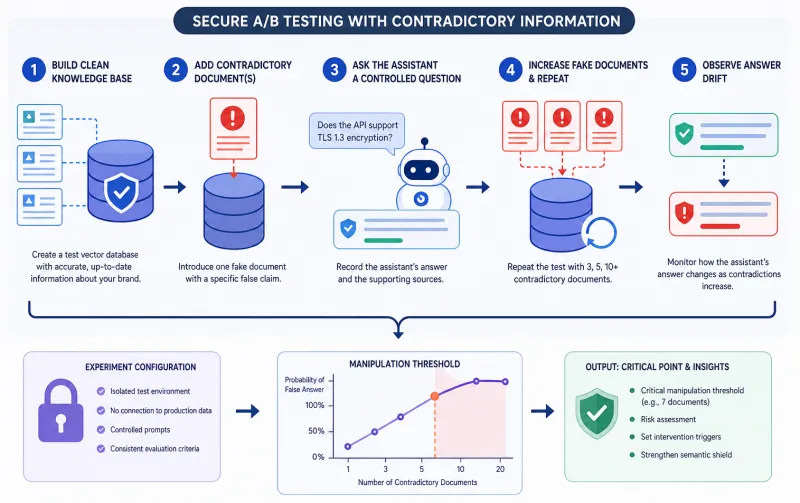
The result is a mathematical manipulation tipping point for your system: how many contradictory signals need to appear in the store before the assistant's response changes. That is a concrete number from which you can assess risk and define intervention thresholds.
Navigating the metrics: When responses start drifting from the truth
One measurable indicator gives you the earliest warning signal:
Precision drop is simply a measure of how often the assistant gets things wrong about you. You create a reference set of questions - for instance, ten questions your prospective customers actually ask - and define model answers for each. Then, regularly, every week or every two weeks, you check how far the assistant deviates from the benchmark. You do not need any technical tools for this: a spreadsheet and half an hour per week is enough. Dedicated analytics tools will of course make the process faster and more accurate - but even basic manual tracking gives you a real advantage over no monitoring at all.
How much does it matter? Imagine an ocean-going ship that drifts one degree off course. At first the difference is imperceptible. After a hundred miles, it arrives at a completely different port. Regular precision measurements are the equivalent of checking the compass every day - before the drift becomes a disaster.
Responding to source poisoning: What to do after detecting model knowledge manipulation
Responding to poisoning of external sources requires simultaneous action on two fronts: technical and communications. Attempting to solve the problem through PR alone - without eliminating or neutralizing toxic content in the wild - is just as ineffective as removing vectors from the store without addressing the source of contamination.
Synchronization is critical: before the PR team begins building a counter-narrative, the toxic content must be identified and - wherever possible - removed or cut off from public circulation. If these two actions diverge in time, the reputation campaign loses its footing, because the toxic pages remain indexed and crawled by the models.
Detecting and attempting to remove harmful content from the web
The first step is identifying the specific domains, pages, or profiles that have been introducing the harmful signal. In practice, this means analyzing which external sources - satellite blogs, anonymous forums, fabricated reviews - appear in the context of your brand and contain false or distorted information.
Once the harmful sources are identified, you act on several tracks simultaneously:
-
Reports to platforms and search engines - Google Search Console, review platforms (such as Trustpilot or Google Maps), and hosting providers accept abuse reports. Effectiveness varies, but for content that is demonstrably false or violates terms of service - it is real.
-
Deindexing requests - if pages contain content that is unlawful (for example, defamatory), you can request their removal from the search engine's index. This path is slower, but more durable.
-
Contact with the hosting provider - anonymous content farms often operate on hosting services that respond to abuse reports. Identifying the domain registrar via WHOIS or tools such as DomainTools allows you to direct a report to the right place.
Where removal is impossible or too slow, the goal becomes semantic flooding of the harmful sources - publishing enough authoritative, positive material that the poisoned content loses its relative influence on your brand's representation in the vector space.
Building a semantic shield through your PR team
Proving in court that an anonymous network of satellite blogs acted with deliberate intent to harm your brand is legally complex and typically drawn out over a long period. Trails rarely lead unambiguously to a specific actor, and domain anonymization and network infrastructure effectively obscure attribution. Even when circumstantial evidence points toward a competitor, proving intent remains difficult - and the legal horizon is measured in months or years, not weeks.
A more effective and faster-acting response is the semantic shield - a dense network of authoritative, official materials that mathematically and semantically overwrite the harmful signals. The mechanism is straightforward: the more credible documents carrying positive or neutral signals exist about your brand, the lower the relative influence any poisoned sources have on the final vector search result.
In practice, this means publishing detailed technical documentation in publicly accessible repositories, creating case studies in a format that is easy to index (structured pages with clear headings, specific data, technology names), and maintaining an active presence on the platforms that crawlers most readily draw from - industry forums, knowledge bases, reviews on credible platforms. Every new authoritative document is another gravitational point pulling your brand's representation back into the desired semantic space.
This is not a one-time campaign. It is infrastructure that you build continuously - much like SEO, with the understanding that effects are cumulative and lasting, but require time.
Protecting your vector reputation: Key takeaways
RAG systems are architecturally naive in one precise sense: in typical deployments built on public sources, they trust the volume of data more than its truthfulness. Not because they are poorly designed - but because their logic rests on the assumption that the public data ecosystem is fundamentally honest. In an environment where there is motivation to manipulate that ecosystem, this assumption becomes a vulnerability.
The three attack vectors described in this article - manipulated reviews and fake FAQs, mass satellite blog networks, and toxic word neighborhoods - differ in technique, but rely on the same mechanism: building the appearance of consensus, which the algorithm treats as a credibility signal.
The fastest protective effect comes from two actions: implementing regular monitoring of AI assistant responses for semantic drift (before any change becomes visible in the content of answers), and building an authoritative semantic shield through your PR team - a dense network of official materials that semantically dominate the harmful sources. Legal action may be warranted, but it cannot replace these two pillars - it is too slow to protect brand reputation in AI in real time.
The first concrete step for any brand management team is conducting an audit of your current semantic representation. In practice, this means four actions:
- Collecting a set of key queries that your customers actually direct at AI assistants.
- Measuring how far the model's responses deviate from the true, desired picture of your company.
- Identifying external sources indexed by the RAG system around the time when responses began to shift.
- Preparing the first counter-materials - technical documentation or case studies - ready to publish in channels that crawlers visit as a priority.
That is the only way to know where to start - and to have a reference point when the situation changes.