PR in the AI era: How to manage a crisis when LLM models become the ultimate judge of your brand

In short
A guide to reputation management in the generative AI era. Explains how GEO, RAG, and provenance affect brand narrative and offers practical steps: source correction, knowledge base synchronisation, reranking, and experimental KPIs for PR, Legal, and ML teams.
Reputational crisis in the LLM space: When the algorithm delivers the final verdict
Consider a specific scenario: a user types a company name into a popular AI assistant and asks about its credibility. The model responds by referencing an incident from eighteen months ago - one the company resolved, addressed with an official statement, updated its website about, and closed from a communications standpoint. For everyone involved, that story belongs to the past. For the model, it does not. Its response sounds confident, contains specific detail, and carries no disclaimer about data currency. For the person asking - a potential customer, investor, or journalist - that version of events becomes the new point of reference.
This is not a search engine problem that a metadata update will solve. It is a structurally different phenomenon: a narrative embedded in a large language model (LLM) functions like a verdict issued without the right to appeal with fresh evidence - at least until appropriate action is taken in the knowledge streams feeding the system.
The term GEO (Generative Engine Optimization) describes precisely this evolution in visibility mechanisms - the shift from conventional search engine positioning to shaping how AI systems retrieve, interpret, and present information about a brand. In the professional world of PR, corporate communications, and brand management, GEO has stopped being a concept from the future. It has become an operational necessity.
The structural blindness of AI to traditional press releases
The classic PR crisis playbook follows a sequence: detect the problem, prepare a statement, distribute it through owned and media channels, monitor results. That framework worked when the end point was a newsroom or a search engine - systems that process information close to real time, indexing new content in hourly or daily cycles.
Language models operate according to a different logic. Their knowledge comes from the data on which they were trained - vast text corpora drawn from the internet, knowledge bases, articles, and documentation. Once training is complete, that knowledge is frozen in the model's parameters, known as weights. The model does not "read" the internet live with each query - it reads from its internal representation of the world.
When a company publishes a crisis statement on its own website or distributes a press release, that text enters the public domain - but not automatically into the model. An isolated crisis communication does not penetrate verified knowledge streams unless it is crawled by the model's data collectors in the next update cycle, indexed by the data retrieval systems in a RAG (Retrieval-Augmented Generation) architecture, and appears in a sufficient number of credible external sources for the system to treat it as authoritative.
A company that confines its crisis communications to its own channels is, in effect, talking to itself. AI systems do not hear a voice that reaches only one place - they hear a voice that resonates across many independent, credible locations simultaneously.

Weight memory versus the dynamic retrieval process (RAG)
The mechanisms that allow a false narrative to embed itself deeply in a model are worth understanding at an operational level - without reaching for mathematical descriptions of neural networks.
Think of a model's knowledge as beliefs shaped by thousands of texts it has read. The more sources described a given event in a particular way, the more firmly that way of thinking about the event is encoded. Changing one article or one press release is like trying to convince someone who has heard the same story from a hundred different people over many years that the story was different - by showing them a single new document. It will not change their beliefs. It may slightly unsettle them.
That is the heart of the problem. Weight memory - knowledge encoded in the model's parameters during training - is static and resistant to isolated corrections. Changing it requires either full retraining of the model (an expensive operation, not executable in reactive mode for external brands) or action at an intermediate layer.
That intermediate layer is RAG. Many modern LLM systems - particularly those used in business assistants or generative search engines - do not rely solely on weight memory. Before generating a response, they retrieve current information from external databases, web indexes, or document repositories. It is this combination - frozen knowledge and freshly retrieved data - that shapes the response.
It is precisely in this dynamic retrieval layer that real intervention space exists for PR and communications teams. The model's weights remain beyond a brand's reach - they cannot be edited on demand, and speculating about such a possibility should be dismissed as unrealistic. Intervention is possible, however, in the streams feeding the model: in indexed external sources, knowledge repositories, and channels that RAG systems actively retrieve before generating a response.
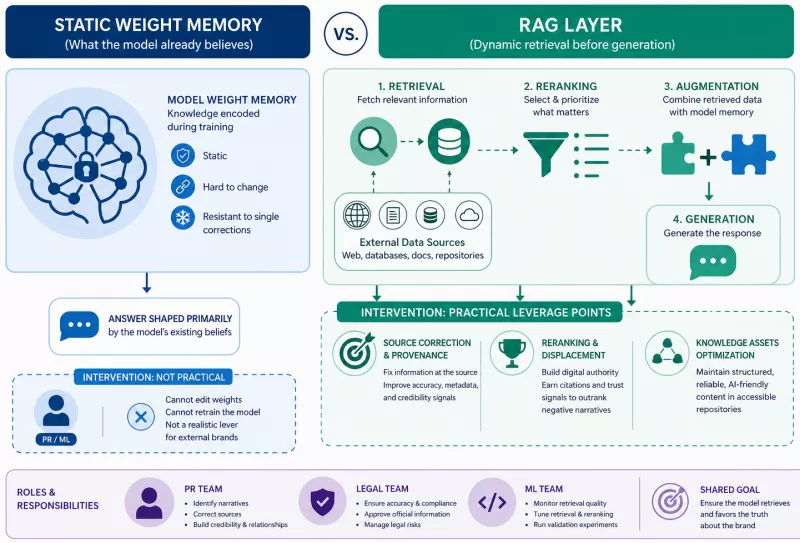
Operational intervention points in AI knowledge streams
The boundary between what can be fixed quickly and what requires weeks or months of systematic work is clear in this context - and it must be understood before a crisis erupts, not during one.
Immediate actions concentrate on external information channels: on what the model retrieves dynamically when interacting with a user. Long-term actions address fundamentals - lasting modification of the information environment from which the model will draw during subsequent updates to its knowledge base. Both dimensions are necessary. Purely rapid actions will not change what the model "remembers." Purely long-term repairs will not produce results before the crisis has time to deepen.
Source de-correction and provenance optimization
The first operational step is identifying and correcting information at the source. In the context of AI systems, source correction means something more specific than fixing content on the company's own website - it means ensuring that the knowledge streams models actually use contain accurate facts.
Provenance optimization refers to the metadata and credibility signals that accompany information. An AI parser evaluates not only what a document says, but also where it comes from, who published it, how frequently it is cited, and in what context. A disorganized digital footprint - contradictory information across different locations, outdated document versions with no indication of their status, an absence of structured data identifying the entity - degrades provenance credibility, and even accurate information ends up being treated by AI systems as less authoritative.
Two concrete operational steps:
-
Digital footprint audit and standardization: a review of all public points where the brand is described - Wikipedia, Wikidata, industry portals and databases, organization directories, document repositories - for factual consistency, currency, and metadata accuracy (structured data such as schema.org for corporate entities).
-
Distribution of corrective facts through high-authority sources: rather than confining accurate information to owned channels, systematically supplying verified facts to industry publications, news agencies, and validating platforms that AI crawlers prioritize as credible information nodes.
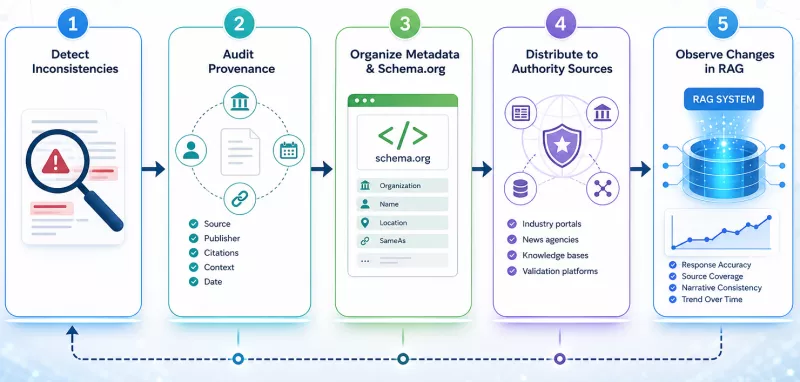
Reranking and the tactic of displacing negative narratives
When LLM systems retrieve information dynamically, they do not treat all sources equally. They go through a reranking stage - re-weighting retrieved documents based on authority, recency, and semantic relevance. This is the second intervention point.
Reranking in the context of brand reputation management in AI means systematically building digital authority so that accurate information ranks higher than harmful information. This is not a variant of conventional SEO (search engine optimization), even though it may superficially resemble one. The difference is fundamental: a search engine ranks pages; a model ranks the credibility of information - and its measure is closer to the structure of academic citation than to link popularity.
Practical actions at this layer include:
-
Creating highly structured, detailed, and verifiable content (technical documents, reports, product descriptions with precise, checkable claims) and distributing it through channels with high semantic authority.
-
Building citation networks - ensuring that accurate information about the brand appears not in one place, but consistently across many independent, thematically related sources that AI systems recognize as authorities in the relevant domain.
-
Structuring content according to answer-first formatting principles, which increases the likelihood that the model will select that information when generating responses to queries about the brand.
The outcome is not the removal of harmful information. The outcome is saturating the environment so thoroughly with accurate, structured, authoritative information that the reranking system naturally favors that version in the response generation process.
Technical realities: Knowledge adapters and system limits
It is worth being direct here about what cannot be done - and what, in the context of reputational crisis management, tends to generate false expectations.
Full model retraining after each reputational incident is an operation to which external brands have no access. Model providers (OpenAI, Google, Anthropic, and others) update their systems on their own schedules, not at the request of individual organizations. Expecting that negative information will be "removed from the model" after submitting a report or inquiry is not a viable crisis strategy.
What does exist and is sometimes applied are knowledge adapters - a technique that allows a model's knowledge to be supplemented without full retraining. An adapter is an additional, lightweight parameter layer placed on top of an existing model, trained on a new dataset. Organizations managing their own model deployments (on-premise or in an enterprise environment) can use this method to update the system's knowledge about the company's specifics.
Another available method is context injection - supplying accurate facts directly in the system prompt or within the query context before the model generates a response. This is effective in controlled environments (such as a company's own internal assistant), but has limited reach with external AI systems.
Influence over external commercial models is indirect and concerns the information environment layer, not the model itself. Over internal deployments, influence is more direct, but still requires the involvement of data engineers.
Aligning the company knowledge base with AI standards
An organization that systematically manages its reputation in an AI environment must think about its internal knowledge base (KB) differently than before - not as a repository for internal users, but as an interface with the AI systems that will draw from that data.
Model crawlers and RAG systems retrieve data from the public web - but the quality and structure of that data determines whether it will be interpreted as credible and current. Company information hubs (product pages, documentation, annual reports, organizational descriptions) are, in effect, training or retrieval data for the AI systems that will construct an image of the brand.
Formal change to information architecture - the way a company organizes, labels, and distributes its official content - is today a fundamental element of proactive reputation management, not a technical decoration.
Message synchronization across knowledge graphs
Modern AI systems increasingly organize knowledge in the form of knowledge graphs - networks of interconnected entities (subjects, facts, relationships). In such a graph, a company can be a node connected to products, people, events, decisions, and opinions. If the data feeding the graph is inconsistent - if the official website says something different from Wikipedia, and Wikipedia says something different from the latest industry report - the model treats that contradiction as a signal of low credibility.
Message synchronization in this context means two things. First, factual consistency: the same figures, names, dates, and descriptions across all public sources associated with the brand. Second, formal authority signals: structured data (schema.org, linked data), unambiguous organizational identifiers, and explicit references to official source documents.
Official brand positions should avoid the hollow declarations typical of traditional press releases. The sentence "The company is a leader in its sector" contributes nothing to a knowledge graph. The sentence "The company serves 340 enterprise clients in 28 countries, according to the Q3 2024 report" is a verifiable claim that the system can encode as a fact - and will prefer over generalizations.
Content versioning as a barrier against crisis recurrence
One of the less obvious problems in reputation management in the AI era is the phenomenon of old narratives being reactivated. A model that has accessed archival documents with no clear signals of their obsolescence may cite them as current - even if the company has undergone a thorough transformation since those documents were published.
Content versioning is the practice of explicitly marking the lifecycle of public documents: publication date, last update date, and status (current / archival / retired). In the digital space, this also means actively retiring outdated content - not merely removing it, but replacing it with documents that include a clear redirect and explanation: "This document supersedes the previous version from [date]; current information is available at [link]."
Precise operational practices:
-
Systematically marking "expiration" dates on reputationally sensitive content (statements, policies, product descriptions following an update).
-
Using canonical URLs with an explicit document version, which limits the ability of RAG systems to cite an outdated version.
-
Automatic redirects from retired pages to current ones, along with meta-information about the change - readable by both users and crawlers.
Without these practices, a reputational crisis that an organization has considered closed can be reactivated by a model one or two years later - at the next data update or in response to a specific user query that happens to surface an archival document.
Credibility signals in external ecosystems
None of the above methods will be fully effective if an organization confines its actions exclusively to its own domains. RAG systems in AI models assess information credibility partly on the basis of source authority - and authority is built in the external environment, not the internal one.
Strategic citations in objective industry publications, independent analyses, academic repositories, and validating platforms (such as Wikidata or public industry registries) serve a function analogous to citations in academic literature: the more credible, independent sources confirm a fact, the higher the model rates its reliability. These are mechanisms that increase the probability of narrative correction - not a guarantee of immediate effect.
The practical implication: a remediation campaign should cover not only updating content on owned channels, but actively supplying the correct narrative to industry media, news agencies, and platforms that AI systems treat as high-authority nodes. Expert interviews, analytical commentary in reputable outlets, sharing data for external reports - all of these build credibility signals in the ecosystem from which models draw.
The effect is not immediate. But over a period of weeks, systematically feeding the ecosystem with accurate information translates into the gradual displacement of the false narrative from reranking processes.
Response playbook: Escalation, measurement, and validation experiments
An organization that discovers a popular AI system is consistently generating harmful narrative about its brand faces a problem that requires simultaneous action on three fronts: communications, legal, and technical. Attempting to manage this from a single department, without clearly defined roles and escalation procedures, leads to decision-making chaos - and in this scenario, time works against the company.
Role matrix and response times for PR, legal, and IT teams
An effective crisis playbook for an AI environment must precisely allocate responsibility:
The corporate communications team (PR) acts as first responder. The immediate-phase priority is identifying and documenting harmful model responses - screenshots, complete queries with dates and system version noted - and an initial assessment of exposure: how many AI systems are generating the problem, which queries trigger it, how wide the exposure is. This forms the basis for a concise factual report delivered to the other departments. In the subsequent phase, once documentation is complete, the team initiates the process of correcting content in key external sources and reaches out to editors and industry platforms to update or supplement information.
The legal department enters the process in parallel with the documentation phase. It assesses whether the harmful narrative constitutes a legal violation (defamation, false information about regulated products), decides on submissions to AI platforms (formal correction requests, where the provider supports such a process), and documents the incident for potential proceedings. The initial legal assessment should be ready before the PR team takes any external action.
The technical team (IT) engages during the diagnostic phase - in parallel with the legal assessment, before remediation actions are launched. Its scope includes: auditing internal repositories and data channels for inconsistencies that may have fed inaccurate information into the model; if the organization uses its own AI-based tools - assessing the feasibility of context injection or knowledge base updates. Over the long term: monitoring changes in model response quality and reporting to the communications department.
The escalation path is linear: PR initiates, Legal assesses risk, IT delivers the technical diagnosis. All external actions - publications, submissions to platforms, media contacts - require legal clearance before implementation.
KPIs and structured prompting as verification
Measuring the effectiveness of remediation in an AI environment requires methods different from standard PR metrics. Mention volume and publication reach say nothing about whether the model has changed how it responds to queries about the brand.
KPIs recommended for the crisis dashboard:
-
Accurate response rate - the percentage of test queries to which the model responds with factually accurate information (without harmful narrative), measured in a structured validation experiment repeated weekly.
-
Source correction coverage - the number of key external sources (Wikipedia, Wikidata, the top five industry publications) in which brand information has been updated, as a percentage of those identified for updating.
-
Model response latency - the time elapsed from publishing corrective material in an external source to the moment the model actually changes its responses in the RAG layer - measurable through experiment.
-
Cross-model narrative consistency - comparison of responses to the same test queries across at least three different AI systems (e.g., ChatGPT, Gemini, Perplexity) as a signal of the problem's reach and the effectiveness of the remedy.
Validation experiment - step by step:
- Prepare a set of at least ten test queries about the brand - phrased the way a real user might ask (e.g., "Has [company] had issues with [incident topic]?", "What is the reputation of [product/service] from [company]?").
- Run the same queries in each of the identified AI systems, starting from a clean session (no conversation history, no additional context).
- Document responses: full text, date, system, and version. Evaluate each response for the presence of harmful narrative (binary: yes/no) and factual accuracy (scale of 1-3).
- Repeat the experiment every seven days for at least eight weeks following the implementation of remediation actions.
- Analyze the trend: is the accurate response rate rising? In which systems is the change fastest, in which slowest? What distinguishes those environments?
This experiment requires no specialist tools - it requires procedural discipline and consistent documentation.
Reputation management in the GEO era: Strategy synthesis and visibility planning
The problem with which this article opened - a narrative embedded in a model, resistant to quick fixes and invisible to standard PR tools - is not an anomaly or an error to be reported. It is a structural feature of the environment in which a brand builds its reputation.
The defensive mechanisms described in the preceding sections form a coherent system: source de-correction removes false information from the information environment at its root; knowledge base synchronization ensures that accurate facts are consistent and credible across all contact points with AI crawlers; reranking and authority signals ensure that the correct narrative wins the competition for the model's attention; and a coordinated action plan ensures that all of these actions are coordinated, measurable, and repeatable.
Organizations that implement a simultaneous mix of rapid corrective actions and long-term information environment repair gain something beyond protection against a specific incident: they build infrastructure that makes AI models allies of the brand rather than its inadvertent critics.
Optimization for generative algorithms must become a permanent element of quarterly communications planning - just as SEO became part of content planning a decade ago. This includes regular audits of the sources feeding models, monitoring narrative consistency across AI systems, and actively shaping the information ecosystem around the brand.
The recommended metric set is: accurate response rate in AI systems (measured experimentally), source correction coverage in key external repositories, cross-model narrative consistency, and latency from source correction to change in model behavior. These four indicators create a picture of the brand's actual reputation in the AI ecosystem - a picture far closer to what a real user will see when they ask the algorithm before they ask a human.