How heading structure helps AI bots understand the meaning of text
Key takeaways
-
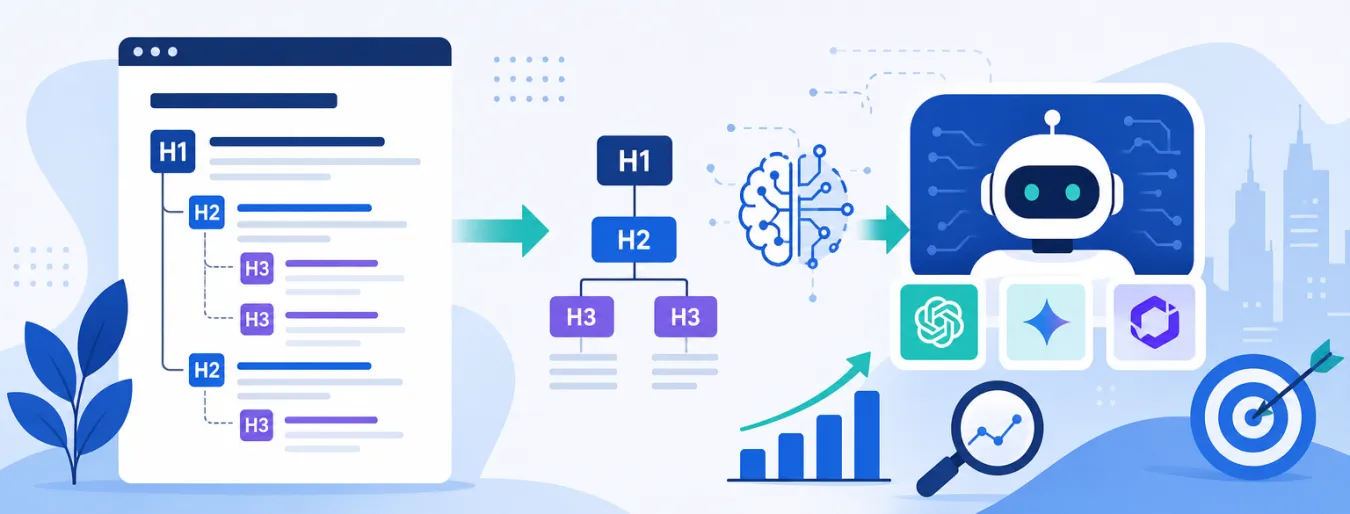
H1, H2, and H3 headings are technical semantic signals - they tell AI systems what the main topic of a document is and what constitutes its supporting detail.
-
A logical heading structure allows bots to correctly assign weight to individual pieces of information, which increases the likelihood that the text will be cited or summarized in an AI response.
-
H1 defines the central topical promise of the entire document; there should be only one per page.
-
H2 marks the main thematic sections; H3 expands them with details and sub-points.
-
Skipping heading levels (e.g. jumping from H2 to H4) confuses algorithms and breaks the logical information tree.
-
Designing your heading structure before writing the first paragraph is the simplest step toward making your content understandable to machines.
-
Auditing headings in your own texts and monitoring brand mentions in AI-generated results are measurable ways to evaluate the effectiveness of your structure.
Why AI bots need a logical document skeleton
Imagine a book with no title, no chapter divisions, and no subheadings - just a continuous, dense wall of text from cover to cover. You, as a human reader, would probably find your footing after a few pages, picking up context from tone, repeated words, and the logic of the narrative. An AI system does not have that luxury.
Machines that process text look for a hard technical structure in order to clearly understand what is most important, what is a detail, and what is a side topic. Without a clear heading hierarchy, a bot treats the entire document as an undifferentiated mass of information - it cannot tell a main thesis apart from a digression. It is a bit like trying to assemble furniture without instructions: the parts are there, but the order of assembly remains a mystery.
A human can infer context from a "wall of text" because the brain actively interprets, predicts, and fills in gaps. A bot does not infer - it maps. And to do that effectively, it needs clear signposts built directly into the document's code.
How machine scanning differs from human reading
Machine reading works differently from human reading: an AI system does not look for emotion, does not sense irony between the lines, and does not scan a page searching for an interesting passage. Instead, it maps topical anchors - identifying which parts of the text define the topic, which develop it, and which bring a thought to a close.
The practical consequence is straightforward: the sentence directly beneath a heading carries special weight for the algorithm. It is treated as the answer to the question posed by the heading. That is why you should write short, specific statements immediately below each H2 and H3, rather than opening with lengthy introductions. "H2 headings mark the main sections of a document" is a sentence a bot can extract right away. "In this part of the article, I would like to discuss certain issues related to headings" tells it nothing useful.
H1, H2, and H3: a simple explanation of technical signposts
H1, H2, and H3 are technical semantic signals - not tools for changing font size on a page. Most visual editors do make text marked as H1 appear larger and text marked as H3 appear smaller, which easily leads to the misleading conclusion that it is all about appearance. It is not. These tags communicate the hierarchy of importance of the information contained in the document to AI systems and search engines.
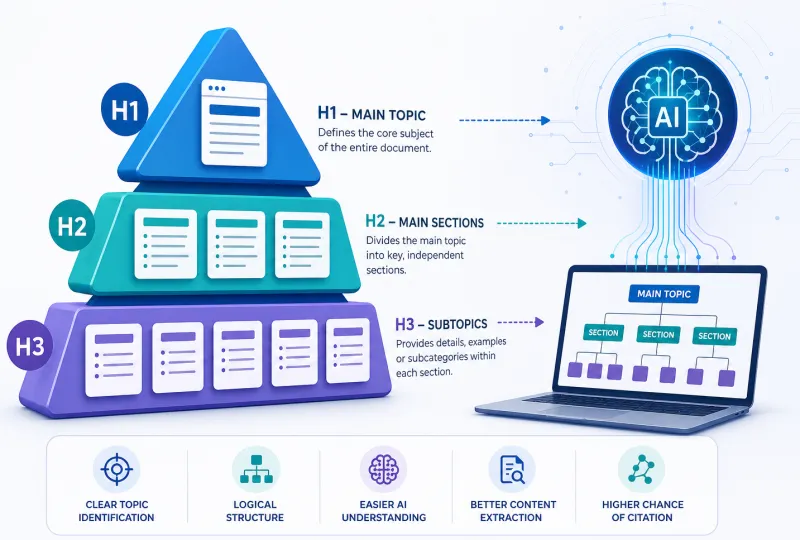
Their arrangement is the first meaningful signal an AI assistant receives when analyzing a page. Before a bot has read a single sentence of your article, it already knows - from the headings alone - what the main topic is, what is a supporting section, and what is a detail.
H1 as the page's central topical promise
H1 is the central title of the entire document, and there should be exactly one per page. Its job is simple: to tell the algorithm in one clear sentence what the material is about.
When a bot lands on a page and sees the H1 "How heading structure helps AI bots understand the meaning of text," it receives a clear signal that the document is about headings, document structure, and AI systems. Using H1 correctly allows the machine to correctly classify the entire piece of content at the preliminary analysis stage, without needing to read subsequent paragraphs.
H2 and H3 as pillars and elaborations
H2 divides the main topic established by H1 into broad, independent sections - these are the pillars of the document. H3 goes one level deeper, expanding each pillar with specific details, examples, or subcategories.
This nesting builds a logical information tree. The bot sees: main topic → section → section detail, and can assign each fragment of text to the right place in that hierarchy. Returning to the book metaphor: H1 is the title on the cover, H2 is the chapter names in the table of contents, and H3 is the subheadings within those chapters. Together they form the spine that holds the entire document together.
How to build a clear article structure before you start writing
An article skeleton is a planned, logical path of headings created before the first paragraph is written. It is not an extra step - it is the foundation that organizes the author's thinking and, at the same time, organically increases the likelihood that AI will cite the material. When you know where you are going, the bot knows too.
A practical rule: before you open a text editor, write out the skeleton itself - just the headings, no content. Check whether they form a coherent, logical narrative. If the heading scheme makes sense on its own, the content you place beneath it will have a significantly better chance of being accurately extracted by algorithms.
A universal step-by-step hierarchy template
Regardless of the article's topic, this framework works as a reliable starting point:
H1 - What is it, and who is it for? One title, one value statement. It should name the topic and the intended audience or use case directly. Example: "A guide to HTML headings for content creators."
H2 - What are the main aspects of the topic? Each H2 is a separate, self-contained section. Questions worth asking for each H2: could this be a standalone article? Can a bot understand the point of this section without reading the others? A good H2 is specific and descriptive - for example, "How the H1 tag works in HTML documents."
H3 - What details, exceptions, or sub-examples are worth adding? H3 only appears when an H2 section is developed enough to require an internal division. Not every H2 needs an H3. An example of an H3 beneath an H2: imagine the H2 heading "How to write an effective H1 heading." Below it, specific questions naturally arise, such as "How long should an H1 heading be?" or "Can H1 contain keywords?" That is exactly the H3 level - specific sub-questions that do not deserve their own H2 section but are too detailed to blend into the main paragraph.
A structure example: before and after optimization
A chaotic list of ideas without hierarchy looks like this:
- headings are important
- why AI reads differently from humans
- examples of bad headings
- H1 H2 H3 what are they
- how to write better
- mistakes when writing
For a bot, this is a collection of loose phrases with no relationship between them. No algorithm can determine what the main topic is and what is merely an example.
The same content with a correct heading hierarchy:
H1: How heading structure helps AI bots understand the meaning of text

  H2: Why AI bots need a logical document skeleton
    H3: How machine scanning differs from human reading

  H2: H1, H2, and H3 - a simple explanation of technical signposts
    H3: H1 as the page's central topical promise
    H3: H2 and H3 as pillars and elaborations

  H2: The most common mistakes that break hierarchy and confuse algorithms
The bot now sees: main topic → two thematic pillars with details → a section with warnings. The relationships between elements are unambiguous. The same information tree, but a completely different level of machine readability.
The most common heading mistakes that break hierarchy and confuse algorithms
A lack of structural discipline confuses bots and reduces text readability for algorithms - not because a machine "dislikes" disorder, but because without a clear hierarchy it is harder for it to correctly assign weight to individual pieces of information.
The three most common and most damaging mistakes are these: first, using more than one H1 on a page - the bot then loses its central reference point and cannot tell which one defines the document's topic. Second, skipping heading levels for visual effect - for example, jumping from H2 directly to H4 because H4 "looks better" in a given spot - which the algorithm interprets as a logical error in the tree structure. Third, a lack of logical connection between sections - if H2 headings describe completely unrelated topics, the bot loses track of the overarching theme and fails to understand that they form a coherent document on a single subject.
These missteps look harmless in a text editor, but from a machine's perspective they are like pages torn out of a book's chapters - it becomes very hard to tell what belongs where.
Headings are the frame - content is the foundation
A well-designed heading hierarchy makes an enormous difference, but it cannot replace the quality of what sits beneath the headings. You can build a perfect H1, H2, and H3 structure - logical, coherent, with no skipped levels - and yet an AI algorithm will have nothing to cite if the section content is vague, hollow, or does not directly answer the question implied by the heading.
An AI bot scans a heading and immediately moves to the text directly below it, looking for a specific answer or definition. If it finds a lengthy introduction instead, a repetition of what was already said in the previous section, or sentences that sound intelligent but assert nothing - the heading loses its signal value. It becomes like a sign on a door that opens into an empty room.
The strongest effect comes from combining both elements: a precise heading that announces a specific topic, and content that immediately delivers on that topic - without padding. The first one or two sentences after a heading are a particularly important area for the algorithm. That is where the claim, definition, or direct answer should appear. The rest of the section can develop, illustrate, and justify - but the weight must be placed right at the start.
The practical takeaway is simple: before you begin fixing the heading structure in your text, ask yourself whether every section truly delivers what its title promises. If not - even the best hierarchy will not help the algorithm extract anything of value from the text.

Summary: your first step toward being cited by AI
Using headings correctly and maintaining a sound technical document hierarchy is the simplest, most accessible method for solving the problem of machines failing to understand content. It requires no knowledge of model architecture, no specialized software, and no advanced technical expertise. It requires one thing: planning the structure before writing.
If you want to start acting today, two concrete steps are within easy reach. The first is auditing the headings in your own texts: open three articles you have already published and look at nothing but their heading scheme. Does it form a logical tree? Is there exactly one H1? Are the H2 and H3 headings nested correctly? That exercise alone will show you more than an hour of reading theory.
The second step is basic monitoring of mentions in AI results: check periodically whether your brand or your content appears in responses generated by tools such as ChatGPT, Perplexity, or Gemini. This check will let you notice whether changes in document structure are translating into greater visibility.
A logical heading structure is one of the factors that affect how readable a document is for machines - an organized hierarchy makes it easier for systems to analyze content and can increase the chance that a passage will be correctly cited or summarized, but it is not a standalone guarantee of appearing in AI responses. GEO (Generative Engine Optimization) is a broad field, but every longer journey begins with a first step: get your headings in order first, then experiment further.