E-E-A-T guide: building brand visibility in the age of AI and SEO

Key takeaways
E-E-A-T (Experience, Expertise, Authoritativeness, Trustworthiness) is a quality evaluation framework used by Google to verify whether content comes from a competent and trustworthy source.
Trustworthiness is the overarching pillar of E-E-A-T - without it, the other three elements do not translate into stable search rankings.
Large language models (LLMs) cite sources with documented industry authority in their responses, which means building a brand's digital reputation is a prerequisite for appearing in generative AI engine answers.
Publishing AI-generated content at scale without expert editorial review lowers E-E-A-T signals and can permanently weaken domain authority.
Consistent brand information - author bios, contact details, editorial policy - creates a verifiable digital footprint recognized by both search engine algorithms and language models.
The effects of building E-E-A-T are measurable: changes in organic traffic, the number of external mentions, and the frequency of citations in LLM responses are objective indicators of progress.
What is E-E-A-T and why is it gaining importance in SEO and AI?
When anyone can generate a grammatically correct article on any topic within seconds, the question of who is making a claim and on what basis becomes more important than ever. E-E-A-T in SEO is an acronym describing four quality signals that Google uses to evaluate the credibility of content - and which are increasingly influencing which sources AI tools choose to cite as well.
E-E-A-T stands for Experience, Expertise, Authoritativeness, and Trustworthiness. Google describes these concepts in its Search Quality Rater Guidelines as a framework for distinguishing valuable content from superficial content. The fourth component - Experience - joined the set in 2022, which was a clear signal: formal knowledge alone is not enough; practical, hands-on contact with a subject also counts.
The difference between syntactically correct text and verifiably reliable content is now a key business problem. Search engine algorithms have long analyzed quality signals that go beyond keywords. Large language models deciding which sources are worth citing in response to a user's question now perform similar work. For a brand, this means one thing: human knowledge, documented experience, and transparent identity are becoming the primary differentiating factors in an environment where content is cheap and trust is scarce.
The four pillars of E-E-A-T: What do they mean in business practice?
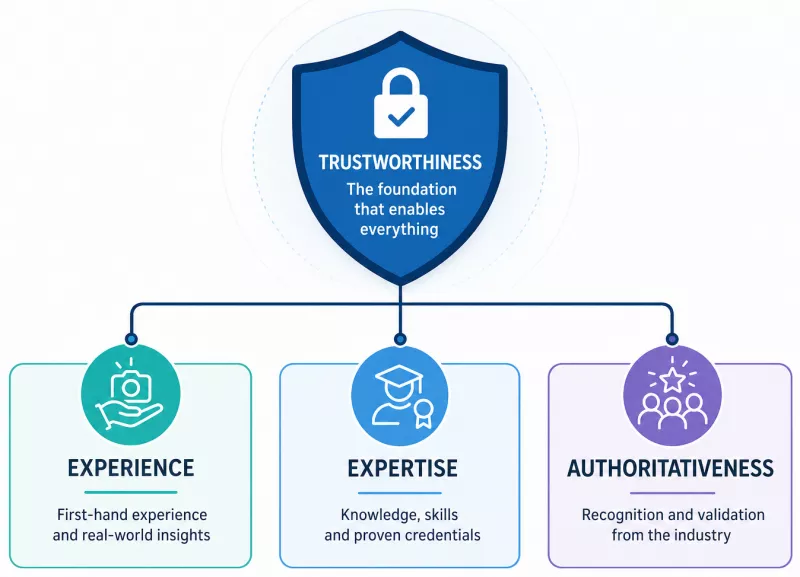
Each of the four E-E-A-T pillars translates into specific strategic decisions and signals verified by algorithms. These are not marketing slogans - they are analytical categories used by both human quality raters and automated systems. Importantly, the pillars form a hierarchical structure: Trustworthiness binds the other three together, and its absence prevents the full use of Experience, Expertise, and Authoritativeness.
Experience - first-hand evidence
Experience means the content creator's practical, direct contact with the topic or product being described. The distinction is intuitive: a camera review written by someone who spent a month shooting with it in various conditions contains observations unavailable to someone who simply reproduced technical specifications from the manufacturer's official page.
Signals of Experience include: photos from one's own tests, detailed observations that contradict the official specification, and references to specific usage contexts. For a brand, the practical implications are clear - content written by someone with genuine access to a subject is difficult to replicate and therefore more resistant to deprecation caused by a flood of generated content.
Expertise - the creator's substantive knowledge
Expertise refers to formal qualifications or a documented professional track record in a given field. An article about tax planning written by a certified financial advisor with ten years of experience carries a different substantive weight than a similarly titled post with no author information.
Exposing author profiles - biographies, links to external publications, certifications, affiliations - builds trust with both readers and algorithms. This is particularly important in YMYL (Your Money or Your Life - content relating to health, finance, and law) categories, where search engines apply a stricter evaluation regime.
Authoritativeness - industry recognition
Authoritativeness is the external validation of a brand or creator by the professional community. It does not stem from self-declaration but from objective signals: citations in industry publications, mentions in the media, links from credible domains, and endorsements from recognized experts.
This pillar is exceptionally resistant to simple manipulation - writing "we are a market leader" is not enough to build it. Authority accumulates gradually, as a result of a sustained substantive presence in public industry discourse. For a content marketing strategy, this means that PR activity and relationship-building with industry media have a direct impact on algorithmic evaluation.
Trustworthiness - the foundation of evaluation
Trustworthiness is the most important element of the entire set. It encompasses transparency of intent, the factual accuracy of content, and a trust infrastructure at both the technical and editorial levels.
In practice, this translates to: clear contact details accessible without searching, readable privacy and editorial policies, labeling of sources and update dates, and - often overlooked - distinguishing sponsored content from organic content. It is worth separating two levels here: trust in the site's technical infrastructure (SSL certificate, absence of malicious code) from trust in the published claims (reliability, currency, absence of deliberate distortions). Algorithms evaluate both.
The impact of E-E-A-T on SEO and visibility in AI engines
E-E-A-T is a multidimensional set of quality signals, not a single ranking factor that can be "switched on" with one technical update. Its impact on visibility plays out on two levels: in traditional organic search and in the growing ecosystem of generative AI answer engines - tools such as ChatGPT or Perplexity that provide a direct answer instead of a list of links.
Quality verification by traditional algorithms
Classic search engines have long moved beyond keyword analysis. Algorithms evaluate, among other things, the consistency of company information across different subpages, backlink profiles, the history of content updates, and Schema.org structured data markup (a standardized vocabulary of tags that helps search engines recognize the type and content of material) - all in order to reconstruct the credibility of the brand behind the domain.
Consistent contact information, brand name, and author data across different parts of a site creates a verifiable digital footprint. Brands that have attended to this consistency typically enjoy more stable rankings during algorithmic updates, because their quality profile is confirmed from multiple points. Industries with high decision stakes - medicine, law, finance - are subject to the strictest verification at this layer.
Generative Engine Optimization (GEO) and brand recognition
Generative Engine Optimization (GEO) is the practice of shaping a brand's presence in responses generated by large language models (LLMs). The mechanism differs from traditional SEO, but the logic is similar: language models learn from vast text corpora and, when generating responses, favor brands - companies, individuals, organizations - that were clearly represented in that data as competent and trustworthy sources.
The key concept here is brand recognizability - the degree to which a brand is consistently and repeatedly described in public, credible sources. What matters is not the volume of mentions but their quality and contextual consistency. A model citing a brand in response to a question is not analyzing a ranking algorithm in that moment - it draws on what it knows from training data and, for systems with internet access, on real-time source verification. In both cases, a brand's documented authority carries real weight.
Strategies for building trust signals for brands
Building a digital reputation translates directly into higher search rankings and more frequent citations by AI tools - but it requires a multi-level operational plan, not a one-time website update. The foundations can be implemented almost immediately; advanced visibility in AI engines is work measured in months.
What a beginner can do
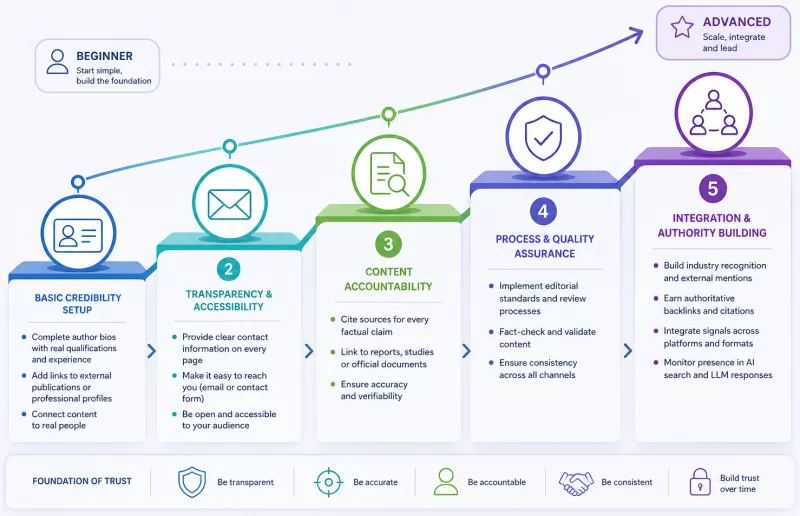
The first action is completing author biographies - not with a one-liner, but with information that includes specific qualifications, professional experience, and, where possible, links to external publications or professional profiles. This is the minimum required for an algorithm to have any chance of linking content to a real person.
The next step is clear contact details - an email address or contact form accessible directly from every subpage, not buried in a footer four levels deep. This is accompanied by clear source labeling: every factual claim should have its basis indicated - a report, a study, an official document. This does not require an academic apparatus of footnotes; a link or explicit attribution is sufficient.
These actions are not purely "SEO hygiene" - they are business standards that allow small brands to build credibility at a level previously reserved for large publishers.
What specialists and teams should implement
At the advanced level, what matters is content governance - the formal management of who verifies published material and how. Content generated or assisted by AI requires substantive review by a qualified specialist: the human-in-the-loop model (a human in the verification loop). Scanning the text for typos is not enough. Verification means fact-checking, assessing the currency of data, confirming alignment with the expert's position, and removing generic sentences that sound credible but contribute nothing specific.
A well-constructed editorial policy should openly describe this process: who decides on publication, what the substantive review looks like, and how often content is updated. Such a document not only reassures readers - it is a signal to algorithms evaluating the transparency of editorial intent.
The next level of maturity is integrating signals from different communication channels. Brand authority is built at the intersection of several streams: owned content on the site, PR activity in industry media, guest articles in external publications, and the presence of brand experts in public discussions (conferences, podcasts, expert commentary).
Each of these activities in isolation produces a weak signal. Together, they create a dense network of mentions that is legible to both traditional algorithms and language models analyzing what reputation a brand has built within its industry environment. A practical rule: every external publication by a brand expert should have a counterpart in the brand's own channel - an in-depth analysis, a summary, or context that links the external mention back to the domain.
Common pitfalls when optimizing for credibility
Superficial implementation of E-E-A-T standards produces the opposite of the intended effect - and it does so subtly enough that the problem is often only noticed after a major algorithmic update.
The first common pitfall is fictitious author profiles. Creating accounts with a vague description like "finance expert" - without verifiable data, links to actual publications, or any trace in public sources - is a cosmetic fix. Algorithms are increasingly effective at detecting the absence of external confirmation for declared expertise, and readers - especially professional ones - immediately sense the artificiality of such profiles.
The second pitfall is concealing commercial intent. Content that is clearly conversion-oriented but poses as an objective guide lowers the Trustworthiness signal. Clearly labeling an article as promoting a product or containing affiliate links is a better long-term strategy than camouflaging intent - both ethically and algorithmically.
The third, and perhaps most common, is mass publication of AI-generated content without expert editorial review. In the short term this may increase content volume on a site, but if that material offers no unique insights, is full of generic statements, and has not undergone factual verification, it effectively dilutes the quality profile of the entire domain. Language models that learn from such content treat it as a weak signal - and proportionally cite it less often.
How to measure the impact of E-E-A-T on brand visibility
The effects of building authority are objectively measurable - both quantitatively and qualitatively. The challenge is not a lack of data but the need to track several categories of indicators simultaneously and interpret them together.
The first category is organic traffic and its stability during algorithmic updates. Brands with a strong E-E-A-T profile typically do not experience sharp drops in visibility after quality-focused updates - which is itself a diagnostic signal.
The second category is external brand mentions: the number of citations in industry media, backlinks from credible domains, and appearances by brand experts in external publications. Growth in these indicators over time correlates with building Authoritativeness.
The third, and technically most difficult, category is the presence of brand citations in responses generated by LLMs. Regularly testing a set of 5–10 industry questions across different AI tools - noting whether and how the brand is mentioned - allows progress to be tracked over time. It is worth distinguishing quantitative measurement (number of mentions) from qualitative measurement (context, the brand's role, accuracy of attribution). An analytics platform such as BrandInAI can help in systematically quantifying this data and transforming it into reproducible reports, eliminating the need to manually search through multiple models.
Qualitatively, it is worth conducting regular content audits for consistency of E-E-A-T signals: whether author bios are up to date, whether contact details are visible, and whether the editorial policy is explicit and complete.
The future of brand trust: Synthesis and next steps
The four pillars of E-E-A-T - Experience, Expertise, Authoritativeness, and Trustworthiness - reflect something older than algorithms: the principles that determine whom we trust as readers and as decision-makers. Algorithms are codifying these intuitions into measurable signals with ever-greater precision, and large language models are transferring this mechanism to a new layer - the decision about whose knowledge is worth citing in response to a question.
For branding strategy, this represents a structural shift in priorities. Brand visibility is no longer solely a function of an advertising budget or the number of published articles. It becomes a function of verifiable reputation: who stands behind the content, what is known about that person or organization from external, independent sources, and how consistent that information is across the entire digital ecosystem. Brands that have invested in this profile gain a stability unavailable to those that relied solely on volume.
Finally, three concrete operational steps for organizations that want to begin systematically improving their E-E-A-T:
The first is a methodical audit of existing assets - reviewing current content for the completeness of author profiles, the currency of factual information, and the consistency of brand data across the entire domain. An audit identifies the largest gaps before the algorithm does.
The second is prioritizing formal expert verification - selecting the brand's key thematic areas and ensuring that content in those areas is associated with genuinely identified experts whose qualifications are publicly verifiable.
The third is testing measurable mentions - launching systematic monitoring of how often the brand appears in generative AI engine responses to questions related to its industry, and comparing those results over time. This is not a one-off experiment but the beginning of a continuous process of managing visibility in an environment that changes faster than any that came before it.