How to check if ChatGPT knows your brand? First steps for marketers

Why ChatGPT is the new search engine for your customers
When someone asks ChatGPT "what project management software should I choose for a small business," they don't get a list of links - they get a recommendation. With arguments, a comparison of options, and often a specific product name. If a brand doesn't appear in that answer, it doesn't exist for that person - regardless of how well it ranks in Google results.
This is the essence of the shift being observed in consumer behavior. Language models like ChatGPT are becoming the first point of contact for product research, service comparison, and opinion gathering. For marketers and brand managers, this raises a question that simply didn't exist until recently: does a language model even associate our company with anything, and what does it say about us?
The goal of this article is to walk through a self-directed, free ChatGPT brand audit - no technical knowledge required, no specialist software, just a step-by-step process.
Before getting to the practical part, however, one fundamental limitation needs to be understood. Language models are trained on data collected up to a certain point in time - after that so-called data cutoff (the training deadline), the model has no access to new information unless it has been equipped with web-browsing tools. This means that press coverage from a few months ago, new products, or changes in communication strategy may be invisible to the model. What's more, language models don't verify facts - they generate text that sounds credible based on patterns in training data. The result is so-called hallucinations: confidently stated information that is simply untrue. Every audit result should be treated as a signal to verify, not as a certified account of brand knowledge.
How to prepare a reliable test: three principles before typing the first prompt
The difference between an audit and simply playing around with a chatbot lies in repeatability. If results aren't documented, they can't be compared three months later, and there's no way to know whether anything has changed.
Before running the first prompt, prepare a simple spreadsheet - Google Sheets or Notion will do - and record: the date of the test, the model version (e.g. GPT-5.4, GPT-5.2), the system prompt (the content of any system instruction used; if using a standard chat interface, note "none"), the temperature (if using the API; in standard chat, note "default"), and the number of repetitions for each prompt.
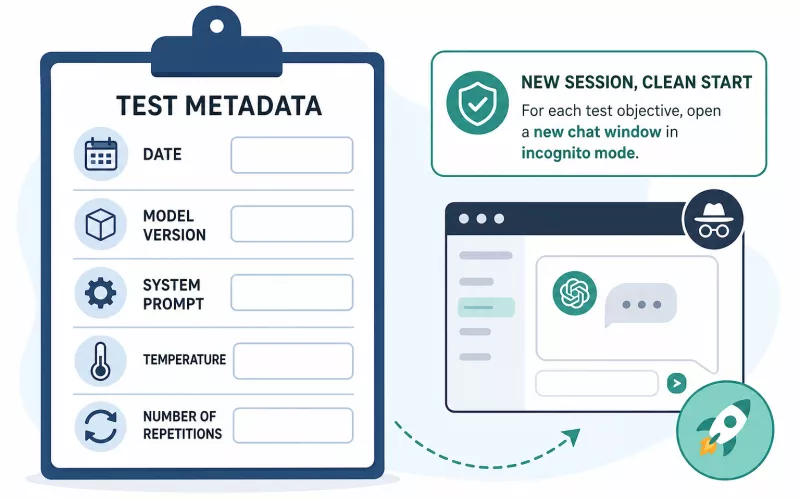
That last point deserves separate emphasis. Skipping metadata may seem like a minor shortcut - until, six months later, the results turn out to be impossible to compare. Without knowing which model version was used and when, there's no way to tell whether any improvement stems from communication efforts or from a model update by OpenAI.
Each distinct test objective should be run in a new chat window (a new session) - ideally in private (incognito) mode. Incognito mode reduces the risk of context carrying over between sessions and provides a cleaner starting point for each test. Within a single conversation, language models "remember" previous answers and may use them to correct or maintain consistency in subsequent responses. This distorts measurement - every session should start without context from previous questions. Where possible, it's also worth running the same set of prompts in one or two other models - such as Gemini (Google) or Claude (Anthropic) - to separate genuine gaps in brand presence from differences between individual providers.
Protecting confidential data when working with public models
In public interfaces such as ChatGPT, data entered by users may be used for further model improvement - though the specific rules depend on account settings and the service's terms of use. Regardless of current privacy policy, one hard rule applies: never paste financial data, unpublished strategies, contracts, customer data, or any information covered by a confidentiality obligation into prompts. A brand audit requires none of this - all prompts below operate exclusively on publicly available information.
Brand audit prompts: what to look for in AI responses and how
An effective audit doesn't come down to a single question - "what do you know about our brand?" A model might pack facts, speculation, and outright fabrication into that one answer, and the whole thing will look coherent at first glance. That's why queries need to be broken down by specific intent - each one tests a different dimension of the model's knowledge.
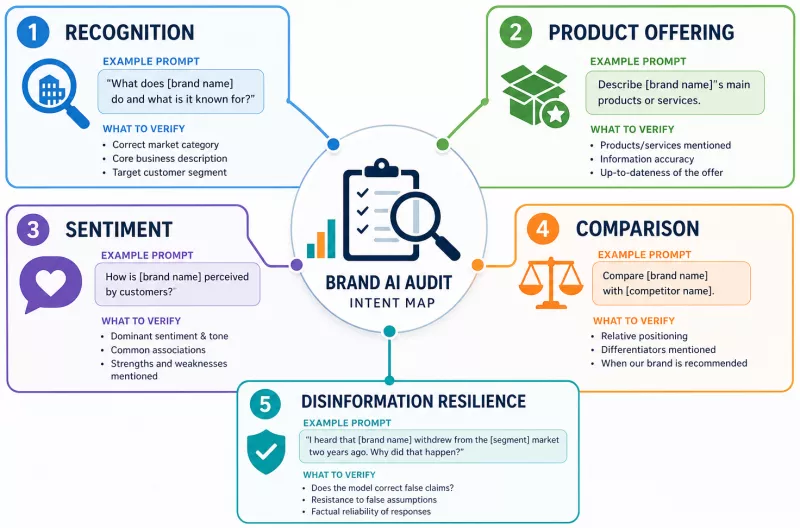
A key methodological principle: each prompt should be run at least three times in separate sessions, and the responses compared. If the model states different facts each time, or claims in one session that the brand is a market leader and in another that it's a niche player, that's a signal the model doesn't have stable, data-grounded knowledge about the company. The averaged picture from three runs is more meaningful than any single result.
Testing basic knowledge and product offering
The starting point of the audit: checking whether the model even recognizes the brand and whether it can correctly describe what the company does.
Sample prompt templates:
-
"What does the company [brand name] do?"
-
"Describe in a few sentences the business profile of [brand name] and its main products or services."
-
"What customer segment is [brand name]'s offering aimed at?"
When reviewing responses, pay attention to several elements. Does the model assign the brand to the correct market category? Incorrect categorization - for example, describing a B2B company as consumer-facing - is a signal that public sources don't define the brand clearly enough. Are the products or services mentioned current? Models frequently retain information about product lines discontinued years ago while failing to mention newer offerings that appeared after the training cutoff. Every outdated reference is worth noting - it becomes a ready-made list of gaps to address.
Analyzing brand image, sentiment, and consumer opinion
Language models synthesize opinions from across the web - reviews, articles, forums, industry media - and assign a brand a particular emotional charge. This synthesized picture can be completely detached from what the company communicates about itself, yet at the same time closely aligned with what customers actually think. That's why asking the model about reputation is worthwhile - not just to learn about brand image, but to understand what stereotype about the brand is encoded in the training data.
Sample prompt templates:
-
"What reputation does [brand name] have among customers?"
-
"What are the main advantages and disadvantages of [brand name] according to public opinion?"
-
"What is [brand name] most commonly associated with in the context of [industry]?"
When analyzing responses, look for dominant adjectives and associations - those words describe how the brand is perceived within the ecosystem of public content the model learned from. If the brand comes up associated with "low price" rather than "quality," despite the brand strategy pointing in the opposite direction, that's a specific signal for communication action.
Head-to-head competition through the eyes of artificial intelligence
Customers are increasingly asking AI models for comparisons: "which platform is better: X or Y?" or "who is the market leader in category Z?" It's worth checking how ChatGPT positions a brand relative to competitors before a customer does the same while making a purchasing decision.
Sample prompt templates:
-
"Compare [brand name] with [competitor name] - in what areas is each one better?"
-
"Who are the main competitors of [brand name] and how does it differ from them?"
-
"In what situations should a customer choose [brand name] over [competitor name]?"
Key observations: does the model treat the company as a segment leader or as a budget alternative? Does it mention the brand unprompted when a question is general (e.g. "what CRM should I choose"), or only when the brand is explicitly named in the prompt? The latter suggests low spontaneous visibility - the model knows the brand, but it doesn't dominate its associations with the category.
Testing resilience to industry myths and misinformation
This test is probably the most revealing. It checks not only what the model knows, but also how it responds to false assumptions - whether it corrects an error or easily yields to a suggestion embedded in the question.
The technique involves deliberately weaving a false assumption into the prompt:
-
"I heard that [brand name] withdrew from the [specific segment] market two years ago - why did that happen?"
-
"Apparently [brand name] went through a serious reputational crisis after the [fabricated event] scandal - how did that affect the brand?"
-
"Is it true that [brand name] is currently owned by [false owner name]?"
A model grounded in reliable data should challenge the false assumption and correct it. A model without stable knowledge of the brand will often accept the false premise and start building on it - creating an entirely fabricated narrative. If ChatGPT confirms events that never happened, that's a clear signal that the brand's visibility in ChatGPT is too low for the model to resist the suggestion.
The problem of common and ambiguous brand names
Not every brand has the luxury of an unambiguous name. Companies whose names are also ordinary words - like "Compass," "Horizon," "Phoenix," or "Leader" - face an extra obstacle during the audit: the language model defaults to answering about the concept, not the company.
When a question simply reads "what does Leader do?", ChatGPT may respond about the traits of a leader as a person, about leadership theory, or about some entirely different company with the same name in a different market. The answer will sound reasonable - and that's precisely what makes it misleading.
The solution is straightforward: always narrow the context of the brand name when there is a risk of ambiguity. In practice, this means adding one of several qualifiers to every prompt:
- the industry - e.g. "the company Leader operating in the real estate sector,"
- the product category - e.g. "Horizon as a manufacturer of office furniture,"
- an explicit label - e.g. "the company called Phoenix" rather than just the word "phoenix,"
- a location - e.g. "the Polish company Compass specializing in logistics."
The same issue applies to brands whose names overlap with well-known products, natural phenomena, technical terms, or other companies from different countries. If a brand shares its name with a popular industry term, the model will almost always respond about the term first - unless the prompt clearly points to the specific entity.
It's also worth testing how significant the ambiguity risk actually is. Simply asking the model without any qualifier - "what do you know about [brand name]?" - is enough. If the response is about a concept or a different entity, that's a signal the brand has a serious distinguishability problem in the training data - and that any user who types just the name is probably not going to find information about the company.
How to interpret results and plan corrective action
After collecting responses across several sessions for each prompt, the question arises: how to tell reliable information from hallucination?
A practical interpretation framework looks like this:
-
Repeatable and verifiable details (dates, product names, specific numbers) = a signal of genuine brand presence in public sources.
-
Variable generalities with no possibility of verification = weak model knowledge about the brand.
-
Confirmation of a false assumption from the misinformation test = susceptibility to hallucination; the brand is not sufficiently represented.
A response grounded in real data typically contains specific, verifiable details: dates, product names, concrete figures that can be checked against publicly available sources. A hallucination, by contrast, tends to operate on smooth generalities - the model confidently states things that sound plausible but can't be confirmed in any source. Fabricated award names, partner organizations, or founding dates are typical symptoms.
A practical verification procedure: every concrete claim in the model's response should be cross-checked against reality - the brand's website, press coverage, industry databases. Claims that can't be confirmed are treated as potential hallucinations and noted separately.
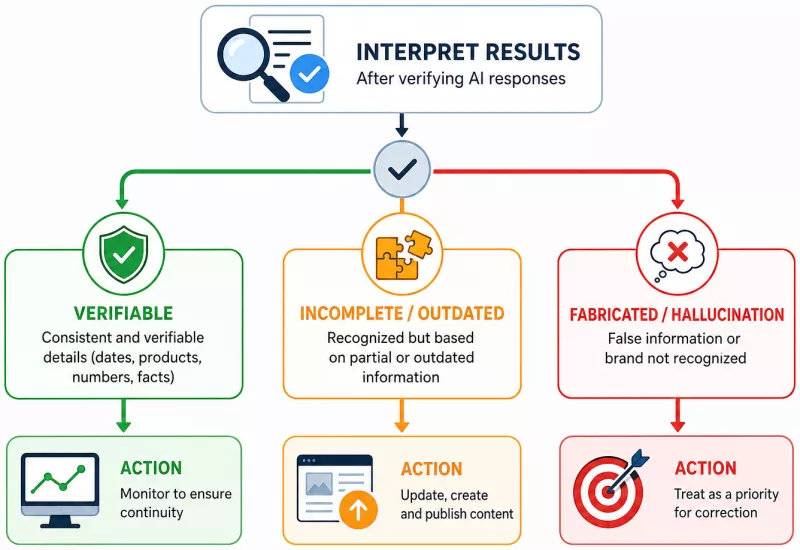
After verification, the material can be divided into three categories:
First: correct and current information - the brand is visible and the model understands it accurately in this area. Action: monitor to maintain that state.
Second: incomplete or outdated information - the brand is recognized, but the model describes it based on older data. Action: publish authoritative, canonical materials on the company website addressing the offering, history, and market position - carefully formatted articles, "About us" pages, FAQs, case studies. This content has a chance of making it into future model iterations.
Third: fabricated information or a complete absence of knowledge - the model either hallucinates or simply doesn't recognize the brand. Action: prioritize filling content gaps; a good starting point is the simplest formats - an article defining the brand and its category, a product page with precise descriptions, and presence in credible industry sources.
Information gaps translate into a concrete publication plan: a list of topics that need to be addressed in publicly available content, prioritized around what the model describes incorrectly or omits entirely.
From manual tests to automated brand monitoring in AI
The process described above has one natural limitation: it works well as a one-off study, but becomes time-consuming when it needs to be repeated regularly - and not just in ChatGPT, but in other models such as Gemini, Claude, or Perplexity.
Manually pasting prompts, documenting everything in a spreadsheet, and comparing dozens of responses every month is real work that a small marketing team simply won't be able to sustain on an ongoing basis. Yet brand recognition in AI is not static - it changes with new model versions, new training data, and the evolving content landscape of the web.
For teams that want to monitor this presence regularly, tools are available that automate the entire process. Platforms of this kind regularly check how a given brand is described by leading language models, track sentiment changes, and deliver measurable metrics over time. One such solution is BrandinAI - a SaaS platform that, beyond basic monitoring, also detects hallucinations and evaluates the factual accuracy of responses. For teams that want to treat AI presence as a regular channel to observe - rather than a one-off project - tools of this kind represent the difference between a single snapshot and a continuous monitoring system.
Summary: visibility in AI is an ongoing process, not a one-time project
A ChatGPT brand presence audit provides no certificate and no guarantees. What it does provide is a concrete picture of the model's current knowledge about the company - broken down into what it knows correctly, what it knows incorrectly, and what it doesn't know at all. That's a sufficient starting point for action.
Three takeaways worth carrying from this article: first, a structured testing environment - date, model version, number of repetitions - is a prerequisite for results to have any comparative value over time. Second, dividing queries by specific intent (recognition, facts, sentiment, comparison, misinformation resilience) produces a multi-dimensional picture that no single general question can deliver. Third, the ability to filter out hallucinations - looking for verifiable details rather than smooth generalities - is essential to avoid drawing false conclusions from the model's seemingly confident answers.
An operational checklist to close:
-
Document the current audit results with full metadata (date, model version, temperature, system prompt) and keep them as a reference point.
-
Publish substantive, canonical content on the official company website that addresses the identified gaps - especially where the model describes the offering in outdated or inaccurate terms.
-
Set a regular schedule for subsequent audits (quarterly is a reasonable minimum, monthly is optimal) and at each round compare results against the previous state, tracking three metrics: brand recognition, factual accuracy, and dominant sentiment.
This is not a one-time project - it is a new habit for the communications team.