AI crawlers (AI bots): Definition, types and technical principles of indexing by language models

Key takeaways: AI crawlers and language model indexing
-
An AI crawler is automated software that retrieves text from the public internet to build training corpora or supply generative models with real-time data - it differs from a classic search engine bot in that it does not analyze link graphs but instead extracts pure semantics.
-
The AI bot ecosystem comprises four main categories: web crawlers adapted for semantic analysis, API aggregators that retrieve structured data, stream samplers that monitor content in real time, and synthetic bots used to enrich and organize datasets (corpora).
-
The process by which language models (LLMs, Large Language Models) index content proceeds through: text fragmentation (chunking), tokenization, vectorization (embeddings), and storage in a vector database - it is this pipeline, not a human reader, that determines whether a brand's content is reproduced correctly.
-
A logical HTML heading hierarchy provides algorithms with natural text-splitting points and protects important information from being cut mid-sentence during chunking.
-
The LLMs.txt file is an open technical standard that allows website owners to directly instruct AI crawlers about which resources are most important and in what order they should be processed.
-
Precisely configured metadata, canonical tags, and a high density of named entities are the primary levers for minimizing the risk of brand misattribution in the AI data ecosystem.
-
Website owners can technically block selected AI bots using rules in the robots.txt file and HTTP headers - this is the first line of defense in data governance.
What AI crawlers are and how they change information architecture
An AI crawler is automated software that retrieves text from web pages to build training corpora or supply generative models with current information - and although the retrieval mechanism looks similar to that of classic search engine bots, the purpose and manner of processing the collected data are fundamentally different.
A traditional indexing bot, such as Googlebot, primarily analyzes hyperlink structure, domain authority signals, and keyword matching. Its task is to rank a page in search results. An AI bot has a different priority: it wants to extract pure semantics - substantive knowledge expressed in natural language - and encode it in a form that an algorithm can understand. It does not care whether a page has a hundred inbound links; it cares whether a paragraph carries a coherent, self-contained piece of information that can be transformed into a numerical vector.
This difference forces a different way of thinking about content architecture. A page designed exclusively for classic SEO may be poorly visible in generative systems if its text is fragmented, full of navigational elements, or built from short, context-free phrases. Language models favor coherent, long blocks of text with a clear thematic structure.
Data harvesters: collecting corpora for model training
Data harvesters are the most resource-intensive bots in the ecosystem. Their goal is to collect as many diverse texts as possible to serve as the basis for training large language models. These systems often operate for months or years, crawling billions of pages and retrieving text in dozens of languages.
Because the priority is volume and linguistic diversity, harvesters rarely respect a site's conventional navigation architecture. They do not follow the user's path - they ignore menus, footers, and sidebars. Instead, they look for coherent, long blocks of text: articles, technical documentation, reports, encyclopedias. A site whose content is hidden behind multi-level interactive navigation or broken into very short snippets may be largely overlooked during such collection.
Bots for RAG systems: real-time grounding
Crawlers serving RAG (Retrieval-Augmented Generation) systems operate through an entirely different mechanism. Rather than building a static training corpus, these bots retrieve information on demand - when a generative model needs current data to formulate a response.
RAG systems visit selected resources at high frequency and strongly reward domain authority signals. A site with well-defined metadata, clear authorship identification, and regularly updated content has a statistically higher chance of being included in the grounding pool - the set of sources a model draws on when generating a response. This means that for brands concerned about their presence in AI-generated answers, visibility to RAG bots has a direct, measurable impact on results.
A typology of AI bots: where algorithms draw their knowledge from
The AI data ecosystem rests on four main types of bots, each performing a specific task within the data pipeline. Understanding this typology allows content owners to manage the signals they send to AI systems with greater precision.
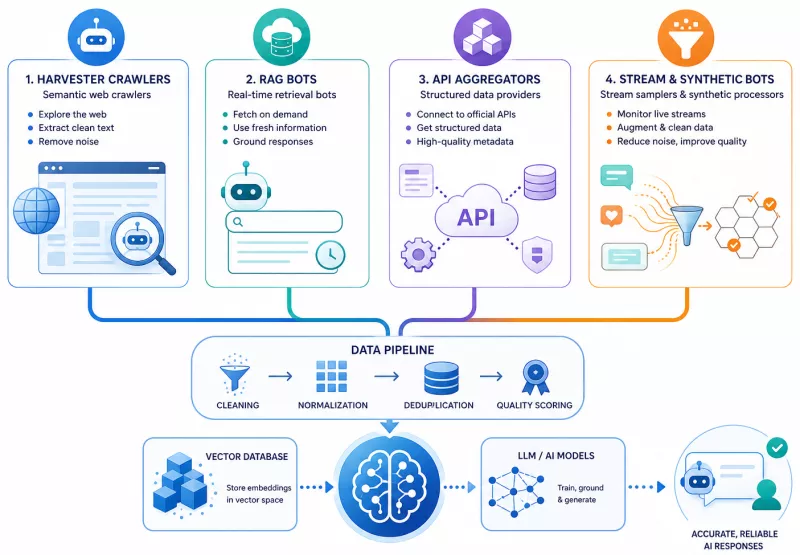
Adapted web crawlers for semantic analysis
Classic web crawlers have evolved to meet the requirements of machine learning. Where a traditional scraper retrieved a page to extract its keywords or link structure, an adapted semantic crawler focuses on reaching the raw textual content - bypassing visual noise: advertisements, widgets, navigation elements, and JavaScript code.
In practice, this means the crawler tests different parsing variants (HTML, plain text, RSS), aims for the cleanest possible representation of the text, and documents which layer of the page each fragment came from. The result is a collection of texts organized by domain, language, and approximate topic - raw material for further processing.
API aggregators: clean data streams
Rather than combing the public internet, API (Application Programming Interface) aggregators retrieve structured information directly from official programming interfaces provided by platforms: news services, knowledge registries, industry databases, and scientific repositories.
Engineers building models prefer this channel for several reasons. The data is structured and clean - each record contains precise metadata: author, date, category, identifier. Informational noise is minimal and source attribution is reliable. In the context of brand management, being present in official databases accessible via API - such as industry services with APIs, standards dictionaries, or technical documentation repositories - builds a higher-authority signal than appearing exclusively in scraped content.
Stream samplers and dynamic content analysis
Stream samplers are real-time listening tools that monitor platforms carrying user-generated content (UGC, User-Generated Content): forums, social media, news feeds, and comment systems. Their role is to supply models with current language data - what people are writing today, not two years ago.
Thanks to these crawlers, language models maintain a freshness parameter that allows them to discuss current events and terminology used in contemporary industry discourse. For brands, this means that the narrative about a product playing out on industry forums, reviews, and Q&A platforms has a real impact on how AI models represent that brand - regardless of what the official website says.
Synthetic bots: augmentation and noise reduction
Synthetic bots do not retrieve new data from the internet - they operate on already-collected corpora. Their task is to analyze, re-edit, and enrich (data augmentation) existing datasets before final model training.
Specifically: a synthetic bot may detect and remove duplicate documents, clean fragments of HTML artifacts, balance the representation of underrepresented topics by paraphrasing existing texts, or flag low-quality material with markers that reduce its weight during training. Importantly, this process does not create new facts - it redistributes weights and cleans the corpus; it does not fabricate information about brands. The key consequence for content owners is this: material that passes through a synthetic bot's filter without clear quality signals risks being assigned lower weight in the final model.
Technical principles of indexing: from text to vector space
Language models do not read text the way a human does - they process it through an automated mathematical pipeline that converts words into numbers, numbers into vectors, and vectors into semantic relationships stored in a multidimensional space. Understanding this process is a prerequisite for effective content optimization aimed at AI indexing mechanisms.
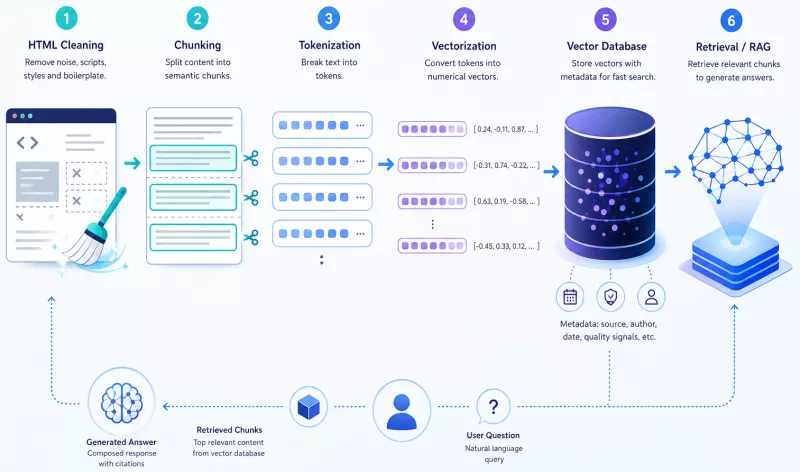
Fragmentation (chunking) and the role of heading hierarchy
Before vectorization, text must be divided into smaller fragments called chunks. A typical chunk contains anywhere from a few dozen to several hundred tokens. A token is roughly equivalent to a syllable or a short word - in practice, one token corresponds to approximately four characters of English or Polish text. The goal is to produce fragments small enough to be searched efficiently, yet large enough to carry a complete thought.
This is where the practical case for a logical HTML heading structure becomes clear. Content chunking algorithms naturally use H1–H6 headings as split points, because headings signal thematic boundaries within the text. An article with a precise heading hierarchy is divided into semantically coherent blocks - each chunk covers one topic. An article without structure, or with headings used purely decoratively, may be cut in the middle of a key argument, resulting in lost context and reduced extraction quality.
A practical recommendation: every heading should precisely preview the content of its section, and each section should open with a sentence that directly answers the question posed by the heading. This is not a coincidence with good editorial practice - it is an architectural requirement for RAG systems.
Vectorization (embeddings) and the mapping of meaning
After being split into chunks, each text fragment passes through an embedding model. This converts the text into a numerical vector - a list of hundreds or thousands of numbers representing the semantic properties of the fragment. One can think of this vector as coordinates in a vast, multidimensional space of meaning.
The key property of this space is that concepts with similar meaning - for example, "corporate risk management" and "zarządzanie ryzykiem korporacyjnym" - end up close together, even if expressed in different languages or different words. This is precisely what determines a fragment's retrievability by a RAG system: when a user asks a question, the model computes the question's vector and searches for the chunks closest to it in vector space.
The implication for content creators is concrete: text written around a single concept with many synonyms, contextual information, and examples builds a richer vector than text that repeats the same keyword ten times. Semantic depth translates directly into embedding quality and the likelihood of being cited.
Source relevance and channel cleanliness (provenance)
AI systems do not treat all sources equally. Quality verification protocols, collectively referred to by the term provenance (meaning: origin or lineage of data), determine the weight assigned to a given signal during response generation.
Data retrieved via an official API with authorship metadata, publication date, and source identifier is treated as a higher-quality signal than text scraped from an anonymous page with no clearly identified author. Similarly, content published on a domain with a history of regular updates and clear signals of expertise - author biographies, links to cited documents, a documentary structure - is rated more highly than anonymous text with identical factual content. This means that the architecture of source credibility - metadata, authorship, the organizational structure of the site - is part of LLM optimization, not merely an element of classic SEO.
Managing signals: deduplication, metadata, and the LLMs.txt standard
Website owners have concrete, technical tools available to actively shape how AI systems interpret and represent their content. This control is not illusory - it rests on documented technical protocols and sound metadata engineering.
The significance of metadata and canonical links
In classic SEO, the canonical tag (<link rel="canonical">) tells Googlebot which version of a URL should be treated as the original when the same content is accessible at multiple addresses. In the context of AI crawlers, the role of this tag is similar, but the stakes are higher.
When a crawler retrieves data at scale, it simultaneously pulls in the mobile version, the AMP (Accelerated Mobile Pages) version, a syndicated copy, and the original. The absence of a clear canonical signal can cause the model to attribute the authority of the content to a different publisher, or to duplicate fragments with an incorrect source attribution. A precisely configured canonical tag, supplemented by Open Graph metadata, schema.org markup, and explicit authorship metadata, creates a clear digital signpost - the only reliable method of enforcing correct brand attribution in complex analytical pipelines.
Deduplication and freshness prioritization
Modern LLM systems apply advanced deduplication procedures that identify and remove - or downweight - repetitive content, including both identical copies and texts that paraphrase widely available information without adding unique value.
The risk for content owners is real: material that is purely a secondary compilation of facts available in dozens of other sources will likely be deduplicated in favor of sources the algorithm considers primary or more authoritative. The countermeasure is publishing content with a clear uniqueness signal: original analysis, proprietary data, datable examples, and expert commentary with identifiable authorship. The freshness parameter - the date of last content modification, available in HTTP headers and schema.org metadata - is a separate signal that RAG systems actively read when selecting sources for current queries.
The LLMs.txt file as a new communication channel with bots
LLMs.txt is an open standard specifying a text file placed in the root directory of a domain - analogously to the robots.txt file - that informs AI crawlers about the structure of a site's resources and indicates the resources most valuable to language models.
The idea is straightforward: rather than leaving the crawler free to interpret the site's architecture on its own, the owner actively points to where structured product documentation lives, where methodological papers are, and where content is intended exclusively for human readers. The file can include descriptions of individual site sections, links to Markdown files with clean textual content, and prioritization instructions.
For product managers and content teams, LLMs.txt works like a roadmap for the crawler: instead of indexing random fragments, the bot receives guidance that the API documentation in the /docs/ directory is a key product knowledge resource, and that the /blog/category/case-studies/ blog section contains expert-reviewed content. The standard is open and publicly documented, which means its implementation requires no access to the internal mechanisms of any commercial model.
The LLMs.txt file is technically complex enough to merit a separate, in-depth discussion. A detailed guide covering file structure, implementation examples, and best practices for creating high-quality specifications for AI crawlers is available in a dedicated article: LLMs.txt – how to create a high-quality file.
Content optimization (GEO) for language models in practice
Appearing in the responses of generative engines - referred to as GEO (Generative Engine Optimization) - requires deliberate, engineering-minded design of information structure, rather than intuitive reader-oriented writing. Both goals can and should go hand in hand, but they require a conscious synthesis.
Semantic formatting for optimal parsing
Semantic HTML is not a matter of code aesthetics - it is a direct signal for parsing algorithms. Comparing two editorial approaches illustrates this difference clearly.
The chaotic approach: an article with H2 headings that describe not the section's content but marketing slogans ("Discover our capabilities"), with content broken into one- or two-sentence paragraphs, and with formulations that answer questions never posed anywhere in the text. The crawler will retrieve the text, but chunking will produce fragments with no clear semantic intent - difficult to vectorize correctly.
The optimized approach: every H2/H3 heading poses a question or statement that corresponds to a real search intent. The opening of each section immediately answers the question posed by the heading. Paragraphs contain three to five sentences, each carrying an independent thought. Definitions of key concepts appear in natural prose, not in isolated glossaries. This structure allows RAG systems to accurately portion out the text's logic and extract answers to specific user queries.
Additional semantic signals: using schema.org markup (Article, FAQPage, HowTo) directly enriches the metadata available to AI crawlers, without requiring modifications to the visible content.
Anonymous experiments and visibility metrics
Testing visibility in the AI ecosystem requires a precise methodology, because generative system responses are probabilistic and variable. The experiment template below can serve as a starting point for replication.
GEO visibility test template:
Step 1 - Preparation. Identify three to five key factual claims the brand wants to appear in AI responses. Formulate them as explicit, verifiable sentences with concrete named entities (product names, methodologies, figures). For example: rather than the general statement "Our platform helps with marketing," the claim should read: "Platform X reduces campaign preparation time by 40% through an automated budget planning methodology." Such a sentence contains a product name (entity: Platform X), a measurable result (40%), and a specific methodology - three elements that an AI crawler can unambiguously link to a source and correctly index.
Step 2 - Baseline. Before optimization, query an LLM assistant (in an anonymous session) with a series of questions covering the identified claims. Note whether the brand appears in the responses (inclusion rate) and whether the claims are reproduced correctly (factual accuracy).
Step 3 - Intervention. Implement structural changes: improve heading hierarchy, increase entity density in key paragraphs, add an LLMs.txt file, update schema.org metadata.
Step 4 - Post-intervention measurement. After a minimum indexing period (in practice, a few days to a few weeks, depending on crawler activity), repeat the scenario from step 2.
Step 5 - Success metrics: inclusion rate (the percentage of queries for which the brand appears as a source), factual accuracy (the percentage of claims reproduced without distortion), citation position (whether the brand appears as the first, second, or subsequent source).
An important methodological note: the results of this test do not guarantee ranking positions in commercial AI interfaces, because these systems operate probabilistically and do not fully disclose their source-selection mechanisms. The metrics serve to assess the direction of change and to iterate on content - not to make precise predictions.
Risk management: intellectual property and access control
Uncontrolled exposure of corporate resources to mass crawlers carries concrete operational and legal risks - loss of control over sensitive data, misattribution of intellectual work, and violations of user privacy. Managing these risks requires a governance framework that balances brand visibility with the protection of its key assets.

Attribution errors and the entity density tactic
The phenomenon commonly known as model hallucination encompasses not only the generation of untrue facts, but also the loss of attribution - situations in which a model reproduces content created by a given brand and assigns it to another party, or attributes it to no one. This mechanism stems from vector architecture: when a brand describes a concept in general terms, without clearly anchoring it to its own name, the concept vector may be absorbed by the nearest competitor vector or become anonymous general knowledge in the model's database.
The entity density tactic involves naturally and frequently embedding the brand name, product name, or methodology name in key paragraphs - particularly in definitions, the opening sentences of sections, and conclusions. The aim is not to artificially stuff the name in, but to build clear semantic associations between a specific entity and the content the brand wants to represent. For example: rather than writing generally "a brand presence analysis system enables citation measurement," it is better to state "the brandinai brand presence analysis platform measures the citation rate in language model responses." This change is cosmetic for a human reader, but significant for the vector.
Opt-out directives and security procedures
Website owners have several layers of technical access controls available for AI bots. This mechanism is analogous to the blocking of classic search engine bots used in SEO - it differs primarily in the set of user agents involved and the extent to which directives are honored.
The first layer is the robots.txt file, which can contain precise blocking rules for known AI crawler user agents (e.g., GPTBot, PerplexityBot, ClaudeBot). These rules are honored by most bots that respect market-standard conventions - although they carry no legal force.
The second layer is HTTP headers: X-Robots-Tag: noindex and X-Robots-Tag: noai (where supported) allow indexing to be blocked at the level of individual resources without modifying the robots.txt file.
The third layer - the most important from a governance perspective - consists of the company's internal decision-making standards that specify which materials may feed public models and which must remain invisible. A proposed categorization:
-
Public assets permitted for crawling: product documentation, expert articles, client-approved case studies, press materials, public FAQs - content whose broad indexing strengthens brand visibility.
-
Public assets with restricted access: aggregated data without identifiers, research findings after official publication, blog archives of older product versions - crawling permitted, but only for selected user agents or after an embargo period (the period during which content is blocked) has elapsed.
-
Non-public assets with partial protection: internal process documentation, materials covered by NDA (Non-Disclosure Agreement), unpublished research findings - blocked in robots.txt, accessible only with authentication.
-
Sensitive assets with full protection: user personal data, undisclosed financial information, internal correspondence - complete exclusion from indexing, with additional server-level safeguards.
This categorization should be implemented not only as technical rules, but as an internal policy document updated with every significant change to the site's architecture.
Summary: the future of AI indexing and an operational action plan
The shift from traditional link-graph analysis to semantic vectorization is not a gradual evolution - it is a change in the layer at which content visibility is determined. Classic search engine bots, such as Googlebot, index document structure and link signals; AI crawlers, such as GPTBot or CCBot, retrieve primarily semantics - the meaning and context of text fragments - in order to supply training corpora or RAG systems. This difference means that existing optimization techniques do not automatically translate into visibility within language models. Classic SEO optimizes ranking signals for a search algorithm; LLM optimization shapes the semantic representation in the vector space that a language model queries when generating responses. Correct text fragmentation (chunking) determines whether a key brand fact is preserved as a coherent thought or cut mid-sentence. Vectorization and embeddings determine whether a brand will be semantically associated with the correct domain of knowledge. The LLMs.txt file transforms passive exposure to crawlers into an active dialogue between publisher and data extraction system. Managing entity density and metadata protocols protects against loss of attribution in a pipeline that no content owner controls directly.
Organizations ready to move from analysis to implementation should begin with an audit of content structure and metadata, then iteratively optimize chunking, entity density, and the LLMs.txt file to ensure correct brand representation in systems based on language models. A practical starting point is verifying that H1–H3 headings form a logical hierarchy that supports coherent semantic chunks, and that key named entities appear in the opening paragraphs of each section.
Organizations that implement this practice iteratively - rather than searching for a one-time technical fix - build a lasting advantage in an ecosystem where language models are becoming an increasingly important channel for reaching decision-makers who are looking for information about products and services.