LLM model temperature: What AI creativity means and how it affects marketing activities


In short
What is LLM model temperature and how does it affect AI creativity and brand consistency in generated content. Learn when to set a low vs. high temperature and how it influences company name usage and control over marketing communication.
Why does AI sometimes use a brand name and other times skip it?
A generative AI-driven content campaign runs without issue for a week - and then a problem appears. With identical prompts, the model mentions the company name three times in the right places in one response, and in the next it replaces it with a pronoun or the generic term "brand." The brief hasn't changed, the prompt hasn't changed, the editorial guidelines haven't changed. The output has.
For a product manager or marketing leader, this is not a purely aesthetic problem. Irregular presence of a proper name in AI-generated content makes brand communication unpredictable - and difficult to audit. Before this phenomenon can be consciously controlled, however, it is worth understanding one key parameter that largely determines it: model temperature.

The problem with inconsistent brand presence in campaigns
Imagine a content marketing team responsible for a series of product descriptions for an email campaign. The prompt is precise, contains an instruction to use the full brand name, and has a defined length and style. The model generates ten variants. In six of them, the name appears exactly where it should. In three, a pronoun replaces it. In one, it is absent entirely - the model used a neutral noun instead.
From a language engineer's perspective, this behavior is in some sense predictable. From a brand manager's perspective, it is a ticking time bomb. Every deviation from the pattern means an additional round of verification, manual corrections, or the risk that content goes to publication with a brand error. The consequences, however, go beyond the mere presence or absence of a proper name. High variability in word choice also affects communication tone: the same brief can produce a straightforward description of product benefits in one instance and emotional, metaphorical language in the next - language that does not fit the established brand voice. In campaigns that require consistency - email sequences, social media post series, or catalog product descriptions - this stylistic inconsistency makes it harder to build a recognizable brand image and extends the editorial process with additional rounds of review.
The source of this variability is precisely LLM (Large Language Model) temperature - and understanding how it works allows guesswork to be replaced with informed observation.
Temperature defined in one sentence
Language model temperature is a parameter that determines how creatively an AI selects words: whether the model, when choosing its next word, sticks to the safest and most obvious options, or allows itself to reach for rarer, less typical - and therefore more surprising - choices.
It is worth noting immediately: "creativity" here means greater diversity in word selection, metaphors, and sentence structures - not intelligence or the model's factual quality. This article examines the phenomenon specifically through the lens of temperature and its effect on language and brand exposure in generated content.
The temperature scale typically runs from 0 to 2, though the specific range depends on the platform and model. Values close to zero produce deterministic behavior - the model almost always selects the most probable word, resulting in repeatable, predictable output. Values around 1 introduce moderate variety: text remains coherent, but greater stylistic freedom begins to appear. At values above 1, the model increasingly reaches for rarer, less obvious words - which can generate interesting associations, but also increases the risk of omitting specific elements such as a brand name.
How does LLM temperature affect sentence predictability?
Language model temperature directly controls how broadly the model "reaches" into vocabulary at each generation step. A low value forces the obvious choice; a high value opens access to rarer and less typical options.
Every word generated by a language model (LLM - Large Language Model) is the result of a selection from a list of candidates. Before each successive token (a word or word fragment), the model assigns probability values to all possible options - the word that fits the context best receives the highest value, and less fitting words receive lower ones.
Temperature acts like a slider that controls how much these probability differences are respected. At a low value, the differences are sharpened: the model almost always reaches for the option with the highest probability, ignoring the rest. At a high value, the differences flatten - options that were previously low-probability become genuinely competitive. The effect for the end reader is straightforward: low temperature produces repeatable, predictable sentences; high temperature produces variable and diverse content.
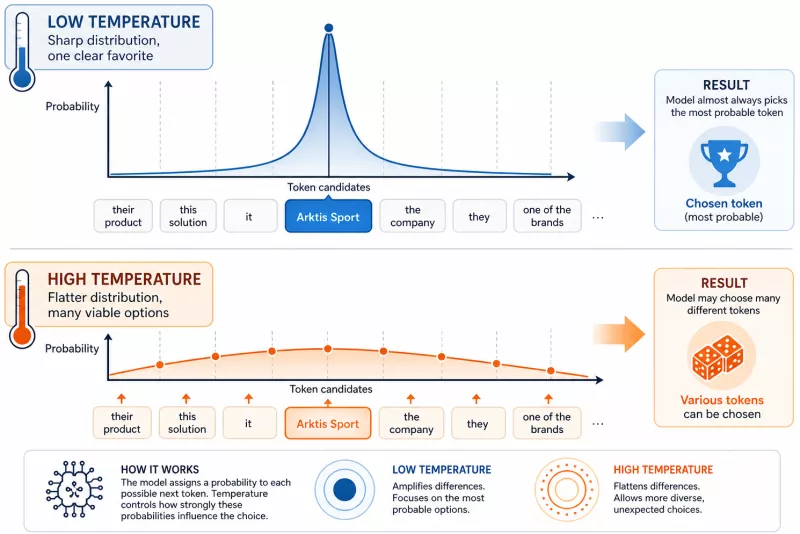
This mechanism is where the answer lies to why the model used a brand name in one instance and not in another. It is not a matter of an error or structureless randomness - it is about how broadly the model "looks around" at available vocabulary options at a given moment of generation.
From obvious choices to non-obvious associations
When temperature is set low, the list of word candidates is effectively narrowed to a few positions at the very top of the ranking. For a sentence describing a specific company's product, the most probable candidate will be the company's full name - because the context points unambiguously to that choice. The model will select it almost every time.
As temperature rises, the list effectively broadens. A pronoun, "their product," "this company's solution" - options that ranked far down the list at low temperature - now become reachable. The model may select them not because the prompt requires it, but because the token sampling mechanism (the process of drawing tokens according to the probability distribution) has opened that possibility.
This is precisely the effect of high temperature that readers interpret as AI's linguistic creativity - greater vocabulary diversity, less formulaic constructions, surprising metaphors. From a technical standpoint, it is simply the effect of drawing more broadly from the probability distribution.
Temperature in practice: How do extreme settings change the finished text?
To move from abstraction to observation, it is useful to look at qualitative examples - how changing this parameter's value manifests in real marketing text. The following examples are not the results of quantitative tests and do not claim to be benchmarks; they illustrate the kind of differences that are observable in everyday work with generative systems.
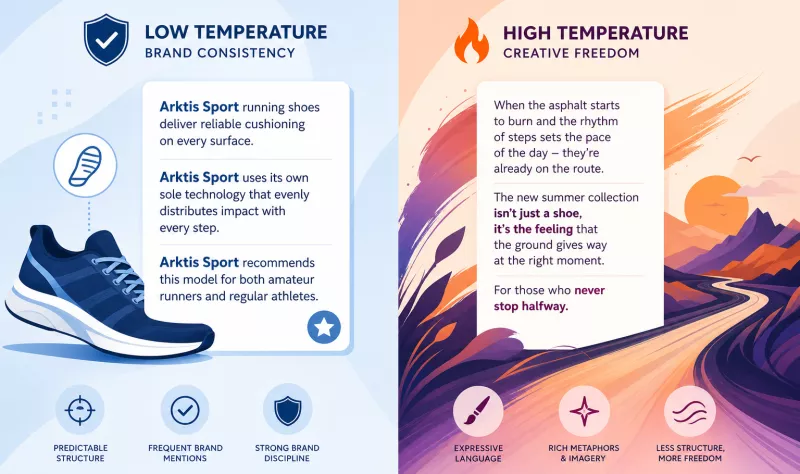
Low temperature: Iron consistency in an official product description
Prompt: "Write a short product description for an online store: New model of running shoes by Arktis Sport. The description should include the brand name and highlight the cushioning technology."
At low temperature, the model generates text similar to the following:
Arktis Sport running shoes are a proposition for runners looking for reliable cushioning on any surface. Arktis Sport has used its own proprietary sole technology in this series, which distributes impact pressure evenly upon landing. Arktis Sport recommends this model for both amateur runners and those who train regularly.
The full brand name appears three times in a short paragraph, sentence structure is predictable, and there are no synonyms or pronouns replacing the name. Low temperature sharpens the probability distribution of tokens and almost eliminates the risk that the model will use a different term in the next run with the same prompt. This is precisely the property that makes low temperature the natural environment for content requiring strict branding discipline - product descriptions, press releases, and regulatory content.
High temperature: Metaphors and freedom in a social media post
Prompt: "Write an engaging Instagram post promoting the new running shoe collection by Arktis Sport. Use energetic language."
At high temperature, the same model may generate text of an entirely different character:
When the asphalt starts to burn and the rhythm of footsteps sets the pace of the day - they're already on the track. The new summer collection is not just a shoe; it's the feeling that the ground gives way underfoot at exactly the right moment. For those who don't stop halfway.
The brand name has disappeared entirely or will appear only in the graphic caption. Sentences have taken on a metaphorical character; the language has become less precise and more suggestive. From a copywriter's perspective, this result may be exactly what they were looking for in an organic post. From a brand manager's perspective, it is a signal that brand consistency in AI content has taken a back seat to expression.
High temperature flattens this distribution: the model reaches for synonyms, pronouns, and metaphors, and breaks structural patterns. Both effects are objectively observable, and neither is inherently worse than the other. The difference lies in what goal a given piece of communication is meant to achieve.
Why does the same temperature value produce different effects in different AI models?
The observation is straightforward: the same nominal temperature value can produce different results depending on the model or platform - and it is worth keeping this in mind before drawing broader conclusions.
Teams working simultaneously with several AI solutions - whether APIs of base models or products with an integrated content generation interface - regularly note that the same nominal temperature value translates into different frequencies of proper name use in outputs. Model A at a setting of 0.3 may behave in practice similarly to model B at 0.6. Output effects can differ significantly even when the number on the slider is identical.
For content teams and prompt engineers (specialists responsible for designing and optimizing instructions for AI models), this means one thing: observations made on one platform do not automatically transfer to another. Assuming full repeatability across models based on the same temperature value is an error that can result in a false sense of control over the content generation process.
Summary: The effect of temperature on brand image management in AI
The starting point was a real operational problem: a campaign in which the model sometimes mentions the company name as briefed and other times omits or replaces it. Behind this variability lies AI temperature - a parameter that controls how broadly the model "reaches" into vocabulary at each step of text generation.
The general rule that follows is simple and descriptive:
-
Low temperature sharpens the probability distribution of tokens - the model selects obvious, repeatable, contextually appropriate options, which translates into a higher probability that a proper name will appear exactly where it should.
-
High temperature flattens this distribution - the model reaches for synonyms, pronouns, and metaphors, and breaks structural patterns, producing text that is more linguistically varied but less predictable from the standpoint of brand consistency in AI content.
-
Low temperature favors repeatable brand mentions; high temperature increases text variance and linguistic creativity - these are practical mental frameworks, not configuration instructions.
It is also worth remembering that the effects of the same setting can differ across the models and platforms available on the market. For product managers and marketing leaders building processes based on generative AI, this means that knowing the parameter is only the first step - awareness of variability between systems is just as important as understanding the mechanism itself.