What is a large language model (LLM) and how can it be used in marketing

Key takeaways
-
Large Language Model (LLM) is a class of artificial intelligence systems trained on massive text datasets, capable of generating, translating, summarizing, and analyzing natural language at a level comparable to human performance.
-
LLMs do not store facts like a database - they predict the most statistically probable next text fragment based on mathematical relationships learned during training.
-
The transformer architecture with its attention mechanism allows a model to maintain broad conversational context, enabling multi-step marketing interactions without losing the thread.
-
LLM training proceeds through three phases: pretraining (general world knowledge), fine-tuning (adaptation to specific tasks), and RLHF (Reinforcement Learning from Human Feedback - behavioral calibration through human feedback), each of which directly affects the quality and safety of generated content.
-
The main deployment risks for marketers are hallucinations (incorrect but convincingly phrased content), cognitive biases inherited from training data, and threats to the privacy of proprietary company knowledge.
-
The choice between cloud-based, hosted, and on-premise deployment determines the level of control over brand data and the long-term economics of the project - this is not a purely technical decision, but a strategic one.
-
Measuring LLM effectiveness in a marketing context requires both content quality metrics and monitoring of brand visibility in responses generated by AI engines (Generative Engine Optimization, GEO).
What a Large Language Model (LLM) is in marketing
Large Language Model is an artificial intelligence system trained on massive text datasets that generates, processes, and analyzes natural language by predicting the statistically most probable word sequences. For a marketer, however, the key question is not how an LLM works from an engineering perspective, but what this class of models makes possible: decoding user intent at a scale that is impossible to achieve through manual methods.
When a customer types an ambiguous query into a search engine or writes a multi-sentence complaint through a chat interface, an LLM can read not only the literal content, but also the context, tone, and underlying need behind the message. This is a capability that until recently required an experienced specialist on the other side of the screen. Contemporary product and brand management increasingly relies on precisely this layer of interpretation - and understanding its mechanics enables better decisions about which processes to entrust to an algorithm and which require human judgment.
The anatomy of a language model: From word fragments to coherent text
An LLM is an advanced word prediction model - not a conscious database, not an encyclopedia, and not a search engine. The system does not "know" anything in the human sense of the word; instead, it has learned extensive statistical patterns between text fragments and uses them to generate subsequent fragments that are coherent with what has already been said.
In practice, this means the quality of the model's output depends on the quality of the context provided to it. A well-constructed prompt - a task description, tone, examples, constraints - produces content that more closely adheres to brand guidelines. Understanding this relationship is the starting point for any marketer who wants to work effectively with these systems.
Tokens and concept vectorization (embeddings)
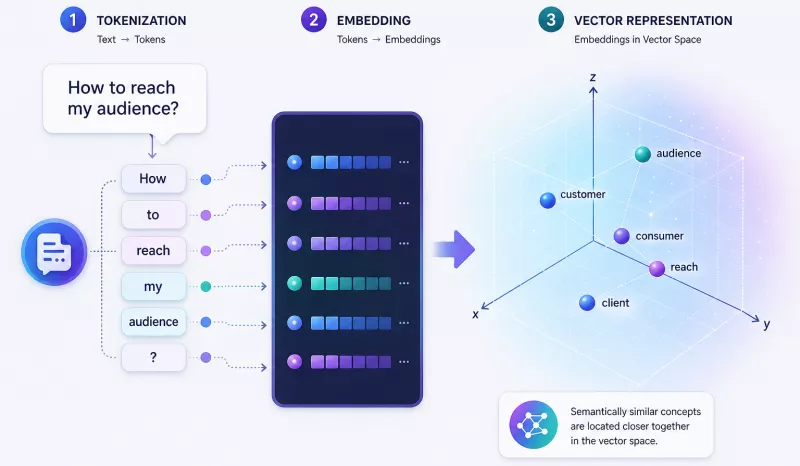
A token is the basic unit of text that a model processes - it can be an entire word, part of a word, or a single punctuation mark. The phrase "advertising campaign" is not two words for the model, but several tokens that the system analyzes sequentially and contextually.
Each token is then represented as an embedding - a point in a multidimensional mathematical space where semantically similar concepts are located close to one another. The words "client," "consumer," and "recipient" will be neighbors in this space, even if they differ literally. This allows the model to understand ambiguous queries: when a user writes "how to reach my audience," the system recognizes the marketing sense of the phrase rather than its geographical literalness. It is precisely this semantic map that allows LLMs to respond accurately to questions phrased in various ways - which has a direct bearing on the quality of purchase-intent interpretation in search engines and AI assistants.
The attention mechanism and transformer layers
The transformer architecture - the structure underlying most modern LLMs - solves a problem that blocked earlier language models: the loss of context with long texts. The attention mechanism allows the model at every moment of text generation to "look back" at the entire preceding conversation and weigh which elements of it are currently most relevant.
This can be compared to an experienced project manager running a multi-hour meeting: rather than remembering only the last sentence, they continuously keep the strategic thread in mind, along with the intentions of individual participants and the relationships between topics. In a marketing context, this means a model powering a chatbot will remember that at the beginning of a conversation a customer mentioned a specific problem - and will take that into account when formulating a response twenty exchanges later. This characteristic determines the naturalness of multi-step user interactions.
The role of parameters in shaping brand voice
Parameters (also called weights) are the numerical values a model learns during training - something like indicators of the capacity and scale of accumulated knowledge. The more parameters a model has, the more subtle linguistic patterns it can absorb and reproduce.
For a marketer, this abstraction has a concrete implication: models with a greater number of parameters differentiate style and tone of expression more effectively. They can maintain a consistent brand tone of voice throughout a long text, adapt register to different audience segments, and avoid generic phrasing that blurs communicative identity. The point is not raw computing power - it is the precision with which the model can reproduce the creative intent contained in a brief.
Model temperature: between creativity and precision
Every LLM exposes a parameter called temperature - a numerical value (most commonly in the range of 0–2) that regulates the degree of randomness when selecting the next token.
When the model chooses the next word, it considers a list of candidates with assigned probabilities. A low temperature causes it to reach for the most probable options - the text is predictable and precise. A high temperature "flattens" those probabilities, opening the door to less obvious choices - the result is more varied text, but less predictable.
In practice, this translates into matching settings to the task:
-
Low temperature (approx. 0.1–0.4) works well where accuracy matters - product descriptions, FAQs, report summaries, and verification of compliance with brand guidelines. It reduces the risk of hallucinations.
-
Medium temperature (approx. 0.5–0.8) is a good starting point for most copywriting tasks: articles, emails, and social media posts.
-
High temperature (approx. 0.9–1.5) is useful in brainstorming - generating variants of slogans or creative concepts. The goal is a set of inspirations, not finished material.
An important implication for brand safety: the higher the temperature, the greater the risk of hallucinations. In environments involving sensitive data - pricing, regulations, product specifications - temperature should be kept low and output verified before publication. Temperature is best treated as a creative risk management tool, not an "better/worse" switch.
AI model training methods and their impact on brand safety
Before a model reaches a marketer's hands, it goes through several stages that shape its knowledge and behaviors. Each of these stages has a direct bearing on what can be expected from the model - and where problems may arise.
The first phase is pretraining: the model processes enormous quantities of text from the internet, books, and other sources, learning general world knowledge, linguistic structures, and relationships between concepts. The result is a foundation - broad, but non-specialized. Such a model knows a great deal about everything, but is unfamiliar with the specifics of any particular brand or industry.
The second phase, fine-tuning, narrows that knowledge to a chosen application. A company can train a model on its own documents, communication examples, or customer service history, producing a system that understands its specific terminology, standards, and quality expectations.
The third layer is RLHF (Reinforcement Learning from Human Feedback) - a process in which human evaluators indicate which of the model's responses are better and which are worse. This is a behavioral calibration mechanism: through it, the model learns to avoid harmful, misleading, or user-expectation-violating responses. The training path - the data and feedback that shaped the model - determines its character: style, topical boundaries, and reliability in marketing tasks.
Hallucinations, cognitive biases, and data privacy
The imperfections of the training process translate into three categories of risk that a marketing director must treat as constant environmental variables, not as one-time bugs to be fixed.
Hallucinations are situations in which the model generates content that sounds convincing but is factually untrue - non-existent citations, incorrect numerical data, invented references. This is not deliberate deception; it is a consequence of the very nature of a predictive model: the system generates what is statistically probable, not what has been verified. In brand communications - particularly in legal materials, product specifications, or financial statements - human verification of model output remains essential.
Bias, or cognitive errors, refers to distortions resulting from uneven representation of groups, perspectives, or languages in the training data. A model can unconsciously reproduce stereotypes or favor a particular communication style - which becomes a real reputational risk in campaigns targeting diverse audiences.
The third category concerns data privacy. Proprietary know-how, undisclosed strategies, or customer data entered into an external model can - depending on the system's architecture - be incorporated into future responses to other users. This is not paranoia; it is a boundary condition that should shape the decision about which deployment model to choose.
LLM applications in marketing: From personalization to analytics
LLMs transform routine creative and analytical processes in marketing not by replacing them, but by radically scaling throughput. Natural Language Processing (NLP) means that a team previously capable of producing five email subject line variants per week can test fifty - and respond to results in a timeframe that was structurally impossible before.
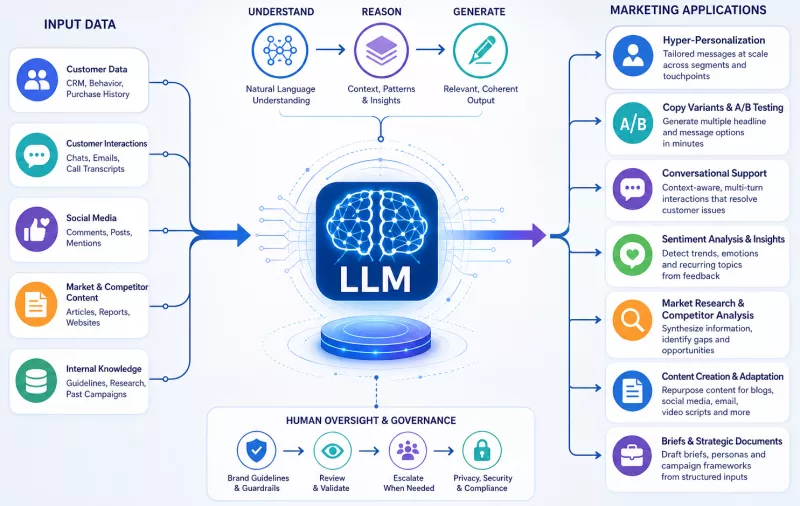
Hyperpersonalization at scale is the first and most significant application of LLMs in marketing. A model can generate message variants tailored to demographic segment, purchase history, stage in the sales funnel, or even time of day - without the need to manually draft each version. An email marketing team can create content that differs not only in the recipient's name, but also in tone, argumentation, and product examples.
The second pillar is generating copywriting variants for A/B testing. Instead of constructing two headline versions, the system can propose twenty, spanning a spectrum from emotional to rational, from concise to expansive. An iteration that used to take a week is compressed into hours.
Scaling customer service through conversational interfaces
Traditional rule-based chatbots operated like decision trees: predictable, limited, and breaking down at every non-standard question. LLMs change this logic fundamentally - a conversational assistant powered by a language model understands context, remembers earlier segments of a conversation, and can conduct multi-step interactions without a rigid script.
A user reporting a problem with an order does not need to navigate through six option menus - they can describe the situation in their own words, and the model interprets the intent and proposes a solution. Resolution time shortens and customer satisfaction improves.
There is, however, a clear boundary the algorithm should not cross on its own: crisis situations - media complaints, legal claims, product safety incidents - require handing control to a human. The absence of this boundary is one of the most common deployment errors, turning a technological advantage into a reputational risk.
Sentiment analysis and synthesis of consumer insights
Thousands of product reviews, call center transcripts, social media comments - this is data that most organizations possess but rarely analyze in its entirety, because manual tagging is too labor-intensive. An LLM can process such a corpus, categorize sentiments, identify recurring complaint patterns, and draw synthetic conclusions - without an analyst needing to predefine categories.
For a product manager, this means access to insights that previously would have become visible only after a quarter of research work. A pattern of dissatisfaction with a specific product feature can appear in a report within days of data collection - giving time to respond before the problem escalates to public scale.
Market research and competitive analysis
Understanding the competitive landscape has always required time - reviewing industry reports, monitoring competitor communications, and tracking trends in specialist publications. LLMs shorten this cycle by enabling rapid processing and synthesis of large text datasets: press articles, competitor product descriptions, conference materials, and website content.
A marketer can quickly obtain a summary of the narratives competitors use, identify gaps in their communications, and pinpoint topics that remain unaddressed in a given market segment. This does not replace in-depth market research, but it radically shortens the preparatory phase - from weeks to hours.
Content creation and adaptation across channels and formats
A content team faces the same challenge every day: one source material - a report, a webinar, an expert interview - must reach audiences on LinkedIn, in a newsletter, as a blog article, and as a script for a short video. Each channel operates by different rules of length, tone, and reception logic.
An LLM can reformat one input document into several variants tailored to the specifics of each medium - preserving substantive coherence while adapting the narrative to the reception context. Instead of writing four different texts from scratch, an editor verifies and refines four proposals. Content production throughput increases without a proportional rise in the workload.
Automated creation of briefs and strategic documents
Preparing a creative brief, a buyer persona description, or a campaign framework is work that in the traditional model consumes significant resources - it requires gathering dispersed data, structuring it, and describing it in a way that is useful to a creative team or agency.
An LLM can synthesize input data - research results, campaign history, brand guidelines - and generate a working strategic document that becomes a starting point for further work, rather than an end in itself. This proves particularly valuable during the onboarding of new partners or agencies: the model can compile brand context from many dispersed internal sources and transform it into a coherent introductory document. The boundary between automation and expert work shifts - people focus on decisions and evaluation, not on organizing information.
Commercial market models: Matching technology to the task
There is no single universal language model that performs equally well across all marketing applications. Individual model families have specialized profiles arising from differences in training data, architecture, and design priorities. Selecting the right tool for a brief is a strategic, not a technical, decision - and the following characteristics should be treated as typical application profiles, not as permanent quality hierarchies, which may change with successive model versions.
GPT-4 and subsequent models from the OpenAI family are characterized by high versatility - they perform well both in generating creative content and in tasks requiring structured reasoning. They are a good choice for teams seeking one model for multiple applications.
Claude (Anthropic) stands out for its attention to linguistic nuance and content safety - the model is designed with a focus on avoiding harmful outputs and subtly controlling tone. In copywriting practice, this translates into texts that more closely meet editorial standards and less tendency to produce intrusive, promotional language.
Gemini (Google) integrates naturally with Google's data and analytics tool ecosystem, making it particularly useful for data-driven campaign planning, search trend analysis, and process automation in environments that use Google Workspace.
Open-source models, such as the Llama family (Meta), give organizations the ability to self-host and customize - which is of critical importance wherever data control is a priority.

Deployment architecture: SaaS, hosted, or on-premise
From the perspective of a communications director responsible for both budget and data sovereignty, the choice of technology distribution model is just as important as the choice of the model itself.
The SaaS model (Software as a Service) offers the lowest barrier to entry: a ready-made interface, immediate access, and pay-per-use pricing. It is the ideal solution during exploration and rapid iteration. The trade-off is that input data - including internal content, briefs, and strategy - may be processed on the external provider's infrastructure.
Hosted solutions represent an intermediate model: the language model runs on dedicated cloud infrastructure, often with data isolation guarantees and confidentiality agreements (SLA - Service Level Agreement). The cost is higher than SaaS, but the level of control over where and how company information is processed is significantly greater.
On-premise deployment - where the model runs on the organization's own infrastructure - provides full data sovereignty. It is the right answer wherever training or input data contains sensitive information: brand strategies, unapproved product pipelines, or customer data subject to GDPR. Deployment and maintenance costs are higher, and iteration speed is lower - but the risk of intellectual property leakage is structurally eliminated.
First steps for a marketer
A marketer who has used LLMs rarely or not at all does not need to start with a corporate system deployment or an in-depth understanding of transformer architecture. A few concrete applications will suffice - ones that can be activated within a single working day, using tools available through a browser.
The easiest entry point is generating content variants. Rather than writing an email to a subscriber base, a social media post headline, or a product description from scratch, it is worth preparing one solid brief and asking the model for three to five versions differing in tone or length. Comparing variants takes minutes and teaches how the precision of an instruction affects the quality of the output.
The second step is testing the model as a tool for quick research and summaries. Pasting a lengthy industry report, a customer interview transcript, or survey results and asking for a concise extraction of key trends is a task LLMs handle efficiently - and the marketer reclaims time for interpretation rather than reading.
The third area for immediate application is preparing drafts of internal documents: creative briefs, campaign descriptions, and meeting agendas. The model does not replace strategic thinking, but it eliminates the blank page syndrome and shortens the time needed to produce a first version of a document.
A few practical tips to get started:
-
Begin with one specific, repeatable task - not with an attempt to automate an entire process at once.
-
Treat every result as a working draft that requires editing, not as finished material. Fact-checking and tone verification remain the responsibility of a human.
-
Describe context precisely: the more specific the prompt (instruction), the better the result. The model does not know brand specifics unless they are included in the instruction.
-
Keep a simple log of prompts that produced good results - this is the first internal knowledge base for working with LLMs.
The first weeks of working with a language model are above all a calibration period - learning what the tool does well, where it needs supervision, and how to adapt it to brand standards. Even without a formal deployment strategy, this phase delivers measurable benefits: less time spent on first drafts, more energy for decisions that genuinely require a marketer's experience.
Decision criteria and analytics in the generative AI ecosystem
A successful LLM deployment depends on the structure of available data and clear business criteria - not on the raw computing power of the available model. Organizations that start by asking "which model is the best?" rather than "what data do we have and what problem do we want to solve?" most often deploy technology that fails to meet their actual needs.
The key question is: does the deployment pay off? ROI calculation should cover both the cost side (licenses, deployment, maintenance, team time spent verifying output) and real savings - shorter content production times, fewer editorial revision rounds, and the ability to scale without a proportional increase in headcount. If the cost of model correction and oversight approaches the cost of manual work, the business case is weak.
How to measure results
The effectiveness of LLMs in marketing applications is worth tracking through several operational metrics:
-
percentage of materials requiring revision - the lower it is, the better the model is calibrated to brand guidelines,
-
average production time per variant compared to the manual process,
-
alignment with tone of voice guidelines - verified by the team or through a qualitative checklist.
These are the metrics that allow an assessment of whether the technology is genuinely relieving the team's workload - and whether the deployment is worth continuing or expanding.
Summary: LLM application in marketing and the evolution of brand strategy
Understanding LLMs at a functional level - from tokens through the attention mechanism to parameters - is not knowledge reserved for engineers. It is a foundation that allows marketers to formulate more precise briefs, set appropriate expectations for technology vendors, and understand why a model behaves one way rather than another in a specific application. The transformer architecture determines the model's ability to maintain context; the fine-tuning phase determines its specialization; RLHF shapes its safety. Each of these layers has a direct bearing on how the technology performs in day-to-day operations: content production, customer service, sentiment analysis, and campaign personalization.
Responsible adoption of the technology begins with organizing questions, not with selecting a tool. What data can an organization safely share with an external system, and what requires isolation? Which model matches the application profile - copywriting, analytics, or conversation? What will the content quality policy look like, and who approves model outputs before publication? And finally: how will the organization measure success - not only in operational terms, but also in the context of the growing role that AI engines play in shaping brand image. A brand that understands the mechanics of these systems is far better equipped to manage them - rather than merely use them.