Prompt decomposition: how models break down complex queries


In short
Prompt decomposition in LLM-based search shows how a complex query can lead to separate sub-queries. It covers combining findings, evaluating sources, and the difference between matching a single feature and recommending an entire offering, taking into account the limits of inferring brand visibility.
What is prompt decomposition in LLM-based search?
The purchasing department of a company that runs a chain of salons in several cities types a single, seemingly compact question into a search-based assistant:
which booking system should a multi-location business choose if it needs payment integration, Polish-language support, and data export.
From the user's perspective, this is one decision. From the perspective of an answer that has to be justified, it is several distinct issues, each of which can be checked separately.
Prompt decomposition is the breaking down of an original question into smaller tasks. Some of them may lead to separate search sub-queries, while others remain analytical work, such as determining what needs to be known in order to answer at all. In engines that use large language models (LLMs), the term describes how a multi-threaded query can be translated into a series of partial searches, and then back into a single answer.
The tension here matters for anyone analyzing brand visibility. The user formulates one purchase, but its outcome may be decided by narrow questions: whether payments work to the required extent, whether the support is genuinely Polish-language, whether data export covers what the company needs. A brand that is strong in the general description of a category may fail to be confirmed in one of these threads. A brand known for one specific feature may, in turn, appear precisely because of it.
The rest of this article consistently develops this booking-system example. The scheme presented explains the concept and serves as an illustration. It does not reproduce the workings of any specific engine, and the following sections explicitly separate what is a useful conceptual model from what could be claimed about a particular system.
How do sub-queries arise from a single question?
It is worth separating, from the start, three elements that easily blur together in everyday descriptions:
-
the original question is the user's full query, in our example the entire request to choose a booking system with three requirements;
-
a search sub-query is a narrower formulation of an issue to be checked, which may be directed to search;
-
the final answer is the text the user actually receives, which combines findings from the individual threads.

The distinction also covers two kinds of work. An analytical task consists of determining which issues require confirmation, and it does not have to search for anything. Search is only the checking of a selected issue in the available materials. A single question may therefore produce more analytical tasks than actual searches, or the reverse, and nothing in the concept itself dictates the proportions.
What is being divided matters as well. The split does not consist of cutting a sentence into fragments or extracting successive nouns. It concerns issues that require determination. The phrase "a business with multiple locations" does not become a sub-query because it is a separate part of the sentence, but because it entails a specific question: does the system support several branches within a single solution.
A single point of reference runs through all these threads: the shared intent of choosing a solution. Each sub-query makes sense only in relation to that intent. The result concerning data export is not interesting in itself, but as a condition of the decision about the whole system. A description of the process should also speak of the functions such a division could serve, not of the model's supposed thoughts, to which no external observer has access.
A shared purchasing goal and separate selection conditions
The overarching goal is one: choosing a booking system. The requirements for how it works are many separate conditions. This separation has practical consequences, because the goal determines why searching is done at all, and the conditions determine what exactly must be confirmed.
Among the conditions, it is worth distinguishing a necessary condition from a preference. If the company must export booking data from all locations to its own reporting tool, export is a necessary condition, and a system that does not provide it is ruled out. If it cares that the panel be "easy to use," that is a preference: it affects the assessment but rarely excludes an offer. The same applies to handling locations. Being able to manage several salons in a single account may be a requirement, while a separate app for each of them is sometimes merely a convenience.
Sub-queries should preserve the context that was actually stated in the question. If the user wrote about a business with multiple locations and Polish-language support, further searching builds on that information. Adding needs that nobody indicated is something else, for example assuming that the company operates in a particular industry or requires a specific payment provider. Such additions are not facts about the user and should not be treated as part of their requirements.
A sub-query concerns an issue to be checked, not a single word
For the booking-system example, the following sub-queries can be imagined illustratively:
| Issue to be checked | Informational goal |
|---|---|
| Whether the system integrates with payments, and to what extent | Establishing which payment methods and operations are supported |
| Whether Polish-language support is available | Establishing the language and channels in which help is actually offered |
| Whether data export is possible, and what it covers | Establishing the formats, the scope of data, and the conditions of export |
Each row has a distinct purpose. The first decides whether transactions can be handled within the system, the second whether the company's team will get help in a language it knows, the third whether the data will be trapped in the tool.
The difference between such a sub-query and a search for a general term is significant. The phrase "booking payment system" leads to materials describing the category, whereas a question about whether a specific function matches the company's need assumes we are looking for confirmation in a product description, documentation, or terms information. The first looks for a topic, the second checks whether a claim is true in a given case.
A single sub-query also does not have to correspond to a single requirement. The issue of "payments and export of financial reports" can sensibly be checked together if the two things are linked, for example when the company wants to export transaction data. The boundaries of sub-queries follow from what can be jointly confirmed, not from the number of requirements on the list.
Some searches can be run separately, others require earlier findings
Some issues are independent of one another. Checking the language in which support operates does not depend on the result of checking payments. These searches can be run in parallel or in any order, because neither needs the other's result.
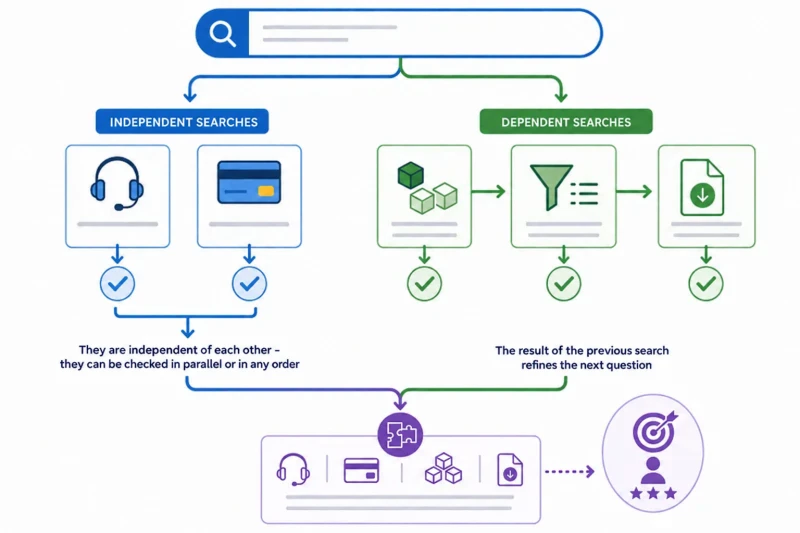
Other issues are sometimes dependent. Suppose preliminary findings show that the system exists in several variants, and the export capability differs between them. The question about export then has to be refined: not "does the system enable export," but "does the variant that supports multiple locations enable it." The result of one search thus justifies changing the next.
Aspects can also be combined. Once the product variant is known, the question about export and payments can be formulated together for that same variant. None of this implies a fixed number of searches or a mandatory order of actions. The dependencies described show possibilities, not a procedure by which every system works.
How do findings from different sub-queries add up to an answer?
The division is only half of the mechanism. The separate findings must be related back to the whole purchasing question, because the user did not ask about export, payments, and support separately, but about a system that will meet all three conditions at once.
Assembling the answer involves several activities worth distinguishing. Materials must be matched to requirements: this description confirms payment support, that one concerns support. It must be checked whether the information refers to the same offer, because the description of one product should not end up in the assessment of another. Finally, gaps and contradictions must be dealt with, that is, places where confirmation is missing or sources say different things.
In the example, the most important thing is the difference between two levels of confirmation. Confirming individual functions says: the system supports payments, the system has Polish support, the system allows export. Confirming that the functions are available together says something stronger: in a single configuration of the offer, it is possible to have all three. The first does not imply the second. Three true statements may refer to three different packages.

Finding a document also does not settle whether it is used. A document may be found as part of a sub-query and still not affect the answer if it turns out to be inadequate, outdated, or about something else. The analysis here stays with the logic of combining findings and does not go into ranking rules or search-engine architecture, which cannot be reliably inferred from the outside.
Each aspect may require a different kind of source
Different issues are settled in different materials. A product description usually says what the offer includes at the level of declarations and what it is meant for. Integration documentation lets one check which payment systems are connected and to what extent. Support information indicates in which languages and channels help is available.
This division of roles explains why a general declaration is often insufficient. The sentence "the system enables data export" confirms that the function exists, but it does not say what data it covers, in which formats, or whether it applies to all locations. Only material describing the scope of export answers the question that was actually asked in the query. The point is thus matching the source to the specific question. No universal hierarchy of materials follows from this, nor a guarantee that a given type of content will be used.
Confirmed features must form a coherent offer
Compatibility has a product dimension. Functions must belong to the same product, the same package, and apply under similar availability conditions. A typical error is to combine the advantages of different variants into a single recommendation: export from the extended package, Polish support from the basic package, multi-location handling from a third configuration. Such a composite offer does not exist, even though each of its elements is true.
When it comes to gaps, it is worth distinguishing three situations. No confirmation found means only that nothing was indicated in the available materials. An ambiguous description allows more than one interpretation, for example "advanced reporting" without listing what it includes. Confirmed unavailability is an explicit statement that the function is not present in a given variant. Only the last situation justifies a negative conclusion. The first two leave the issue open.
Contradictory information, for example two sources giving a different scope of support, is a reason to retain uncertainty. Filling a gap with a guess, even a probable one, would turn a lack of knowledge into apparent certainty and lower the value of the whole answer.
Does every search engine split a question in the same way?
The scheme described is a useful conceptual model, not a description of a specific system. Engines may differ in how they split the question, how they combine threads, and how they use search. In one case a complex question may be divided into distinct partial searches, in another handled in fewer steps, and sometimes the answer arises largely without separate searches. A complex question therefore does not have to lead to a visible series of queries.
From the analyst's point of view, it is worth distinguishing three materials of differing cognitive value:
-
the final answer shows what was said, but not how it came about;
-
the cited sources indicate which materials the answer relies on, though not necessarily all of those that shaped it;
-
the search log, if the system makes it available, is closest to a description of the actual sub-queries, but not every engine reveals it, and what is revealed may be truncated.
A separate caution applies to a description of its own way of working, which a model can generate at the user's request. Such a description is text like any other and is not in itself a reliable record of the operations performed. It may be convincing, coherent, and still inconsistent with what was actually done.
This boundary needs to be set before moving on to conclusions about brand visibility. Everything concerning decomposition remains a description of conceptual mechanics. Claims that a specific engine split a specific question in a particular way would require evidence that the final answer usually does not provide.
Why do sub-queries matter for niche features of an offer?
The mechanics of partial searches have practical significance for features that are secondary in a general description of a category but decide the choice in a specific purchase. Data export and multi-location support illustrate this well: in an overview of the "best booking systems" they may barely appear, yet for a chain business they are crucial.
The importance of such a feature depends on the requirements, not on its own weight. The same detailed statement about the scope of export is marginal for the owner of a single practice and decisive for a company with a dozen branches that must transfer data to its own tools.
Here it helps to distinguish three things that are easily confused: the relevance of information to a sub-query, its use in the answer, and the presence of the brand in that answer. Information may be relevant to a thread and not be used. It may be used and not lead to the brand being named. Decomposition creates the possibility that a narrow specialization will be taken into account, because for a sub-query about export, material about export matters, not general recognition. This is not automatic, however. The match has limits: the information must be available, unambiguous, and consistent with the rest of the offer, and the final answer must actually incorporate it. The mechanics alone imply no promise of improved visibility.
A narrow feature may decide a solution's suitability
Let us compare two questions. The first: which booking system should be chosen for a salon? The second: which booking system should be chosen if the purchase depends on being able to transfer customer data and visit history to another tool? In the first, the detailed scope of export is one of many criteria and may not enter the answer at all. In the second, it becomes a necessary condition and one of the sub-queries that decide whether a given offer is in the running at all.
Being niche therefore does not mean being of little value. A feature rarely mentioned in category descriptions may be narrow and decisive at the same time. Its significance stems from its link to a specific requirement and from available confirmation, not from the mere presence of the right words on a page. The appearance of the phrase "data export" in a text is not the same as a documented export capability to the required extent.
Finding information does not yet mean the brand is named
From the analyst's perspective, it is important to separate four events:
- finding a document during searching,
- using the information it contains in the answer,
- indicating the source as the basis of the answer,
- an explicit mention of the brand.
They are not equivalent and do not form a mandatory path. A document may be found and the information from it used without citing the source. A source may be cited without the brand being named in the text of the answer, and a brand may be mentioned on the basis of general knowledge, unconnected to any document found. The final answer usually does not allow all these events to be confirmed at once, so the presence or absence of one of them does not entitle one to conclusions about the others.
Matching one requirement does not settle a recommendation
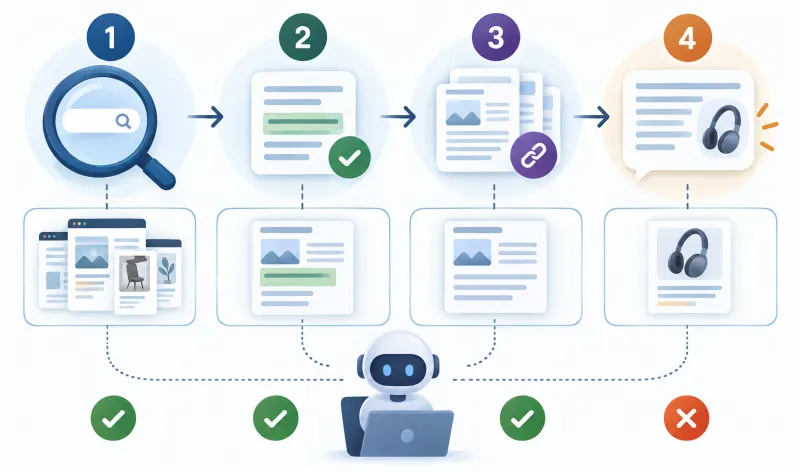
Imagine an offer that answers the export need superbly: a wide range of data, many formats, clear documentation. At the same time, it fails the payments condition or does not provide Polish-language support. The answer may cite such a brand as an example of a system with extensive export and not recommend it as a solution for the whole question.
This is the difference between pointing to a brand as an illustration of a specific function and recommending an entire solution. A strong answer to one thread does not remove the remaining constraints of the original purchasing question. The shared intent of choosing a system still requires that the conditions be met jointly, not individually.
What can be inferred from a brand's presence in an answer?
Let us translate the distinctions so far into an interpretation useful in work on visibility. Take two hypothetical questions about a booking system. The first stresses ease of use: the system should be intuitive and quick for a small team to deploy. The second stresses export and payments: what matters is data transfer and extensive transaction handling.
In both cases the same offers may fare differently, because different requirements change the meaning of individual features. A product distinguished by a minimalist interface may be rated highly in the first question and drop into the background in the second because of limited export. These differences should not, however, be attributed solely to decomposition. The wording of the question, the available materials, the model's general knowledge, and the way the answer is phrased all influence the result at once, and their respective shares cannot be isolated from the answer alone.
When interpreting, it helps to distinguish three levels of certainty:
-
an aspect indicated in the answer: the answer says the brand stands out for export;
-
a sub-query confirmed by a search log: an available log shows that the export issue was actually checked;
-
a possible explanation: a hypothesis that a separate search on export may have led to such an indication.
Only the second level is a documented fact about the process. The first describes the outcome, and the third is an interpretation that may be plausible but remains a conjecture.
The absence of a brand mention in an answer does not prove a lack of fit. An offer may meet the requirements and still not be named, because the answer cites a limited number of solutions, because the material was not used, or because in a given framing of the question other features took precedence. Likewise, a brand's presence does not prove that all of its requirements were confirmed. Such conclusions are analytical in nature, not procedural, and require caution about what actually follows from the final answer.
Prompt decomposition helps explain what a brand may be visible for
A single purchasing question encompasses many requirements, some of which are necessary conditions and some preferences. Sub-queries may separate out distinct issues to check while preserving the shared goal of choosing a solution. Findings from different threads must be combined into a coherent offer, distinguishing the lack of confirmation from ambiguity and from confirmed unavailability. Narrow features, such as the scope of export or multi-location support, may gain importance in this arrangement, but they guarantee neither use in the answer, nor a brand mention, nor a recommendation.
The model described should be treated as a tool for understanding, not as a description of how every engine works.
Its value lies in changing the question an analyst asks about brand presence. Instead of the general "does the brand appear," one can ask in which purchasing thread, and thanks to which feature, it is visible, and in which it is missing or remains unconfirmed. Reading results this way helps one understand why the same offer is sometimes named in one question and overlooked in another, without ascribing to it in advance an advantage or flaw stemming from the mechanism itself.