Digital Alzheimer's in LLMs: Why established brands vanish from assistants' memory overnight


Key takeaways: why a brand can vanish from AI answers
A company that has dominated its category for years may still be absent from an assistant's answer to a question about the best solutions in that same category. An established market position does not guarantee that a language model will include the brand in its answer. "Digital Alzheimer's of LLMs" is used in this text purely as a metaphor: it conveys the impression that the system has "forgotten" a brand, not a diagnosis of any real process. The takeaways below describe what can reasonably be claimed and what the observation of answers does not allow us to conclude.
-
Brand visibility depends on the question and on the system. The same company may be recommended for one phrasing of a question and omitted for another, and it may look different across different assistants.
-
Changes in the model are one possible cause of omissions, not the only one. Assistant instructions, conversation context, source selection, and randomness in generation can produce a similar effect for the recipient.
-
Information available to the system does not always make it into the final summary. The ability to reproduce data about a company does not mean that it will be selected for the answer.
-
A trend requires comparable measurements. A single answer, however striking, does not show the direction of change; a fixed set of questions and a record of conditions are needed.
-
Updating information about a brand does not guarantee a mention. Correcting an erroneous description is valuable in itself, but it is not equivalent to regaining recommendations.
What a decline in brand visibility in assistants' answers means
Brand visibility in assistants' answers is the presence of a company and the way it is presented in answers to a defined set of questions. The definition is deliberately tied to a set of questions: without one, it is impossible to say which visibility is meant. A company is not "visible" in general, only in relation to specific topics, phrasings, and systems.
Within this definition, it is worth separating three distinct phenomena:
-
company recognition - the assistant knows the brand exists and can answer a question that contains its name,
-
description accuracy - the information presented about the offering, the market, and use cases matches the actual state of affairs,
-
inclusion in recommendations - the brand appears spontaneously when a user asks about a category or a problem rather than about a specific company.
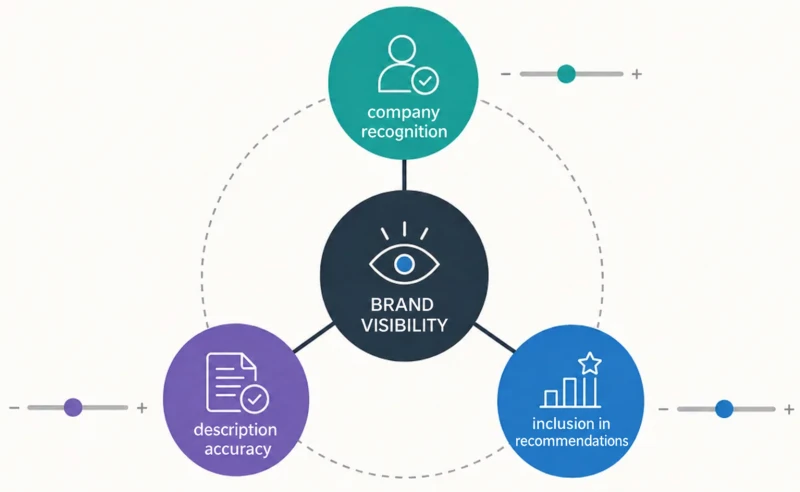
These three dimensions can change independently. A brand may be perfectly recognized and yet absent from comparison lists. It may also appear in those lists, but with a description that is several years out of date.
A weakening of visibility therefore does not have to mean that the name disappears. It takes three typical forms: less frequent mentions, loss of relevant context (the brand is mentioned, but without the feature that distinguishes it), or incorrect attribution of the offering (the company is credited with products or segments it does not operate in). Each of them requires a different interpretation and a different response.
The boundary of this entire analysis is as follows: neither a single answer nor a trend in the studied sample constitutes standalone proof of a change in market position. An assistant's answers describe how the system presents a brand under particular conditions. They do not measure sales, market share, or reputation among customers.
The brand still appears, but its presence may be weaker
Consider a hypothetical example. A team analyzes answers to questions about one category of solutions, say project management software. In three answers, the brand appears in the following roles:
- Recommended solution - mentioned at the beginning, with a justification matched to the needs stated in the question.
- Side example - mentioned at the end of a list, in a single sentence, without indicating when it is worth choosing.
- Company described outdatedly - present in the answer, but with an offering and target group from several years ago.
A mention counter would indicate the same thing in all three cases: the brand was mentioned. Yet for a potential customer these are three completely different experiences. The first answer supports a purchase decision, the second marginalizes it, and the third may steer it toward wrong expectations.
The example illustrates the dimensions of visibility: the brand's role in the answer, the context, and the currency of the description. It does not present study results and does not prove any lasting change. It only shows why the raw number of mentions is too coarse a measure.
Can changes in the model weaken the recall of information about a company?
Modifications to a model may change how it recalls information about companies, but the omission of a brand from an answer does not reveal whether such a mechanism actually operated. The technical fact itself is real; inferring from an observed answer to a specific cause is far weaker.
The first distinction concerns the source of information. Knowledge consolidated during training is what the model "took away" from training data and stored in its parameters. Information supplied in conversation or via search appears only while answering: the user pastes material, or the system fetches pages from the internet. An assistant using search may answer correctly about a company that its parameters know little about - and vice versa.
With this split, two possible, solution-dependent sources of differences come into play: model compression and changes following successive training stages. Both are described below as possibilities, not as established causes. The key point here is the difference between the technical possibility of degraded answers and a confirmed cause of a decline in a specific company's visibility. The former is justified by knowledge of the techniques; the latter would require insight into a model to which a marketing team usually has no access.
Weight compression: a smaller model does not automatically mean less knowledge about a brand
Weights are the numerical parameters of a model that jointly shape its answers. They do not work like separate records in a database where one entry corresponds to one company. Information about a brand is spread across many parameters at once and shares them with information about other topics.
Compression is a general name for techniques that reduce the size or running cost of a model. One example is lowering the precision with which parameters are stored (quantization): numbers are kept in a less exact form, which saves memory and speeds up operation. The effects of such a procedure depend on the method used and on the model itself. In some cases the differences in quality are small, in others noticeable.
It is therefore possible that some answers - for example about facts that occur less often in the data, such as details of a smaller company's offering - will deteriorate. However, no rule follows from this according to which compression selectively removes information about brands. Any deterioration that does occur is diffuse and hard to predict for an individual entity.
Subsequent training stages may change answers without simply "erasing" knowledge
After initial training, models are usually fine-tuned further: taught how to answer, what style to use, what to avoid. Further training and fine-tuning may change both the ability to recall some information and the preferred manner of answering. These are two different effects that are easy to confuse.
The first concerns factual accuracy: after changes, a model may answer about a given company less precisely than before. The second concerns the choice of examples and form: a model may "know" just as much about a company but choose it less often as an illustration, reach more often for other names, or answer more generally. From the perspective of an external observer, both effects look similar - the brand disappears from answers - although the mechanism differs.
Successive model versions should not be presented as one continuous process in which knowledge gradually wears out. Each version is a separate result of specific technical decisions. Degradation of knowledge is also not an inevitable consequence of an update: sometimes a newer version answers about a given company better than the previous one.
An omission may result from changes outside the model itself
An assistant's answer is not a pure product of the weights. It is also shaped by:
-
assistant instructions - hidden commands concerning style, length, caution, or limiting the number of recommendations,
-
conversation context - the user's earlier statements may narrow the interpretation of the question,
-
question wording - a slight change in phrasing changes which materials and examples seem relevant,
-
generation variability - the same request, asked twice, may yield different answers.
In systems with search, further factors come in: the availability of the company's pages to the content-fetching mechanism and the selection of sources from which the answer is built. A change in this area can change the result without any change in the model.
An answer is the product of the whole system, so observing a change in it does not automatically allow us to point to a change in weights. A change in weights is one of many hypotheses, not the default explanation.
How available information about a brand drops out of a synthetic summary
The ability to recall information about a company does not ensure that it is selected for the final answer. An assistant does not transcribe everything it "knows" or has found; it produces a compact summary in which most of the available information is necessarily omitted.
A simplified scheme that organizes this issue consists of three stages:
- Availability of information - whether data about the brand can be recalled from the model's memory or retrieved from sources.
- Fit to the question - whether the information seems relevant to the need described by the user.
- Selection for the summary - whether it fits among the limited number of elements that will make it into the answer.
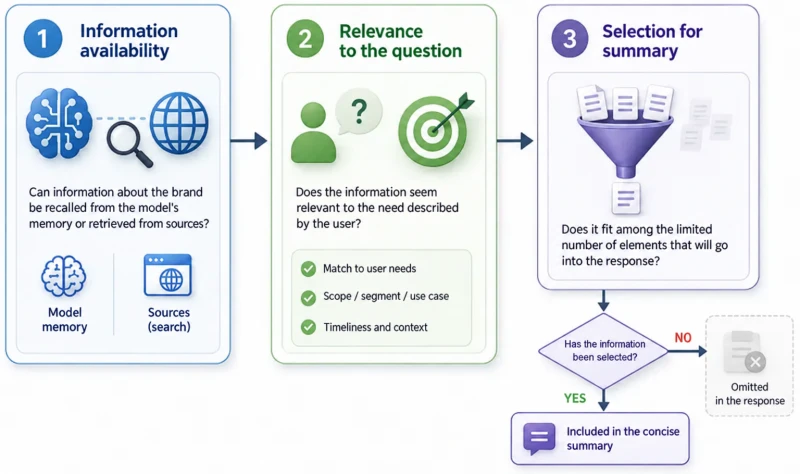
The scheme is a mental model that facilitates analysis. It does not suggest that there is insight into the model's hidden workings or that these stages are clearly separated within it.
In assistants with internet access, it is worth additionally distinguishing four levels: finding a page, using its content, citing the source, and naming the brand. A page may be found, yet its content go unused. The content may serve to formulate an answer, without the source being indicated. A source may be cited and the company name still not appear in the text. A change at any of these levels produces a similar effect for the recipient - no brand in the answer - although the causes are entirely different and require different verification.
Why an assistant knows a company but does not recommend it in its category
A hypothetical situation: to the question "What does company X do?" the assistant answers correctly and in detail. To the question "Which solutions should I choose in category Y?" company X does not appear in the list. This looks like a contradiction, but it stems from different tasks.
In the first case, the name in the question points directly to what to look for. In the second, the assistant must itself judge which companies deserve attention. The result is influenced by:
-
fit to the needs described in the question - if the question indicates a specific segment or use case, a company with a broader or different profile may drop out of the group,
-
limited number of examples - lists usually hold a few items, so some recognized brands do not fit in them,
-
materials drawn on - in systems with search, the composition of the answer is influenced by the pages and publications that happened to be fetched.
Preserved brand recognition narrows the interpretation of the problem: it is known that the system knows the company. It does not, however, prove that its knowledge is fully current or that the whole system works flawlessly. Absence from a list is therefore not proof of "forgetting," but neither does it show that everything works correctly.
A shorter answer may keep the topic but drop the name
It is worth comparing two summaries of the same hypothetical material. The extended one names six companies, each with a short description of its offering. The shortened one says that the market offers solutions focused on automation and general-purpose solutions, without any names.
Shortening triggers several repeatable effects: company names are replaced by a description of the category, some examples drop out, and offering details - the first thing lost when content is compressed - disappear. The topic of the answer stays the same, so at first glance everything is "fine," and yet the brand disappears.
That is why the effect of shortening must be separated from a factual error. There is nothing untrue in the shorter answer - there is simply less of it. A drop in the number of mentions requires interpretation in light of the changed form of the answer: if an assistant has started answering more concisely, fewer names may result from the format rather than from a weakening of the brand's position in the system's knowledge.
How to distinguish a single omission from a lasting decline in brand visibility
The reliability of an assessment comes from the repeatability and comparability of observations, not from the vividness of a single example. A striking screenshot in which an assistant omits a well-known company is an anecdote. A conclusion about the direction of change requires a measurement that can be repeated.
Three elements make up one line of reasoning: the choice of questions, the conditions under which answers are obtained, and explicit rules of assessment. A change in any of them can fake a trend. If a team modifies the question set in a later period, for example by adding more queries about narrow use cases, the share of answers containing the brand may fall even though nothing in the system has changed. Likewise, a change in the counting method - a different criterion for treating a mention as a recommendation - will shift the result without any connection to reality. A measurement allows us to state in which direction and to what extent answers changed in the studied sample. Nothing more without additional evidence.

A fixed set of questions must match the real needs of audiences
The question set should reflect how audiences actually search for information. It usually covers three kinds of queries: about choosing a category ("which solution to choose for…"), about comparing offerings, and about specific use cases.
It is important to separate two situations. Answers that spontaneously mention the brand - to questions that do not contain it - speak to real visibility in the category. Answers to questions that contain the company name show rather the level of recognition and the accuracy of the description. Mixing both types into a single number blurs the picture.
An excessive share of one type of question distorts the result: a sample made up mainly of questions containing the brand name will fare better than real user behavior implies. Topics particularly important to the company's business should also be interpreted separately, because an average over the whole set can hide a decline precisely where it matters most.
Repetitions show variability, and recording conditions allows periods to be compared
Assistants' answers vary between successive queries, so a single observation carries little information. Repeating observations shows how large the natural variability is and what spread should be considered normal. Without this, it is unknown whether the difference between two results is a change or noise.
The comparability of periods depends on documenting conditions:
-
the language of the questions,
-
the conversation context,
-
the search mode (on or off),
-
the assistant version label, if available,
-
the saved answers for later verification.
A result obtained before and after an update, under unknown or differing conditions, is a weak basis for a conclusion.
There is no point in specifying one universal number of trials - it depends on the variability of the particular system and topic. Limitations must also be kept in mind: providers may change the assistant without announcement, so even carefully documented conditions do not always cover all relevant variables.
Mention frequency does not replace assessing recommendation and accuracy
Brand presence frequency is the share of answers in which a company appears, calculated against an explicitly defined set of evaluated answers. Without specifying the denominator, the number has no interpretation.
Frequency alone is not enough. It is worth assessing separately:
-
the brand's role - whether it is the main recommendation, one of several options, or a side example,
-
consistency of the description with the offering - whether the features and use cases presented are current,
-
visible sources - which materials the assistant relies on, if it shows them.
This requires fixed classification criteria, applied identically in each period, and keeping the answers themselves for later verification. An aggregate result risks hiding different kinds of weakening: a rise in the number of mentions may go hand in hand with a decline in their quality, and a "no change" result may mask a growing share of outdated descriptions.
Persistence and scope of a change matter more than a single jump
One can speak of a lasting change only when the same direction persists across successive periods and the scale of the difference exceeds the existing fluctuations. A single jump followed by a return to the earlier level is more a fluctuation than a trend.
Scope is equally important: whether the change concerns one topic, several, or the entire studied set. A change limited to one area suggests different hypotheses than a parallel decline across many topics. With a small number of observations, uncertainty is large and the conclusion should reflect it.
A qualitative example: if over three successive periods the brand in answers about one category gradually shifts its role from recommended solution to side example while remaining stable in other topics, one can conclude that a decline persists in that category. The conclusion, however, is limited to the studied question set and the studied systems, without extending to market position.
What a decline pattern allows us to say about its cause
Measurement results help organize hypotheses but do not reveal the technical cause. A decline pattern narrows the search field and indicates what to check first.
Three patterns differ in the direction of verification they suggest:
-
No recommendation despite a correct description of the company. The assistant knows the brand and answers about it correctly but does not include it in lists. This points rather to the stage of selection for the summary and fit to questions than to loss of the knowledge itself.
-
Deterioration of answers directly about the brand. Descriptions become inaccurate or outdated. This is a stronger reason to check the quality and consistency of the available information and the change in knowledge recall.
-
A change in visible sources. The assistant begins to cite different pages than before. This directs attention to access to sources and their selection, not to the model's weights.

A further distinction concerns scope. A decline limited to one assistant suggests a cause related to that particular system: its update, instructions, or search method. A change across several systems at once may point to a common factor, but caution is needed: different assistants often draw on shared materials, for example the same search results. Convergence therefore does not have to mean independent confirmations.
A coincidence of a decline with the date of a model update is a clue, not proof. It fits the hypothesis of compression or knowledge degradation, but it fits just as well a change in the assistant's instructions or sources.
How to limit the risk of losing presence without promising influence over answers
A company can improve the availability and quality of information about itself and detect worrying changes earlier, but it does not control the assistant's choices. This caveat defines the scope of sensible actions: they concern what the company can influence, not the outcome itself.
The response should depend on the confirmed nature of the problem and the importance of the given topic to audiences. Three situations call for different approaches:
-
an erroneous description - requires correction where the error originates,
-
missing data - requires supplementing,
-
an unexplained decline in recommendations - at this stage requires above all further observation.
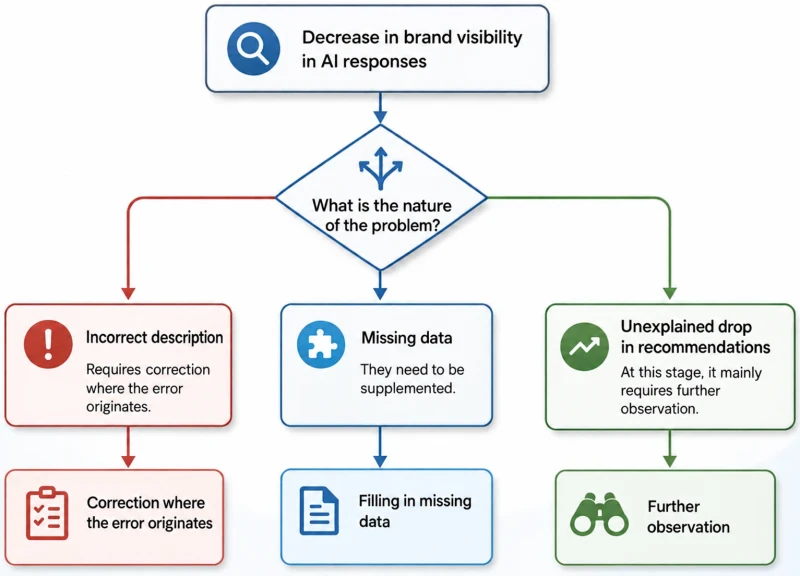
Observation is a full-fledged action here, not a lack of one. Not every decline justifies intervention, and a hasty reaction to an unconfirmed problem consumes resources without any certainty of improvement. This approach rests on an analysis of possibilities and limitations. It does not assume that publishing content directly updates a model's weights - it does not.
Measurement results should indicate where to check information
Persistent errors or omissions are a signal to review the sources the assistant might draw on. This concerns the company's own materials, offering descriptions, and relevant external sources. The review covers four aspects:
-
currency - whether descriptions reflect the current offering,
-
naming consistency - whether the company and its products are named uniformly everywhere,
-
category clarity - whether the content clearly shows which category the company operates in and who its offering targets,
-
content accessibility - whether pages can be read and fetched.
Materials controlled by the company must be separated from independent publications: the former can be corrected directly, the latter require other routes or remain out of reach. A missing mention also does not automatically mean a need to create more content; often the problem is the quality or consistency of existing content, not its quantity.
Improving information and regaining visibility are two different outcomes
Removing a confirmed error in a company's description is valuable even when the number of recommendations does not rise. A correct description has standalone value: it reduces the risk of misleading audiences.
That is why further comparable measurements should show separately the accuracy of the description and the brand's presence in recommendations. The first may improve while the second stays unchanged, and vice versa. Possible delays must also be taken into account - changes in sources do not immediately translate into answers - as well as parallel changes on the systems' side. A later improvement therefore does not prove the effectiveness of a single intervention or the durability of the effect.
GEO/SEO as a factor in improving visibility
SEO (Search Engine Optimization) makes content easier to find and index, while GEO (Generative Engine Optimization) increases the unambiguity of information used in answers. Both approaches operate at the level of content availability and readability, not at the level of model weights.
In practice this means clear descriptions of the company, a precise link between the offering and its use cases, and content that is understandable without additional context - content from which a single fragment retains its meaning when lifted out of the whole. Such materials are easier to read, interpret, and cite.
A separation should be maintained here between three levels: the availability of a page, the use of the information it contains, and a mention of the brand in an answer. Optimization can improve the first level and increase the chance of the second, but it does not guarantee a recommendation and does not directly update a model's weights.
Variability of brand presence in AI requires measurement, not a diagnosis of "erasure"
An established brand may be omitted from assistants' answers because recalling information, accessing sources, and choosing content for a summary are separate problems. Weight compression and successive training stages are among the possible explanations, alongside assistant instructions, conversation context, source selection, and shortening of answers.
That is why regular, comparable measurements are the basis of assessment. They determine the direction and scale of a change, not its cause. Their interpretation should lead to verification of the available information about the brand and to a proportionate, cautious response - not to treating a single omission as proof of lost position.
Finally, it is worth keeping the distinction with which this analysis began: visibility in AI answers is not the same as the brand's health in the market. Presence in an assistant's answers is one signal, valuable and in need of monitoring, but it does not replace data on sales, reputation, and customer behavior. And none of the described actions guarantees regaining mentions - they do, however, provide a better basis for judging what is happening and whether it is worth reacting.