GEO checklist before publishing a new post: 5 points for beginners

Why GEO verification is an important standard before every publication
Publishing content without optimization for generative models means fewer chances that an article will be cited by AI systems or appear in AI-powered search results. In the era of tools like ChatGPT, Perplexity, and Gemini, the difference between well-prepared and poorly prepared content is becoming increasingly measurable.
Generative Engine Optimization (GEO) is a set of editorial and technical practices that make content readable, citable, and useful not only for human readers but also for AI systems that generate answers to user queries. Simply put: a well-optimized post increases the chances of appearing as a source in a ChatGPT, Perplexity, or Gemini response. An article without this optimization loses that opportunity.
The following checklist contains five concrete steps for beginner copywriters and content managers working in a business, marketing, or technology environment. Each point is an action that can be performed directly in the CMS panel before clicking the "Publish" button.

Key takeaways
-
Every new post requires a one-sentence intent brief that specifies the content's purpose and target audience - without it, algorithms and AI models may misclassify the article.
-
Correct heading hierarchy (H2, H3), a completed title tag, and meta description are the minimum technical standard enabling effective indexing by modern bots.
-
Every data-based claim in the text should include a publication year and source attribution - verifiable facts are prioritized by systems based on Retrieval-Augmented Generation (RAG).
-
Short paragraphs, unambiguous visual hierarchy, and precise alternative descriptions (alt-text) for media reduce the risk of content being skipped by machine scanners.
-
Before publication, baseline values of key performance indicators (KPIs) should be recorded: CTR (Click-Through Rate), average time on page, and organic traffic level - without a reference point, it is impossible to assess the effectiveness of optimization.
Step 1: Define the goal and audience using a one-sentence AI brief
An explicit declaration of the text's intent prevents the risk of misinterpretation by language models - and that is the reason it is worth spending literally two minutes on it before starting work on an article.
AI models, much like a human reader landing on a page with no title and no introductory paragraph, attempt to independently infer what the text is about and whom it is intended for. When that answer is not obvious, the risk of miscategorization increases. Precisely defining the target audience and business goal makes it easier for algorithms to match content to actual user queries - which translates into search result relevance and the chances of an article being cited by a generative model.
A practical verification method: after pasting a finished draft into a free AI tool (e.g. ChatGPT or Claude), ask directly: "Who is this text for and what problem does it solve?" If the answer diverges from the intent, the brief needs refinement. This is a simple consistency test that can be performed before every publication.
How to write and implement a post intent (example)
A correctly formulated intent brief looks as follows:
This article helps beginner content managers implement a five-point GEO checklist before every publication, in order to increase the chances of being cited by AI models and improve organic traffic.
Such a context marker should be pasted at the very beginning of the working document (in an internal note or in the CMS "Editorial description" field) - before the first paragraph of the actual text is written - so that it serves as a compass throughout the entire content creation process.
Step 2: Organize the information architecture and key metadata
A clear technical structure and logical headings function as a precise navigational map for modern bots - without it, even a substantively valuable article may be skipped or incorrectly indexed.
The mandatory minimum in any CMS covers three elements. First, the title tag (the "SEO Title" or "Title tag" field) - it should contain the main keyword and not exceed 60 characters. Second, the meta description (the "Meta description" field) - one or two sentences summarizing the text's most important argument, up to 155 characters. Third, heading hierarchy: H2 headings mark the article's main sections, H3 headings are subsections within them - never the other way around and never skipping a level.
What is an intuitive text structure for a human is, for RAG systems, a set of signals that allow key claims in the article to be rapidly extracted and assigned to the correct topics. Organized formatting accelerates this process - disorganized formatting blocks it.
Implementing TL;DR summaries and basic Schema
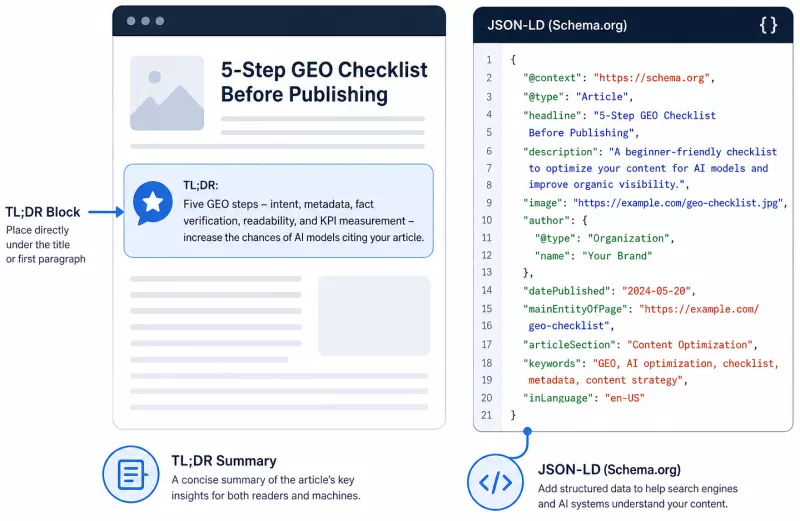
A one-sentence TL;DR (Too Long; Didn't Read) summary compresses the article's most important knowledge into a form readable by both users and machines. Example: "TL;DR: Five GEO steps - intent, metadata, fact verification, readability, and KPI measurement - increase an article's chances of being cited by AI models." This block should be pasted directly beneath the title or below the first paragraph, using the "Quote" or "Info block" field available in most CMS systems.
For more advanced users: it is worth filling in the basic JSON-LD fields (i.e. Schema.org structured data in a search-engine-readable format) - in WordPress, the Yoast or Rank Math plugin handles this without any need to write code.
Step 3: Verify facts, dates, and cite credible sources
Verifiable data and credible citations build content authority in AI-generated results - and this is one of the few areas where the substantive quality of content directly influences its visibility in AI systems.
Systems based on RAG architecture handle specific numbers, publication dates, and expert names more effectively. An article that states vaguely "many studies suggest" has a lower chance of being cited than a text that writes: "The Exploding Topics report from 2024 indicates that the number of queries directed to AI search grew by 35% year over year." The mechanism is straightforward: when a generative model cites a source, it needs data that allows the claim to be verified - without a date and author, it is difficult to process.
The practical pre-publication verification process involves three actions: checking that all dates in the text are current (articles with outdated years are automatically deprioritized), embedding at least one link to an external report or study in every data-based section, and replacing vague sentences with sentences that include source attribution.
Example of correct citation: "According to the BrightEdge report from 2024, 68% of marketers consider AI search optimization an editorial priority for the next 12 months." Such phrasing minimizes the risk of so-called model hallucinations - situations in which AI generates non-existent claims because it has nothing to reference.
Step 4: Optimize formatting and accessibility for machine scanners
Dense, multi-sentence text blocks make life difficult for scanning algorithms - and they just as quickly discourage the business reader who skims an article in 90 seconds between meetings.
There are four specific readability rules to check before publication. A paragraph should not exceed three to four sentences - if a thought requires more, it should be split. Each sentence should carry one complete piece of information; multi-clause sentences hinder machine extraction. The linguistic level of the text should be adapted to the reader: in a business-technology environment, the reader understands industry abbreviations but expects them to be explained on first use. Section headings should be specific and descriptive - "How to fill in the meta description" is a better heading than "Metadata."
A clean text environment reduces the reader's cognitive load, which leads to longer time spent on the page. That behavioral signal is subsequently read by algorithms as evidence of the material's usefulness - creating a direct connection between formatting and organic visibility.
The role of short paragraphs and alt attributes for media
Every sentence in a well-optimized article should carry a complete thought that a machine can extract and cite without additional context. In practice, this means abandoning elaborate, multi-clause sentence constructions in favor of short, precise statements.
Alternative descriptions for images (the alt-text attribute) are an element that most beginners overlook, yet they serve a dual function: they improve accessibility for users of screen readers and simultaneously provide context to machines that cannot "see" an image. An example of this synergy: if an article contains a chart showing organic traffic growth after GEO implementation, the correct alt-text reads: "Line chart showing a 40% increase in organic traffic over 8 weeks following implementation of the GEO checklist" - not "chart" and not "image001."
Step 5: Set up a simple plan for measuring key performance indicators
Every GEO modification requires establishing a reference point before publication - without a baseline, it is impossible to assess whether the optimization produced an effect or the article simply happened to hit a good seasonal moment.
For a beginner marketer, three metrics are sufficient. CTR measured in Google Search Console shows how often users click on an article after seeing it in search results. Average time on page (available in Google Analytics 4 as "Average engagement time") indicates whether the content is actually being read. Organic traffic growth dynamics - the number of sessions from search engines on a weekly basis - communicates the visibility trend.
Before clicking "Publish," one concrete action is required: open a spreadsheet or the view in an analytics tool and record the current values of these three metrics for the page or a comparable article as a starting point. A simple table with columns for date, CTR, time on page, and organic traffic is sufficient. Four weeks after publication, the same values are measured again and compared. If traffic has grown and time on page has increased - the checklist worked. If not - it becomes clear which step needs correction.
Quick checklist implementation in the CMS system
Automating the five steps prevents bottlenecks from forming in the editorial process - and implementing it takes less time than a one-off pass through the checklist without a system. In practice, this comes down to three actions: adding mandatory fields in the CMS ("Intent brief," "Meta description," "Alt-text" as required before publication), preparing a new post template with a ready-made H2 and H3 heading structure and blank fields to complete, and creating a simple editorial note - one page or card in Notion, Asana, or even Google Docs - with a list of five points to check before every publication. This turns GEO verification into a three-minute ritual, not a separate project.
Summary and challenge: Test your first GEO post
The five checklist steps work as a whole: intent prevents misclassification, metadata builds a readable map for bots, fact verification raises credibility in RAG systems, formatting facilitates information extraction, and KPI measurement turns optimization into a repeatable process with measurable results. Together they form a solid publication architecture that increases the chances of being cited by generative models and of organic visibility growth in AI-powered search engines.
The next step is concrete: choose one article - new or existing - and run it through all five checklist points. Before publication, record the baseline of three KPIs. Two to four weeks after publication, compare the results and note the difference. This minimal before/after comparison is sufficient to assess which steps produce the greatest effect in a specific editorial environment.
For those who want to track brand visibility in AI model responses in a more systematic way - an analytics platform such as Brandinai makes it possible to quantitatively measure how and how often a brand appears in results generated by language models, turning intuition about "GEO visibility" into concrete numbers ready for reporting.