How to combine SEO and GEO: Expanding existing processes without doubling the work

Why treating AI search as a separate channel wastes budget
Every organization that decides to create a dedicated "AI Search team" will discover the same problem within a quarter: two parallel content streams, two sets of briefs, two approval processes, and - inevitably - two brand messages that begin to conflict. Generative engine optimization (GEO) - adapting content for citation and exposure in responses generated by large language models (LLMs) - is not a separate discipline requiring a separate budget. It is a surgical modification of processes that are already running.
The starting point is straightforward: traditional crawlers and generative engines feed on the same quality signals - factual precision, entity consistency, and logical argument structure. The difference lies in how content is consumed. A search engine returns a link; a language model cites a passage. One high-quality article, optimized with both consumption formats in mind, serves both channels simultaneously.
The duplicate-work loop and content cannibalization
Consider a typical scenario: the SEO team produces a how-to article optimized for long-tail phrases. A newly formed "AI team" creates a separate piece on the same topic - shorter, written in a more question-driven style, because someone read that models prefer direct answers. The result? Two pages competing for the same semantic context, internal link signals dilute, and Googlebot encounters content that cannibalizes itself.
Siloed processes also generate invisible organizational costs: data becoming stale in one of the streams, inconsistencies in product naming, contradictory definitions of proprietary terms. Language models are particularly sensitive to this kind of contradiction - if the same service is named differently in two places on a site, the model struggles to assign context unambiguously to the business entity and may skip the brand entirely or cite it with an error.
GEO as an operational overlay on existing processes
Generative optimization, in practical terms, comes down to three priority shifts - not building from scratch. First: from keyword density to precision of the first answer - every paragraph should open with a claim or definition, not with context-building. Second: from broad topical scope to fact density - a specific number, a clearly defined range, a named tool. Third: from loose topical association to entity relationships - a consistent, complete brand, product, and location name at every occurrence.
A micro-scenario illustrating the difference: an old paragraph opens with "our company offers comprehensive support in the area of...". After GEO restructuring: "[Full company name] delivers server performance audits for e-commerce stores in the Polish market, reducing page response time by an average of 40% within 90 days." The second sentence contains an entity, a quantification, and a time horizon - three signals a model can extract and cite verbatim. Rebuilding such a paragraph takes three minutes with a standardized prompt; the effect works simultaneously on organic rankings and generative visibility.

Where to implement GEO within an existing SEO process
GEO does not require inserting new stages - it requires expanding the criteria within stages that already exist. Every content manager already runs some cycle: audit → brief → production → on-page optimization → publication → monitoring. Below are three entry points that do not conflict with existing procedures.
On-site audit extended with information density
A standard content audit evaluates phrase coverage, duplicates, cannibalization, and technical parameters. It simply requires adding three columns to the audit spreadsheet: does the paragraph open with a claim or definition, is the brand/product name given in full at first mention, how many specific data points (numbers, dates, ranges) does the section contain.
Eliminating marketing generalities is a high-return step. Phrases like "innovative approach", "comprehensive service", or "leading quality" have no extractable value - a model cannot cite them because they are semantically empty. Replacing them with specifics (what exactly, for whom, with what result) simultaneously improves readability for humans, relevance for crawlers, and citation utility for LLMs.
An important detail that confuses models more than almost anything else: pronoun substitution in product and service descriptions. "Has offered it since 2018" is useless for an algorithm that has no memory of context from the previous paragraph on the page. A full name and brief description at every logical entry point into a topic is a zero-cost editorial rule with a measurable impact.
H2/H3 headings as direct entry points for models
Traditional subheadings served a navigational function and were often constructed as curiosity-gap hooks: "The secret of an effective campaign", "What your competitor doesn't know". For a generative model, such a heading is useless - it contains no extractable fact.
An answer-first structure for headings looks different: the heading formulates a specific question or claim, and the first paragraph beneath it immediately delivers a direct answer. An example conversion: instead of "Page speed optimization" - "How page load time affects e-commerce conversions". Opening paragraph: "Every second of page load delay reduces the conversion rate by an average of 7% - regardless of industry or device." The model now has a complete unit: a question, a verifiable answer, and an application context.
The implementation cost of this principle on an existing content library is re-editing the headings - without touching section content. One hour of editorial work across a dozen or more articles.
Data extraction through Schema.org and local signals
Schema.org - structured semantic data describing page content in a machine-readable format - is the point where technical SEO and GEO fully converge. Rigorous implementation of Organization, LocalBusiness, Product, and FAQPage markup is not an "extra task for AI" - it is overdue technical work that now has a double business justification.
The key parameter for generative visibility: entity unambiguity. If a page describes a company called "Brandin" in one place and "BrandIn AI" in another, and Schema.org contains yet a third version, the model has difficulty identifying the entity and may skip the brand entirely when citing a response. Standardizing naming across the entire domain - from schemas to article content - is a one-time action with a long-lasting effect.
Local signals carry particular importance for companies serving specific geographic markets. Language models often apply a location filter when generating responses - explicitly defining the scope of operations in content and data structures increases the probability of citation for market-specific queries.
Mapping SEO elements to GEO rules
The table below collects key on-page elements and their corresponding editorial rules or prompt patterns. The first three columns concern content restructuring; the last concerns the standardization of technical or editorial principles.
| SEO element | GEO rule | Type of change |
|---|---|---|
<title> tag |
Full entity name + market context in the first words | Editorial standardization |
| Meta description | Opening sentence with a claim or result, not a question | Content restructuring |
| H1 | Mirrors the main query; contains the service/topic name directly | Content restructuring |
| H2/H3 | Question/claim formula + answer in the first paragraph | Content restructuring |
| Schema.org | Consistent entity name in all markup; aligned with content | Technical standardization |
| Local signals | Geographic scope defined in content and structured data | Technical standardization |
| Data blocks | Tables, definition lists, steps - instead of continuous narrative text | Content enrichment |
3 operational interventions: Scaling visibility on an existing content base
The three tactics below apply exclusively to refining the existing asset. None requires writing new material from scratch. Each has a defined outcome and an estimated workload.
Standardizing prompts for bulk paragraph restructuring
A fixed system template for paragraph restructuring eliminates the need for manual rewriting and enables batch updates. The mechanism is straightforward: an SEO specialist defines a single instruction for an AI tool - specifying compression criteria (remove generalities, add the entity name at first mention, open with a claim, limit to X sentences) - and then batch-processes selected subpages.
The benefit is twofold: shorter, more precise paragraphs fit better within the context window of generative models and simultaneously improve readability for users - which translates into time on page. Standardization also means reproducibility: every new specialist on the team applies the same template and achieves consistent results without additional training.
One important caveat: such templates do not replace a subject-matter editor who verifies facts. They reduce time spent, but do not eliminate responsibility for accuracy.
Enriching older posts with structured data blocks
Articles from two or three years ago that retain organic traffic often contain valuable information buried in dense, narrative paragraphs. A generative model struggles to extract data from continuous text - it cites far more readily when information is embedded in tables, headed lists, or definition blocks.
The intervention involves identifying ten to twenty of the highest-traffic articles and adding structured blocks to them - without rewriting the content - such as a parameter comparison table, a glossary of key concepts, or a step list with specific actions. Such a block inserted mid-article raises the page's informational authority in the eyes of ranking algorithms and simultaneously provides models with a ready, citable unit.
Workload: thirty minutes to one hour per article, depending on topic complexity. Effects become visible in Search Console reports (longer time on page, lower bounce rates for high-information-density pages) and - after several weeks - in brand presence monitoring within AI Search.
Automated tag and alt attribute variants from within the CMS
Content management systems (CMS) typically offer integration with external tools via API or plugins. Connecting a CMS to a tool that generates title and meta description variants yields several versions of the <title> tag and meta description for each subpage, with different syntax but consistent entity representation.
These variants serve two purposes simultaneously: traditional search engines can test the CTR (click-through rate) of different formulations, while the richer semantic context (different phrases describing the same subject) provides generative models with additional signals during content indexing. alt attributes for images, generated automatically from a template incorporating the full entity name and visual context, work analogously - reinforcing the semantic consistency of the domain without manually describing each image file.
Quality control and measuring effectiveness without slowing publication
Automating micro-editorial tasks makes economic sense only when QA (quality assurance) processes do not consume the time that was saved. Full manual verification of every generated sentence negates the financial gains from automation and introduces a bottleneck that will eventually become the pretext for abandoning the entire process.
An agile sampling model for content verification
Rather than reading every generated paragraph, an experienced editor verifies a representative sample - typically 10–15% of updated subpages, chosen randomly from across different topic silos. Verification covers three checkpoints: factual accuracy (are the added data points true and current), entity consistency (are brand and product names given in full), and style (does the text sound mechanical in sections critical to conversion).
The sample result determines the decision: if below the agreed error threshold - publish the entire batch; above the threshold - review the prompt template and resample. This model is scalable: with a thousand updated subpages, an editor verifies a hundred and has statistical confidence in the quality of the entire batch.
Metrics overview: From CTR to LLM citation indicators
Classic SEO metrics remain valid and should continue to be monitored: positions for tracked phrases, CTR from Search Console, time on page, and bounce rate. Generative optimization adds a new set of indicators to this mix, requiring dedicated analytics tools.
| Classic metric | GEO metric |
|---|---|
| SERP position | Frequency of brand citation in LLM responses |
| Organic CTR | Model sentiment toward the brand |
| Time on page | Contextual accuracy of citations |
| Number of internal links | Entity naming consistency in responses |
GEO metrics require operational definition. Citation frequency is measured as the percentage of sampled queries in which the brand appears in the model's response. Sentiment determines whether the citation context is positive, neutral, or negative toward the brand. Contextual accuracy checks whether the model attributes the correct services and markets to the brand - not confusing it with a competitor or citing the name with an error. Each of these metrics is recorded before the pilot launch as a baseline, then compared after a minimum of four weeks. This kind of measurement requires specialized analytics platforms capable of systematically sampling generative responses - manual verification (asking ChatGPT once a week) does not yield representative or repeatable data.
Integrated strategy: Summary of the operational framework and pilot implementation
The operational framework described here does not require a new team, a new technology stack, or a budget restructuring. It requires three decisions: expanding audit criteria, standardizing prompt templates, and implementing a lightweight sample-based QA process. Each of these decisions operates within existing stages of the content lifecycle.
The systemic effect is more significant than the sum of small improvements. An SEO specialist who applies this framework stops reactively fixing individual texts and begins managing information architecture at the domain level - deciding which entities are precisely defined, which topic silos have structured data blocks, and how quickly new publications reach generative indexes in optimized form.
Checklist: A 4-week plan for the first pilot
The pilot should be deliberately narrow: one topic silo (e.g., a blog category covering a single product topic), no more than 20–30 subpages, four weeks.
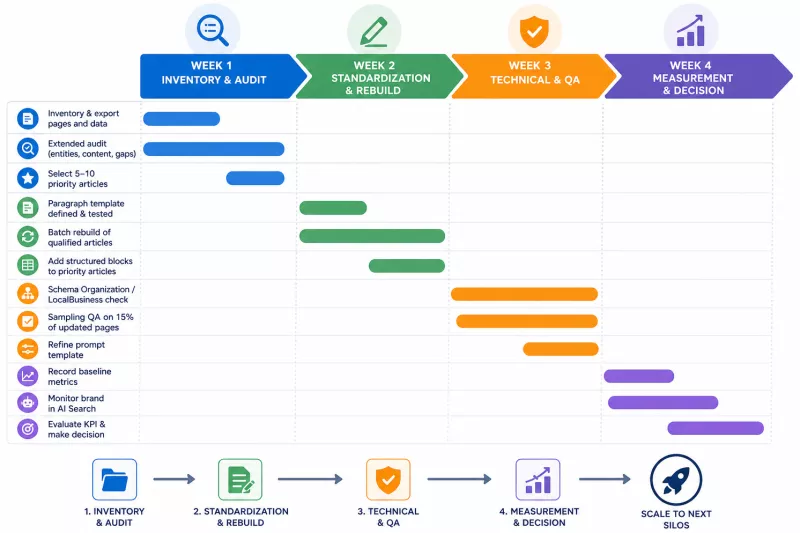
Week 1 - inventory and audit
-
Export the subpage list with traffic and position data.
-
Run the extended audit: flag paragraphs without fully named entities, sections opening with generalities, and missing structured blocks.
-
Identify 5–10 highest-traffic articles as priorities.
Week 2 - standardization and restructuring
-
Define one paragraph compression template; test it on 3 articles, approve or refine.
-
Run a batch restructuring of all qualifying articles.
-
Add structured blocks (tables, definition lists) to the 5 priority articles.
Week 3 - technical work and QA
-
Verify and standardize the
Organization/LocalBusinessschema for the entire subpage set. -
Conduct sampling QA on 15% of updated subpages; document errors.
-
Apply corrections to the prompt template based on QA results.
Week 4 - measurement and decision
-
Record baseline metrics: positions, CTR, and time on page for the pilot set.
-
Launch brand presence monitoring in AI Search for phrases associated with the silo.
Then, after another 4 weeks, evaluate results against minimum KPIs: stable or improved organic positions, measurable growth in brand citations within generative responses.
If these KPIs are met, scaling to additional silos is justified - with the same template and the same QA process. If not - the pilot delivers concrete data for refining the method, not for abandoning it.
The return on this approach is threefold: fewer editorial hours through standardization, preserved SEO rigor through integration with existing audits, and measurable growth in AI Search exposure without duplicating content. This is not a compromise between traditional SEO and generative optimization - it is one coherent process serving both channels at once.