Answer Engine Optimization (AEO): what it is and how it works


In short
Answer Engine Optimization (AEO) and GEO describe brand visibility in answers to questions and in AI-generated responses. This overview explains how they relate to SEO, the role of owned and third-party content, and the limits of influencing and measuring brand presence.
AEO and GEO – key takeaways
A page can rank first in search results and still never appear in the ready-made answer that a user reads instead of browsing links. This difference between being found and being used defines the scope of two concepts: Answer Engine Optimization (AEO), an approach to visibility in answers to user questions, and Generative Engine Optimization (GEO), an approach to the presence of content or a brand in answers produced by generative systems.
-
AEO is an approach focused on the visibility of a brand or its content in answers to user questions.
-
GEO is an approach concerned with the presence of content or a brand in answers generated by generative systems.
-
AEO and GEO may overlap, and their boundaries of meaning are not unified by any common standard.
-
Both approaches complement SEO (Search Engine Optimization), rather than replace it.
-
No action guarantees that a brand will appear in an answer, be cited, or gain recognition.
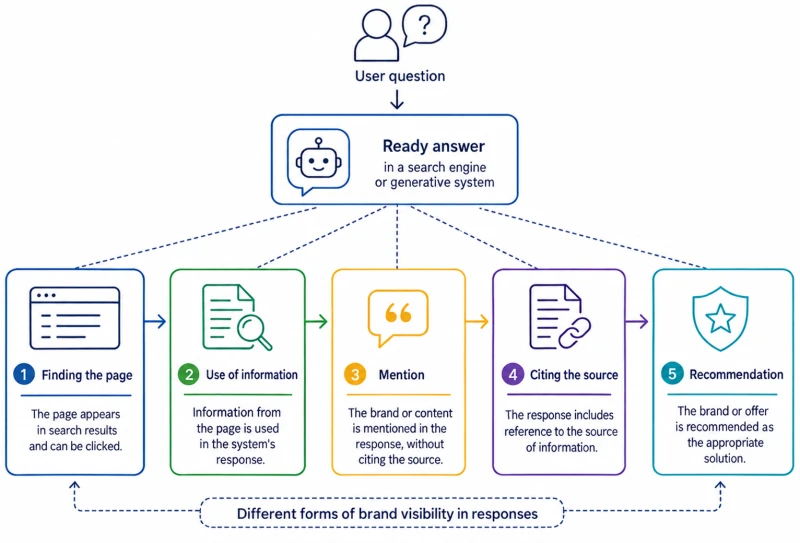
What changes when a ready-made answer replaces a list of results?
A list of results directs the user to sources, whereas a ready-made answer presents information that has already been selected and organized. In the first model, the recipient compares pages; in the second, part of that work is done by the system.
It is worth tracing this through a hypothetical example. A marketing director is looking for an agency to handle the rebranding of a service company. In classic results, they get ten links, open several of them, and build a picture of the market themselves. In a generated answer, they get a description several paragraphs long: what rebranding is, what to pay attention to when choosing a contractor, and a few sample agencies with a short profile of each. The first situation requires the brand to be found and the user to visit its website. In the second, the brand can become known without a single visit to its site – solely because of how it was described in the answer.
Presence in an answer, however, takes several distinct forms:
-
Mention – the brand name appears in the text of the answer.
-
Source citation – the answer points to the specific page the information came from.
-
Recommendation – the brand is presented as a solution worth considering, often with caveats about its applicability.
These forms do not always occur together. Information from a given page may be used in an answer without being attributed to the brand, and a brand name may be mentioned without a link to its site. Moreover, many search engines combine both formats: the ready-made answer appears above the classic list of results, so the user can read it and still go on to the source pages.
Since an answer does not rule out further browsing, yet can replace part of it, a practical question remains: in what situations does a brand name actually become necessary in an answer?
How can a user's question lead to information about a brand?
A brand may appear in an answer when its offer or information about it is relevant to the question asked and is used by the given system. Both conditions are necessary: the mere existence of a brand is not enough, and neither is the relevance of its offer alone if the system has no access to it or does not include it in the response.
The path presented below – from the user's need, through available information, to the ready-made response – is an explanatory model. It does not describe the specific algorithm of any tool and should not be read as a universal rule governing how answer systems work.
In this framing, three stages can be distinguished that are easy to confuse in practice:
- Acquiring information – where the system gets the knowledge it needs for the answer.
- Presenting information – how that knowledge is arranged, condensed, and phrased.
- Interpretation by the recipient – what the user takes from the answer they have read and how they evaluate it.
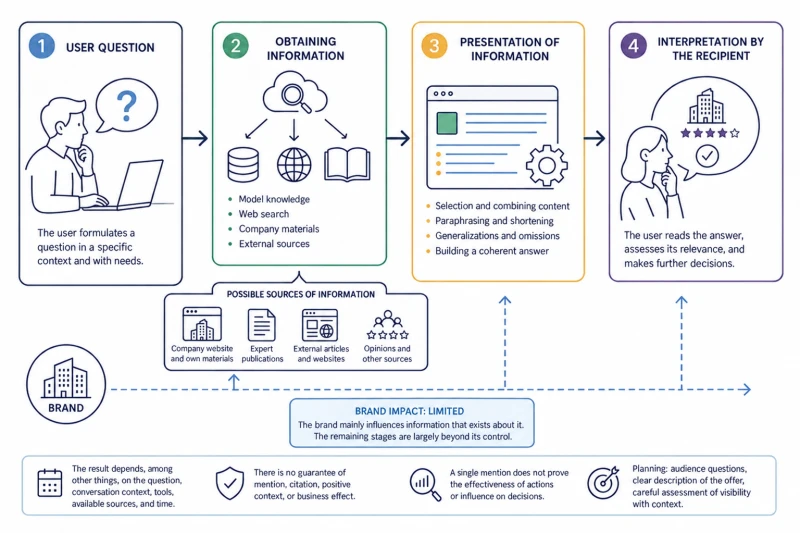
A brand can mainly influence what information about it exists. The remaining stages lie largely beyond its control. This thread will be followed through a single scenario: a company providing a marketing analytics service for mid-sized businesses, whose name appears or does not appear depending on how the question is worded.
When does an answer need a brand name?
The type of question largely determines whether a brand name makes sense in the answer at all. Three typical forms are worth setting side by side.
The first is a question about the essence of a problem: "What is marketing analytics and what is it used for?" A good answer is an explanation of the concept. The name of a specific company would be superfluous here, and might even distort the meaning of the response.
The second is a question about possible solutions: "How can a mid-sized company start measuring the effectiveness of its marketing activities?" The answer may describe several approaches and types of tools. The names of specific providers may appear as examples, but they do not have to.
The third is a comparison of providers: "Which companies offer marketing analytics for service-sector businesses, and how do they differ?" Here, brand names are almost part of the question itself, because the user is asking for a list of entities.
This does not mean that each type of question is tied to a fixed outcome. The shape of the answer is also influenced by the user's requirements – budget, industry, company size – and by the earlier context of the conversation. A person who has previously described their sales system and its constraints may receive an answer to a general question already adapted to that context.
Where can the information used in an answer come from?
Generative systems can draw on two categories of knowledge. The first is information fixed when the model was built – knowledge gathered during training, limited to a certain point in time. The second is information retrieved while handling the query, for example through a web search. A single answer may rely on both sources at once.
Sources of information about a brand may include materials published by the company itself – the offer page, service descriptions, expert publications – and external sources, that is, texts created by other entities. The distinction matters because the brand manages the first group and only indirectly influences the second.
This description does not mean, however, that everything that has been published ends up in an answer. Not every system retrieves up-to-date materials; some rely solely on knowledge fixed in the model. And even where search is used, the availability of a publication does not mean it will be used. A page may be fully accessible and correctly described, yet still not be included.
Why is an answer not a copy of a single page?
A generative system may combine information from different sources, paraphrase it, shorten descriptions, and omit some details. The answer is therefore a new text built from input material, not an excerpt from a particular website.
Let us return to the company with the marketing analytics service. The description on its page contains a polished profile: dedicated dashboards, implementation support, specialization in the service sector, a limit to companies employing more than fifty people. In a comparison of providers, this description may be reduced to a single sentence: "an analytical tool for mid-sized service companies." Part of the information disappears, part is generalized, and the company-size restriction may not make it into the response at all.
This does not mean that we know the rules for selecting brands or the order in which they are presented. Those rules are not documented in a way that allows firm principles to be formulated, and observations of individual answers do not justify generalizations. What is known, however, is that the way an offer is presented in an answer may differ from the way its own page describes it.
How does the context of an answer affect the image of a brand?
The presence of a brand name in an answer is only the beginning of the analysis. What matters is the context in which that name appears. Three different situations can be distinguished:
-
Neutral mention – the brand is named as an existing entity, without evaluation.
-
One of the alternatives – the brand is one of several solutions, and the answer compares them against criteria.
-
Conditional recommendation – the brand is indicated as suitable in specific circumstances, for example for companies with a particular profile.
Each of them carries a different message. A conditional recommendation may be more favorable for a brand than a neutral mention, but it may also narrow how the brand is perceived to a single use case. Accuracy of the description also counts: whether the indicated use corresponds to the actual offer and whether the service's limitations are presented in line with the facts.
The mere presence of a name therefore proves neither a favorable presentation of the brand, nor the reliability of the answer, nor an influence on a purchasing decision. A brand may be mentioned in the wrong context, and a correct mention need not influence the recipient's choice.
How do AEO, GEO, and SEO differ?
AEO and GEO describe related goals of presence in answers, while SEO remains an important point of reference for the discovery of pages and content. These are not three separate categories of tools, channels, or techniques, but different perspectives on visibility that partly overlap.
The comparison can be based on three axes:
| Approach | Object of interest | Expected type of visibility | General direction of action |
|---|---|---|---|
| SEO | pages and their positions in search results | finding a page and visiting it | making content discoverable and useful |
| AEO | answers to user questions | presence in the answer to a specific question | providing clear answers to recipients' questions |
| GEO | statements made by generative systems | presence of a brand or content in a generated answer | caring about what information about the brand is available and how it may be used |
In the scenario with the analytics company, these differences look as follows. From the SEO perspective, the question is: is the service page displayed when someone searches for analytics for mid-sized companies? From the AEO perspective: does the company have a clear answer to the questions potential customers ask, for example about how marketing analytics differs from sales reporting? From the GEO perspective: when a generative system builds a comparison of providers, is information about the company available, consistent, and capable of being included?
An important caveat: the terms AEO and GEO do not have one universally binding boundary of meaning. Different authors use them in slightly different senses, sometimes interchangeably. The comparison above is an organizing simplification, not an official classification. The relationship between AEO and GEO themselves requires the most clarification.
AEO focuses on answers, GEO on their generation
AEO is distinguished by its focus on answering the user's question, and GEO by its focus on presence in a generative system's output. The first concept starts from the recipient's information need, the second from the mechanism that produces the answer.
The shared area is easy to see in the example of an answer generated with the use of search. The user asks a question, the system searches for sources, and then builds a response from them. From the AEO perspective, what matters is whether the brand answers that question in a way that can be used. From the GEO perspective, what matters is whether information about the brand will be included in the generated text. It is the same situation described from two sides.
The difference appears where the two perspectives diverge. AEO need not concern only generative AI: answers to questions existed in search engines long before language models appeared, for example as featured snippets above the list of results. GEO, by contrast, refers by definition to generative systems. Both terms have been shaped by market practice and should not be treated as strict standards.
Why do AEO and GEO not replace SEO?
The common denominator of all three approaches is the importance of content that is discoverable, understandable, and useful. Where an answer system uses search, the visibility of sources may play a role in which materials enter its pool at all. Search may therefore supply the sources of an answer, but finding a page does not guarantee that it will be used or cited, and the rules for selecting sources remain unclear.
The key is to distinguish two things: finding a page and using the information it contains. The first concerns presence in results, the second the presence of content in a response. A position in results does not guarantee citation, because the system may reach for other sources or build an answer from knowledge that it does not attribute to any page.
Presence in an answer also does not replace all the functions of a website. A site still serves to present the full offer, build relationships, collect contacts, and serve customers, and organic traffic remains an important channel of reach. AEO and GEO therefore widen the field of view rather than shift the weight of visibility from one place to another.
Why does information on the brand's site and elsewhere matter?
Information about a brand may be dispersed between its own materials and publications by other entities, and a generated answer may draw on both groups. For a marketer, this means that the image of a brand in an answer does not arise solely from the company website.
Within its own materials, what matters most is a clear description of the offer, its uses, and its limitations. A general declaration such as "we offer high-quality analytics solutions" says little about who the service is intended for. A concrete explanation – that the service is for service companies employing fifty to two hundred people who need campaign reporting in one place and have no analytics department of their own – contains elements that can be used in an answer to a question about fit. The same applies to limitations: information on what the service does not cover helps avoid a misrepresentation of the offer.
Outdated or contradictory data is a separate problem. If the company website describes a different scope of services than an industry directory, and an old publication gives yet another version, the system or reader has several divergent pictures of the same brand at their disposal. It is not known which of them will be used, and when an answer is created, the discrepancy may translate into inaccuracy.
External sources include industry publications, reviews, and company directories. They often show how others perceive the brand and what uses they attribute to it. The brand does not control their content, but it can influence whether they exist at all and whether they are based on reliable information.
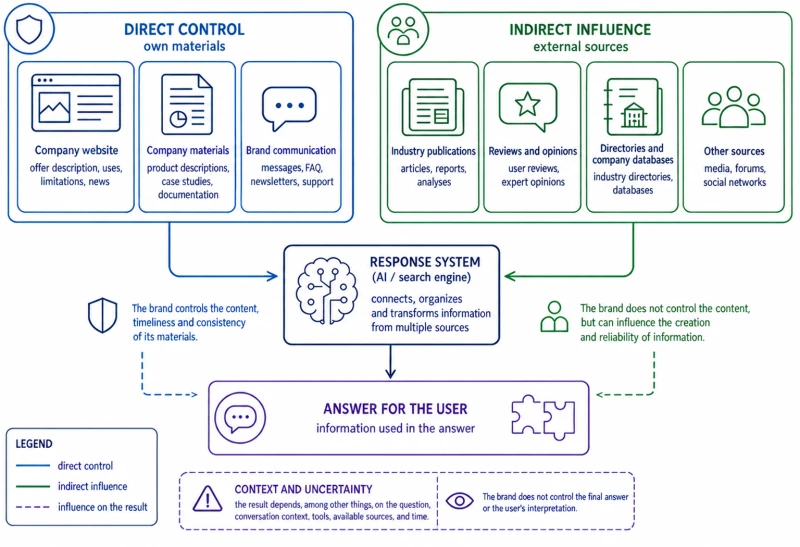
Two issues must nevertheless be kept apart. A consistent, concrete, and up-to-date description of a brand has communicative value regardless of AI systems: it makes the offer easier to understand for both humans and any tool that draws on it. It is quite another matter to claim that answer systems prefer a particular content format, consistency of message, or a large number of mentions. Such hypotheses are sometimes put forward, but they are not confirmed rules that ensure a brand will be chosen, and they should not be presented as certainties.
Why can a brand's presence not be guaranteed in every answer?
A brand does not have full control over three things: the question the user asks, the information available to the system, and the final content of the answer. It can shape part of the available information, but it does not decide on the whole set of sources or on how they are used, so no promise of constant presence has any justification.
Several further limitations come into play:
-
Conversation context – the same matter may result in different answers depending on the user's earlier statements.
-
Differences between tools – systems differ in how they acquire and present information.
-
Timeliness of sources – the information available to the system may be older than the current state of the offer.
-
Variability of results – even the same tool may give different answers to the same question at different times.
Consider two similar queries about marketing analytics. The first: "Which analytics tools would you recommend to a service company with a three-person marketing team?" The second: "Which analytics tools would you recommend to a large corporation with an extensive data team and its own infrastructure?" The difference in requirements may completely change the set of solutions indicated. A company providing services to mid-sized businesses may appear in the first answer and vanish from the second – and this will be correct behavior, because its offer is not intended for the second recipient. The absence of a mention therefore need not signal an error or a shortcoming in communication efforts.
This yields a distinction that should organize planning. Rational communication activities – describing the offer, keeping information up to date, caring about what others say about the brand – make sense in themselves. A promise of constant exposure, citation, or growth in recognition, however, goes beyond what any such activity is able to ensure.
What can be inferred from a single mention?
Observing a single answer confirms only that the brand appeared in that particular answer, in that tool, at that moment. It proves neither lasting visibility nor the effectiveness of any specific action. The brand may have appeared for reasons unrelated to any steps taken.
When interpreting, it helps to separate four different matters:
- Presence – whether the brand name appeared in the answer.
- Accuracy of description – whether the presentation of the brand corresponds to the facts.
- Recipient's interest – whether the user reacted to the information presented.
- Business outcome – whether the answer led to an inquiry, contact, or sale.
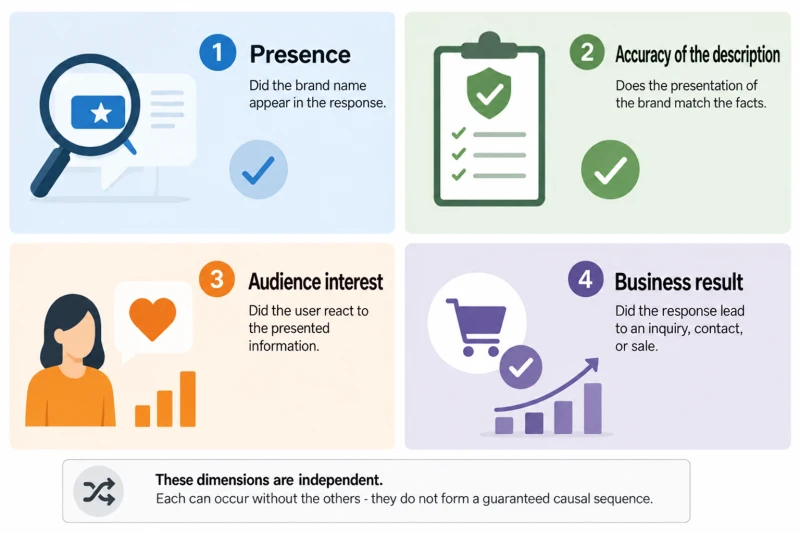
Each of them can occur without the others. A brand may be present and wrongly described; it may be described correctly but draw no reaction from the recipient; it may spark interest that does not translate into sales. Both the appearance of a brand and its absence require context: neither is automatically a success or a failure.
How can AEO and GEO be factored into marketing planning?
AEO and GEO extend marketing planning by two elements: the questions asked by recipients and the way a brand is presented in ready-made answers. They do not require abandoning existing practices, but rather widening the perspective from which those practices are assessed.
The earlier distinctions can be translated into three planning decisions: about communication topics, about the description of the offer, and about the assessment of visibility. The first concerns what the brand talks about and which recipient questions it answers. The second concerns how clearly and concretely it presents its services, uses, and limitations. The third concerns how it observes its presence in answers and how it interprets that observation.
Continuity with existing activities is essential. There is no basis for building a separate strategy for each of the abbreviations: SEO, brand content, and external communication remain a shared foundation, while AEO and GEO describe additional ways of looking at what that foundation delivers. Planning must also account for an asymmetry of influence. A brand can shape its own materials directly; publications by other entities and system answers can be, at most, indirectly inspired and observed by it.
How can content be linked to questions and choice situations?
The topics and keywords familiar from marketing can be extended with questions covering four areas: the problem the recipient is trying to solve, the use of the offer, comparison with alternatives, and its limitations. Let us return to the company with the marketing analytics service. Instead of the phrase "marketing analytics for companies" alone, the brand can also account for questions about when a mid-sized company should start measuring campaigns, how an in-house analytics team differs from an external service, and for which businesses the solution will not be suitable.
A question about the definition of analytics need not contain the company's name; a question about choosing a provider for mid-sized businesses – certainly may.
How can visibility be assessed without reducing it to a number of mentions?
The number of mentions is a poor indicator, because it captures only the first of the matters identified earlier. Visibility can be considered in several distinct dimensions: appearance of the name, citation of the source, accuracy of the description, and the context of the recommendation.
Each observation gains value when accompanied by three pieces of information: what question was asked, in which tool the answer was obtained, and when. Without them, the result is an anecdote that cannot be compared with others. The assessment is also worth linking to the brand's communication goals: for a company that wants to be recognized in a particular niche, how it is described in questions from that niche will matter more than the overall number of times its name appears.
AEO and GEO broaden the understanding of visibility, but do not provide full control
Brand visibility is no longer limited to being found. It also covers whether, and in what way, information about the brand will be used in a ready-made answer – the move from finding a page to using information is the essence of the change that both concepts describe.
AEO and GEO partly overlap: the first starts from answers to questions, the second from the output of generative systems. SEO retains its role as responsible for the discovery of pages and content, and the new approaches complement it without replacing it.
The image of a brand in an answer is made up of both its own materials and external information, and the answer arises in a way that the brand does not fully control. An important conclusion for marketing follows: what counts is not only whether a brand appears, but also the relevance and accuracy of its presentation.
In planning, this means taking recipients' questions into account, caring about the quality and consistency of communication, and interpreting observations cautiously, since a single mention or its absence settles neither success nor failure. None of these decisions, however, makes results predictable. A brand that understands this limitation assesses its visibility more reliably than one that expects any guarantees from generated answers.