The future of the purchase journey: when an AI assistant makes the decision for the customer

The end of the advisory era: When artificial intelligence closes the cart
Over the past decade, the e-commerce industry has learned to communicate with consumers through algorithms - recommendations, chatbots, personalized search results. The critical boundary point was always a human being: it was the human who ultimately clicked "buy now." That boundary point is disappearing.
Autonomous AI agents (autonomous AI agents) are systems that receive a goal - "order the office coffee supply for next week" or "find and buy a birthday gift under 100 USD with delivery by tomorrow" - and independently carry out the entire chain of actions: they search catalogs, compare offers, verify availability, calculate the final cost, and complete the transaction without any human interaction at the checkout stage. This is a fundamental difference from the conversational model, in which AI suggests and the decision remains with the user. In other words: autonomous AI agents in e-commerce do not deliver recommendations - they close the cart.
For brand and e-commerce managers, this means one thing: the human emotional factor - loyalty, aesthetics, the power of an advertising campaign - is removed from the bottom of the sales funnel. The decision is made by an algorithm, and its criteria differ from human ones. Visibility strategies built around humans require thorough rebuilding.
The mechanics of the algorithm: How the machine filters the local market
An autonomous agent does not browse a store - it executes a query against a data structure. Upon receiving a purchasing goal, the system instantly scans the product catalogs available to it and compares offers according to a set of variables it can mathematically verify: current price, availability status, guaranteed delivery window for a given location, total transaction cost, and seller reliability indicators.
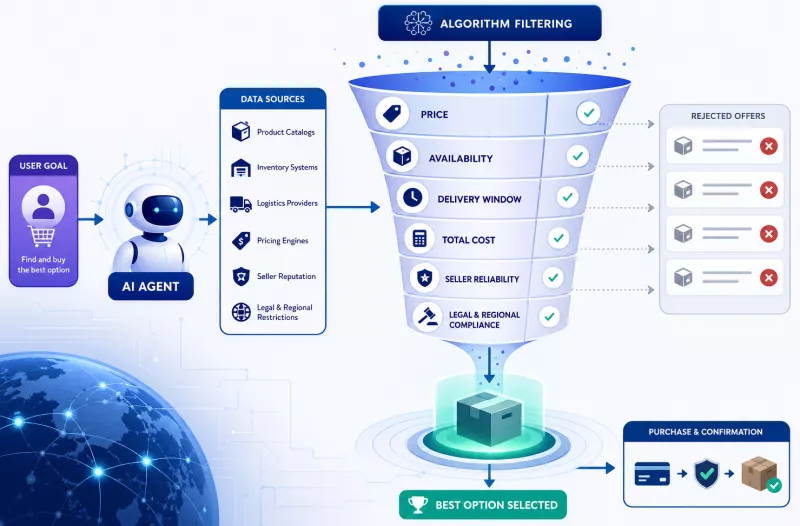
Traditional marketing messages - "season's bestseller," "limited edition," "we recommend" - are not a decision signal for the agent, because they cannot be converted into a verifiable value. The agent looks for a logistical promise, not a branding narrative. If the system cannot unambiguously confirm that a product is available in the warehouse serving a given region and will arrive before a specified time, it rejects the offer and moves on to the next one.
This ruthless comparison of variants is the key feature distinguishing an autonomous agent from a search engine or chatbot. A search engine returns a list of results - the choice belongs to the human. The agent selects, pays, and closes the transaction. A brand whose data fails to meet the criteria does not lose to a competitor in the customer's eyes - it simply does not exist at that moment of decision.
Critical GEO signals: What data determines the choice?
In the context of this article, GEO means operational locality - a brand's ability to deliver precise, up-to-date data on product availability, costs, and delivery times for a specific geographic location. Geotargeting in the era of autonomous agents no longer means matching an advertisement to the user's location. Operational GEO is the brand's ability to expose that data in a format a machine can immediately process and verify.
Standard advertising slogans, local promotions, and display campaigns do not reach the agent, because the agent does not read them. It verifies data infrastructure, not marketing communication. Product and e-commerce teams must accept this shift in perspective as the starting point for a complete revision of their local presence architecture.
Inventory truth and the accuracy of delivery windows
A purchasing agent will reject an offer with an unclear or outdated availability status - not because it is being cautious, but because its task is to minimize the risk of failed fulfillment. The message "product usually available" or "check availability" is equivalent to a refusal for the system. The algorithm prefers a mathematical guarantee: a specific number of units in the warehouse serving a given region, a specific delivery time window - for example, "delivery to Krakow tomorrow before 18:00" - and an unambiguous yes/no answer.
Real-time inventory synchronization (inventory sync) becomes a threshold condition for agent visibility. Stores operating on feeds updated once a day or even every few hours are structurally invisible to systems verifying availability at the moment of decision. The latency between the actual state and the state exposed externally is a risk the agent eliminates by bypassing the offer.
Total cart cost and measurable trust indicators
The base price of a product is the agent's starting point, not its endpoint. The system calculates the total cart cost for a given location: the product price plus local delivery cost plus any additional charges (installation, insurance, taxes). A promotion that lowers the product price by 15% while hiding a high delivery cost does not improve the offer's position - the algorithm sees the total.
Seller credibility functions as an elimination filter. Historical return rates, aggregated ratings, the number of canceled orders - the agent treats these parameters as a proxy for the brand's operational capability. A high product rating alongside a low seller rating does not offset the risk: the agent evaluates the overall relationship, not a single SKU. Brands with a neglected operational reputation may be permanently downgraded in agent rankings even after correcting their data.
Legal constraints and regional trade restrictions
An autonomous agent acts on behalf of the user and bears - indirectly - responsibility for the correctness of the transaction. For this reason, these systems actively verify whether a given offer can be fulfilled in a specific region. The absence of metadata concerning sales bans on certain product categories in a given province, missing information about dimensional restrictions for selected delivery zones, or outdated product certification data leads to two scenarios: the agent either skips the offer, or - worse - initiates a transaction that cannot be completed.
This second scenario generates operational errors that the algorithm records and factors into subsequent decisions. Incorrect or incomplete information about regional restrictions is not a one-time mistake - it becomes a permanent entry in the brand's credibility profile within the system.
Visibility architecture: Where machines look for an offer
A store that is visible to AI shopping agents is not a store with the best UX - it is a store that exposes a structured real-time data stream. Designing an online store over the past two decades has centered on the visual experience: conversion, UX, the customer journey, retention. An autonomous agent bypasses this layer entirely. An HTML page with a beautiful layout, animations, and product descriptions written for human SEO readers is unreadable or irrelevant to a bot.
The machine looks for a structured data stream: current stock levels, prices, delivery parameters, product identifiers, and location metadata. A store that does not expose this information in a machine-readable format is absent from the market as far as the agent is concerned - regardless of advertising budget, search engine ranking, or brand strength. This is the new definition of "falling out of the market": not a loss of visibility to the human consumer, but the absence of a contact point with an autonomous decision-maker.
API instead of feeds: The battle for minimal latency
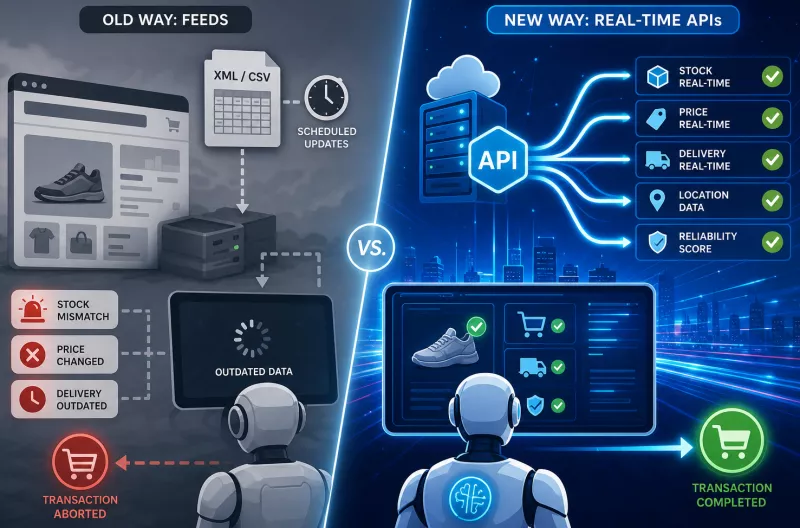
Traditional XML or CSV feeds, updated on a schedule, were sufficient when a human on the other side was browsing a price comparison site. At the moment when the decision is made by an algorithm operating in real time, scheduled updates become a structural flaw.
Direct API contact points (Application Programming Interface - programming interfaces enabling real-time data exchange) report price and stock changes immediately upon their occurrence. When an agent verifies a cart, it sees the current state - not the state from four hours ago. The difference may seem like a technical detail, but its consequence is operational: data asynchrony at the moment a machine checks a cart results in the immediate abandonment of the transaction and a move to the next offer in the catalog. The store loses the transaction not because it had an inferior product, but because its data infrastructure could not keep up - and that is a brand visibility problem, not an IT problem.
Implementing API endpoints that handle cart and availability requests is not an IT project for next quarter - it is a condition of participation in agent-initiated transactions.
E-commerce analytics: New KPIs for algorithmic traffic
When a computer script becomes the primary conversion driver, existing analytics tools produce a signal that looks like a problem - and that is precisely where the trap lies. Managers accustomed to analyzing the behavior of human users may interpret algorithmic traffic as a system failure or a bot attack, rather than recognizing it as a new conversion category.
Dead ends: Which behavioral metrics lose their meaning
A human user browses a page, scrolls, compares, returns, hesitates. A shopping bot executes a query, verifies data, and closes the transaction - or leaves the site - within seconds. Zero page scrolling, a session lasting under two seconds, a one-hundred-percent bounce rate (bounce rate) - all of these parameters, which in a human user would signal a UX problem or a poorly targeted landing page, represent normal and desirable behavior in the algorithmic traffic segment.
Drawing conclusions about offer quality or page effectiveness based on aggregated behavioral metrics that do not distinguish human from algorithmic traffic leads to flawed decisions: optimizing what is working correctly and ignoring what is actually blocking conversion.
Operational success metrics for autonomous commerce
For transactions generated by autonomous agents, a separate set of operational metrics must be introduced:
-
API checkout success rate - a measure of transaction fulfillment effectiveness through API interfaces; it measures what percentage of queries initiated by agents result in a successfully completed order.
-
Local data completeness rate - the percentage of SKUs listed in the catalog that have a full set of local data: current stock, delivery window, cost for a given region, and restriction metadata.
-
Price synchronization error measure - the frequency of discrepancies between the price returned by the API and the price recorded in the order management system at the moment of finalization; every discrepancy is a potential cart abandonment or transaction error.
-
Endpoint response latency - the API response time for an availability and price query; exceeding the thresholds acceptable to the agent's system eliminates the offer from comparison.
These four parameters should become the operational effectiveness command center in the era of autonomous commerce - not as a supplement to the marketing dashboard, but as a separate layer of operational reporting.
Risk management and operational audit of locality
Delegating the purchasing decision to a machine shifts operational and financial responsibility to new places. A store that exposes outdated information on availability, pricing, or delivery restrictions bears the consequences of incorrectly fulfilled transactions: costs of returns, complaints, cancellations - and, harder to repair, degradation of its credibility profile in agent systems.
Legal risk is equally real. If an agent completes the purchase of a product in a region where its sale is restricted or requires additional certifications, the liability for the incorrect transaction rests with the seller - regardless of the fact that the decision was made by an algorithm. Outdated regulatory metadata is not an exculpatory argument.
Privacy and trust risks are a separate matter. An autonomous agent operates on the user's purchasing intent data - information about what they buy, when, for whom, and from which region. Passing this data to the agent's system raises questions about the scope of processing, retention, and regulatory compliance. A brand does not control how the agent's platform interprets and stores these signals. In parallel, risks of decision errors emerge: the algorithm may select a suboptimal offer from the customer's perspective - the cheapest one, but not the best fit - or it may fulfill an order based on outdated preferences. This is not a hypothetical scenario; it is the direction in which agent systems are already making decisions. Brands should consider which product categories or order values they wish to subject to full autonomy, and where they want to maintain verification checkpoints.
The infrastructure supporting algorithmic traffic should include limits on automated transactions - upper thresholds on the volume or value of orders initiated by agents without human verification - as well as transparent logging of every algorithmic session with a complete record of the data state at the moment of decision. This is not only an operational safeguard; it is a precondition for conducting a reliable audit after an error.
A rapid GEO integration audit checklist
E-commerce teams should immediately verify four critical areas:
-
Local stock refresh frequency - is the stock level for every location served by the store updated in real time or with a delay not exceeding an acceptable threshold (typically below a few minutes)? Have periodic feeds been replaced or supplemented by push APIs?
-
Availability and performance of cart endpoints - does the API handling checkout operate without interruption, return responses within the time limits required by agent systems, and is it monitored for availability 24/7?
-
Consistency of transaction costs - is the total price exposed by the API (product + local delivery + additional charges) identical to the price confirmed in the order management system? Are any costs added only on the backend side, outside the agent's visibility?
-
Completeness of regional metadata - does every SKU have assigned sales restriction metadata for all regions served, including information on bans, dimensional restrictions, and certification requirements?
A gap in any of these areas is not technical debt to be addressed in the future - it is an active elimination filter operating right now.
Summary: The algorithm as the ultimate purchasing decision-maker
The transition from conversational AI to autonomous purchasing agents changes the very nature of a brand's relationship with the market. A brand no longer communicates with a consumer who makes their own decision - it begins to expose data for an algorithm that decides on the consumer's behalf. The brand promise ceases to be narrative; it becomes infrastructural. What counts is API speed, logistical precision, and the flawlessness of GEO data - not the quality of copywriting on the product page.
The key conclusions are operational: real-time inventory synchronization is a condition of participation, not a competitive advantage. Total cart cost must be transparent and consistent across systems. Regional and regulatory metadata must be complete and up to date. Behavioral metrics lose their interpretive value for the algorithmic traffic segment and require a separate analytics layer. Where AI-executed purchases become a significant channel, metrics designed for humans cease to describe the reality of conversion.
Two urgent actions for managers: first, launch a testing environment that simulates agent traffic - check how an autonomous system sees the store's current offer, what data it retrieves, what it rejects, and why. Second, establish technology partnerships with agent platform providers or catalog aggregators supported by agents - in order to understand the data format requirements and performance thresholds that these systems enforce.
A market in which a significant share of transactions is initiated by algorithms is not arriving as a distant-future scenario. For many product categories - electronics, subscriptions, office supplies, food with a regular purchasing cycle - it is already an operational reality. Brands that treat this shift purely as a technology project are surrendering control over local conversion without a conscious choice.